
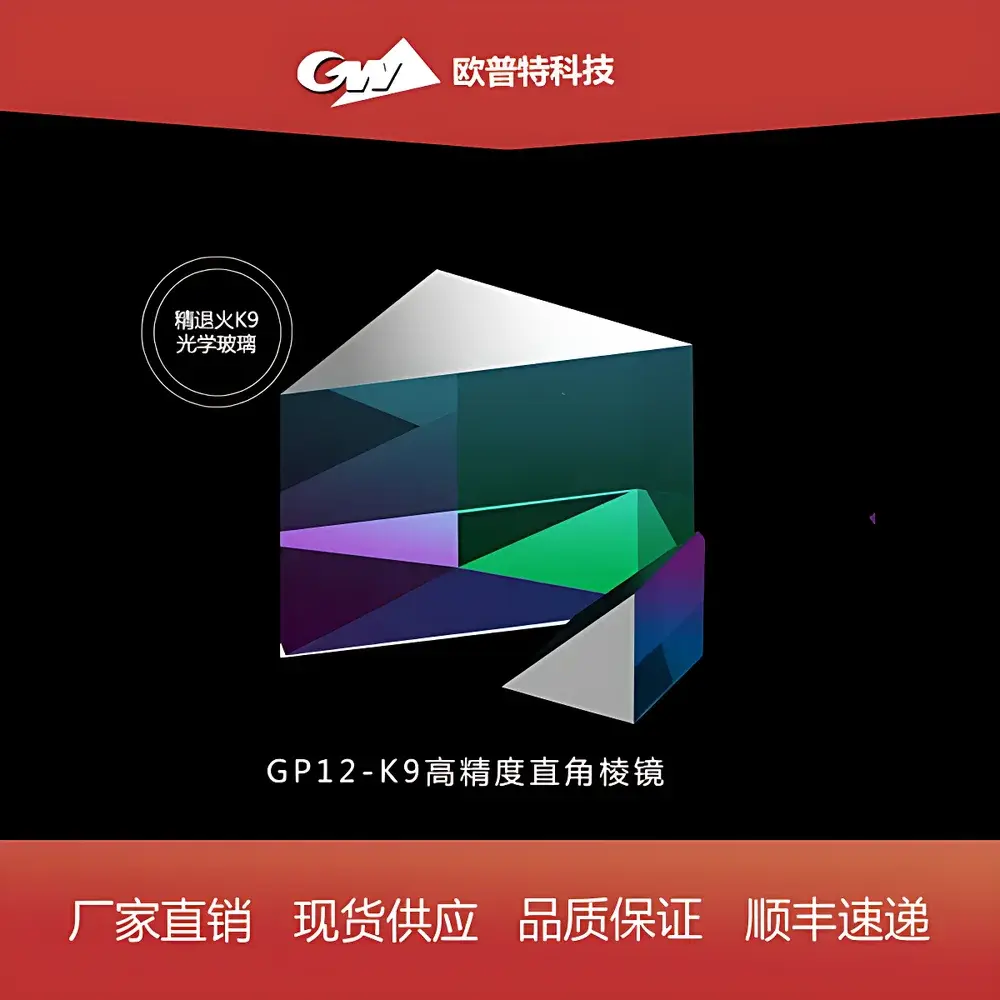
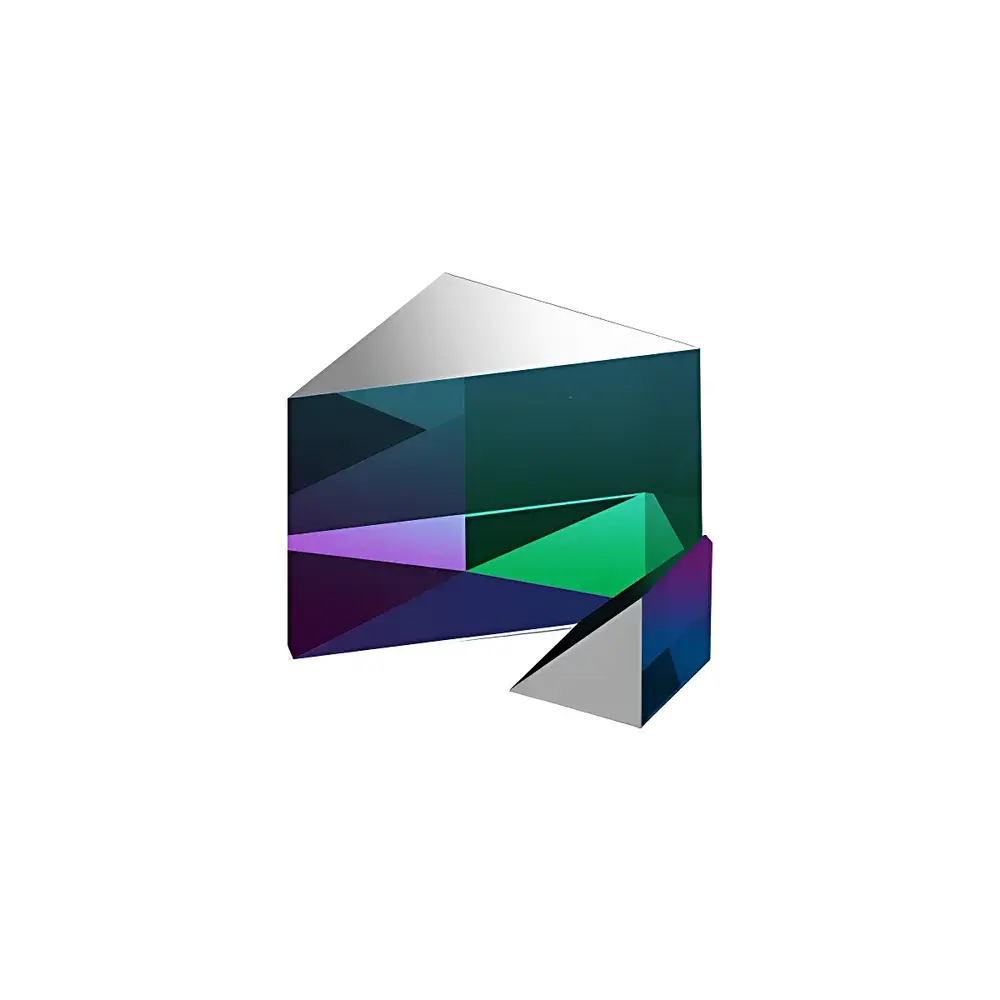
GP12-K9 Precision Right-Angle Prism
| Material | K9 precision-annealed optical glass |
|---|---|
| Dimensional tolerance | +0.0 / −0.1 mm |
| Surface figure | λ/10 @ 632.8 nm |
| Surface quality | 1–2 scratch-dig |
| Angular accuracy | ±15 arcseconds |
| Beam deviation (tower error) | <5 arcminutes |
| Edge bevel | <0.25 mm × 45° |
| Coating options | Uncoated, VIS/NIR anti-reflection on hypotenuse or legs, aluminum mirror coating on hypotenuse with AR on legs |
Overview
The GP12-K9 Precision Right-Angle Prism is a high-fidelity optical component engineered for beam steering, image inversion, and path folding in demanding laboratory, metrology, and industrial optical systems. Fabricated from certified K9 borosilicate crown glass—fully annealed to minimize internal stress and birefringence—the prism delivers exceptional wavefront fidelity and thermal stability. Its 90° apex angle is maintained to ±15 arcseconds, ensuring minimal angular deviation during total internal reflection (TIR) or mirror-based deflection. When used in TIR configuration, the prism operates without coating dependency across the visible spectrum; when enhanced performance is required at non-normal incidence or for polarization-insensitive operation, optional aluminum mirror coatings on the hypotenuse—paired with broadband anti-reflection (AR) coatings on the entrance and exit faces—provide >95% reflectance and <0.25% residual reflectivity per surface. The prism’s surface figure of λ/10 @ 632.8 nm (HeNe wavelength) and surface quality rated to 1–2 scratch-dig meet ISO 10110-7 standards for precision optical components, making it suitable for alignment-critical interferometric setups, laser cavity folding, and OEM optomechanical integration.
Key Features
- Precision-ground 90° apex angle with angular tolerance of ±15 arcseconds, verified via autocollimation interferometry
- Surface figure accuracy of λ/10 @ 632.8 nm, measured using phase-shifting Fizeau interferometry
- K9 optical glass substrate with full annealing history documented per MIL-O-13830A and ISO 10110-5
- Controlled edge bevel of <0.25 mm × 45° to prevent chipping and support vacuum-compatible mounting
- Multiple coating configurations available: uncoated, aluminum mirror + VIS/NIR AR (per face), and custom dual-band AR options
- Dimensional tolerance held to +0.0 / −0.1 mm on all three equal legs (A = B = C), enabling repeatable kinematic mounting
Sample Compatibility & Compliance
The GP12-K9 prism is compatible with standard optomechanical mounts including SM1-threaded lens tubes, kinematic mirror mounts (e.g., KM100 series), and custom-designed prism housings. Its K9 material exhibits a coefficient of thermal expansion (CTE) of 7.1 × 10⁻⁶ /°C and transmission >91.5% per surface in the 350–2000 nm range (uncoated). All prisms undergo 100% inspection per ISO 10110-1 (general tolerances) and ISO 10110-3 (surface imperfections), with test reports traceable to NIST-calibrated interferometers. Coated variants comply with ISO 9211-3 for coating durability (adhesion, humidity, abrasion) and are qualified for use in GLP-compliant optical calibration workflows and ISO/IEC 17025-accredited metrology labs.
Software & Data Management
While the GP12-K9 is a passive optical element, its specification data—including dimensional drawings, interferometric surface maps, coating spectral curves, and batch-specific certification reports—are delivered in standardized digital formats (PDF, STEP, Zemax .ZAR, and CODE V .DAT). These files integrate seamlessly into optical design environments (Zemax OpticStudio, Synopsys Code V, FRED) and PLM systems (Siemens Teamcenter, PTC Windchill). For traceability in regulated environments, each prism ships with a unique serial-numbered certificate of conformance that includes measurement uncertainty budgets aligned with GUM (JCGM 100:2008) and supports FDA 21 CFR Part 11-compliant electronic record retention when stored in validated document management systems.
Applications
- Laser cavity folding and beam redirection in DPSS and fiber-coupled laser systems
- Image erecting and relay optics in stereo microscopes and endoscopic imaging trains
- Reference elements in autocollimators, theodolites, and angular displacement sensors
- Beam combiners/splitters when paired with a second identical prism (Rochon or Wollaston configuration)
- Alignment fiducials in multi-axis optical breadboards and photolithography tooling
- Calibration standards for angular metrology instruments operating at 632.8 nm or 780 nm wavelengths
FAQ
What is the maximum incident angle for reliable total internal reflection (TIR) in the GP12-K9 prism?
For uncoated K9 glass (n = 1.515 @ 587.6 nm), the critical angle is approximately 41.3°; therefore, TIR is guaranteed for angles of incidence >41.3° relative to the hypotenuse surface normal.
Can the GP12-K9 be used in vacuum or cleanroom environments?
Yes—K9 glass is outgassing-compliant per ASTM E595, and the controlled bevel and absence of organic adhesives make it suitable for Class 100 cleanrooms and UHV optical chambers (10⁻⁷ mbar) when mounted with metallic kinematic interfaces.
Is coating damage testing performed per ISO 9211-3 included in the certification package?
Yes—each coated batch undergoes mandatory adhesion (tape test), humidity (40°C/90% RH, 24 h), and abrasion (CS-10 wheel, 1000 cycles) testing; results are summarized in the Certificate of Conformance.
Do you provide Zemax-compatible coating models for the aluminum + AR configurations?
Yes—spectral reflectance/transmittance data for all standard coating variants are provided as ASCII .DAT files and pre-configured Zemax coating definitions (.ZCO) supporting multi-layer stack modeling and polarization analysis.
Are custom sizes or non-standard angles available beyond the listed dimensions?
Yes—custom fabrication from 1 mm to 100 mm leg length, including 45°, 30°, or 120° variants, is supported under NRE-based engineering agreements with full metrology reporting and ITAR-compliant documentation.




