
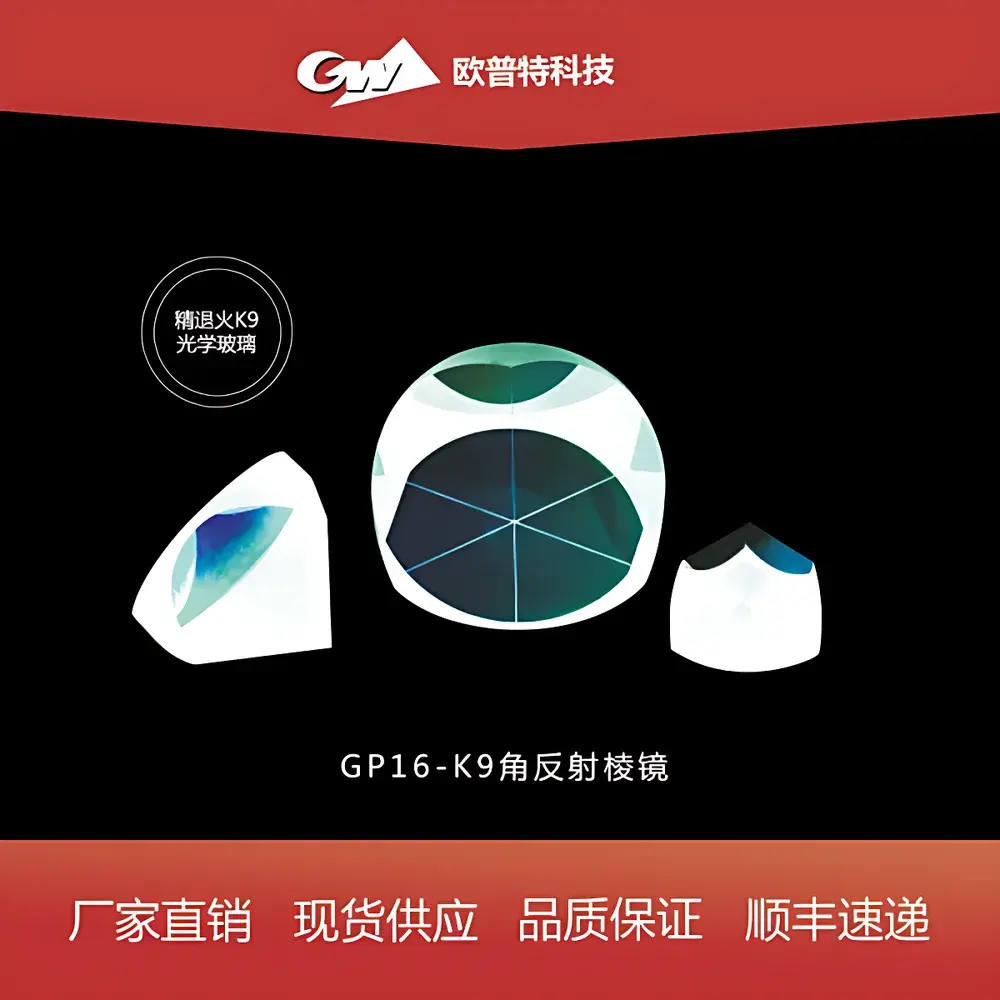
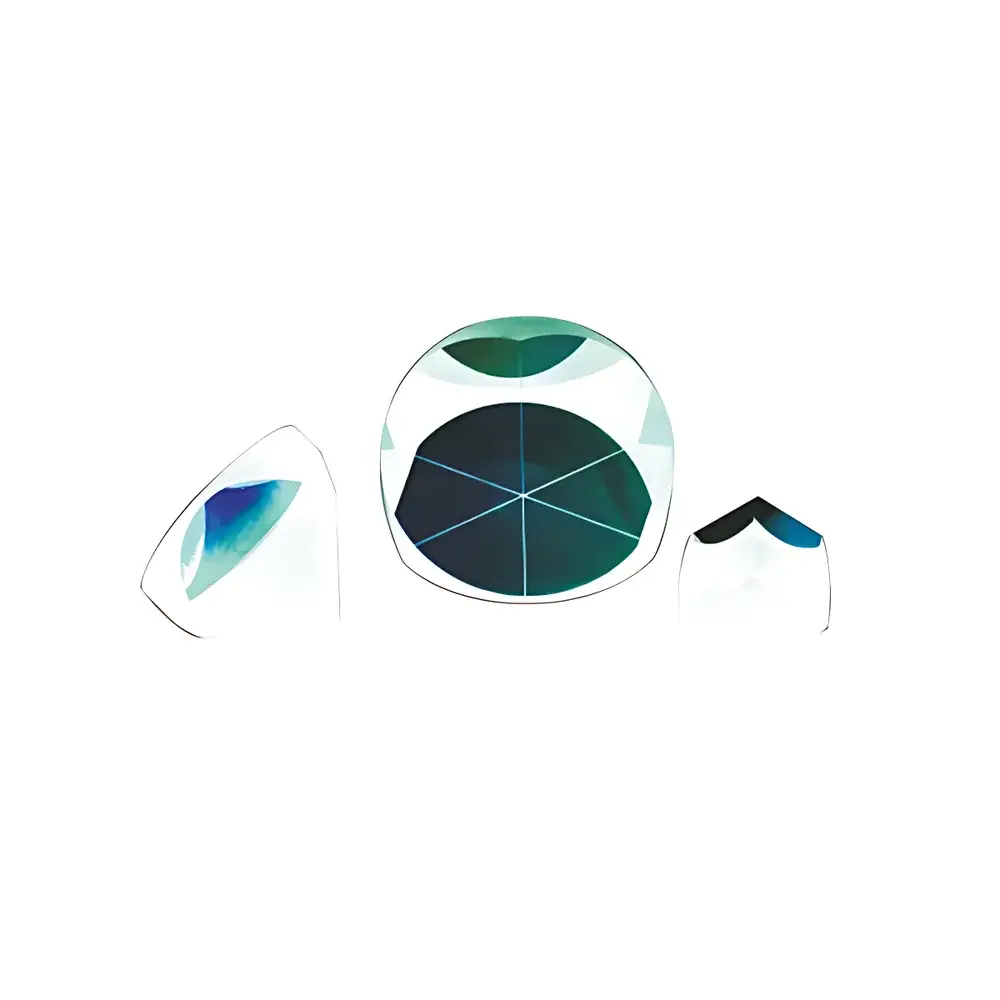
GP16-K9 Corner Cube Retroreflector
| Material | K9 precision-annealed optical glass |
|---|---|
| Diameter tolerance | +0.0 / −0.1 mm |
| Height tolerance | ±0.2 mm |
| Surface flatness | λ/10 @ 632.8 nm |
| Surface quality | 3–4 scratch-dig |
| Edge chamfer | <0.25 mm × 45° |
| Beam deviation | ≤10 arcseconds (model-dependent) |
| Coating options | Uncoated |
| Component category | Optical element |
Overview
The GP16-K9 Corner Cube Retroreflector is a high-precision passive optical component engineered for stable, wavelength-insensitive beam return in alignment, interferometry, metrology, and laser ranging applications. Based on the principle of total internal reflection within a trihedral prism geometry, it ensures that any incident ray—regardless of angle of incidence within its acceptance cone—is reflected back parallel to its original path with minimal lateral displacement and angular deviation. Constructed from certified K9 borosilicate crown glass (Schott BK7 equivalent), the GP16 series undergoes precision grinding, polishing, and annealing to minimize residual stress birefringence and thermal drift. Its monolithic design eliminates air gaps and bonding interfaces, delivering intrinsic mechanical stability and long-term wavefront fidelity under thermal cycling and vibration.
Key Features
- Monolithic K9 optical glass substrate with certified homogeneity and low bubble/inclusion content per ISO 10110-2
- Surface flatness maintained at λ/10 @ 632.8 nm across all three reflecting faces, verified via phase-shifting interferometry
- Tight dimensional tolerances: diameter controlled to +0.0 / −0.1 mm; height held to ±0.2 mm for consistent mounting and kinematic compatibility
- Beam deviation specified ≤3 arcseconds for standard variants (GP16-010, GP16-015, GP16-025-1, GP16-038, GP16-050A/B, GP16-072) and ≤10 arcseconds for extended-height configurations (GP16-008, GP16-025-2, GP16-065**, GP16-072)
- Surface quality rated 3–4 scratch-dig per MIL-PRF-13830B, ensuring minimal scatter in high-dynamic-range optical systems
- Optional protective silver coating on retroreflecting faces with broadband anti-reflection (AR) coatings applied only to the entrance face—available in VIS (400–700 nm) or NIR (700–1100 nm) spectral bands
- Controlled edge treatment: 0.25 mm × 45° chamfer applied to all non-optical edges to prevent chipping and support vacuum-compatible handling
Sample Compatibility & Compliance
The GP16 series is compatible with standard optomechanical mounts including SM1 (1.035″-40), RMS, and custom kinematic bases. All units are manufactured and tested in accordance with ISO 10110 optical component standards for surface form, roughness, and defect control. While the component itself carries no active regulatory certification, its material traceability (K9 batch certification), surface metrology records, and coating spectral performance data support integration into systems requiring compliance with ISO/IEC 17025-accredited calibration workflows. The silver+AR configuration meets reflectance >97% over its designated band and transmittance >99.5% at normal incidence on the entrance face—enabling use in Class 1 laser safety architectures per IEC 60825-1 when properly integrated.
Software & Data Management
As a passive optical element, the GP16 requires no embedded firmware or driver software. However, comprehensive technical documentation—including measured wavefront error maps, spectral reflectance/transmittance curves (VIS/NIR variants), and mechanical drawings in STEP and PDF formats—is provided with each shipment. All product identifiers (e.g., GP16-025-1-VIS) are traceable to individual lot numbers, supporting GMP/GLP-aligned inventory control and audit-ready documentation packages upon request. Coating performance data conforms to ISO 9211-3 for thin-film characterization, and surface flatness verification reports include uncertainty budgets compliant with ISO/IEC Guide 98-3 (GUM).
Applications
- Laser interferometric displacement measurement (e.g., in heterodyne Michelson or Twyman-Green configurations)
- Free-space optical communication terminals requiring robust beacon return without active tracking
- Alignment references in synchrotron beamlines and EUV lithography tooling
- Distance measurement systems (e.g., time-of-flight LIDAR, absolute distance interferometers)
- Vibration-isolated optical tables where thermal expansion matching with aluminum or Invar mounts is critical
- Calibration artifacts for autocollimators and electronic theodolites per ISO 10791-6
- Space-qualified ground test hardware (non-radiation-hardened but compatible with outgassing-controlled environments per ECSS-Q-ST-70-02C)
FAQ
What is the maximum incident angle for guaranteed retroreflection?
The GP16 maintains retroreflective performance up to ±2.5° full-angle field of view for standard models (diameter ≥10 mm). Acceptance angle decreases slightly for smaller apertures (e.g., GP16-008); consult the angular deviation curve in the technical datasheet.
Can the GP16 be used in ultra-high-vacuum (UHV) environments?
Yes—when specified with uncoated or silver+AR configurations and cleaned per ISO 10110-7 Class 5, the component exhibits total mass loss (TML) <1.0% and collected volatile condensable materials (CVCM) <0.1% per ASTM E595, making it suitable for UHV optical paths.
Is there a specification for wavefront distortion after reflection?
Each unit is supplied with interferometric wavefront error data referenced to a calibrated transmission sphere; typical PV error across the clear aperture is ≤λ/8 @ 632.8 nm for standard production lots.
How is thermal stability characterized?
Coefficient of thermal expansion (CTE) follows K9 bulk specification (7.1 × 10⁻⁶ /°C); angular deviation drift is <0.05 arcsec/°C over 15–35°C ambient range, verified by environmental chamber testing.
Are custom diameters or coatings available?
Yes—custom sizes up to Ø100 mm and specialized coatings (e.g., protected aluminum, dielectric HR stacks, or dual-band AR) can be quoted under OEM agreements with minimum order quantities and extended lead times.



