
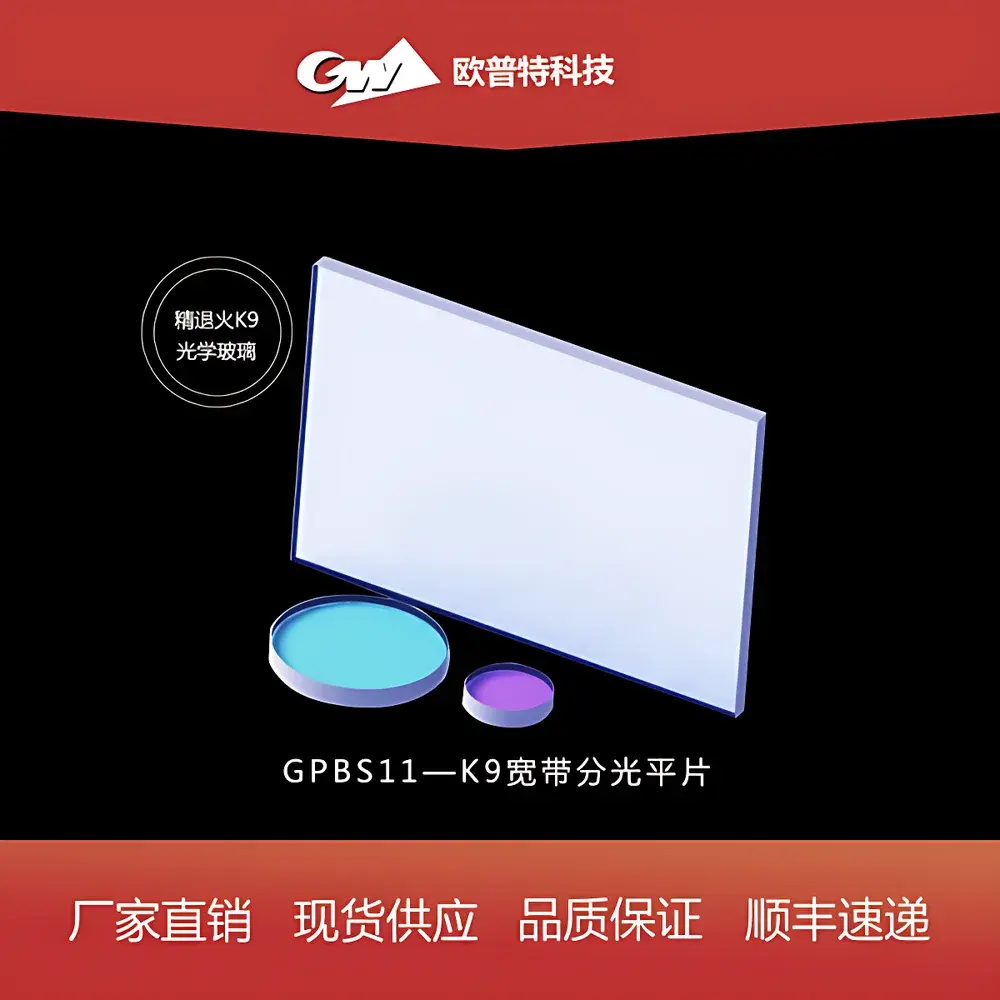
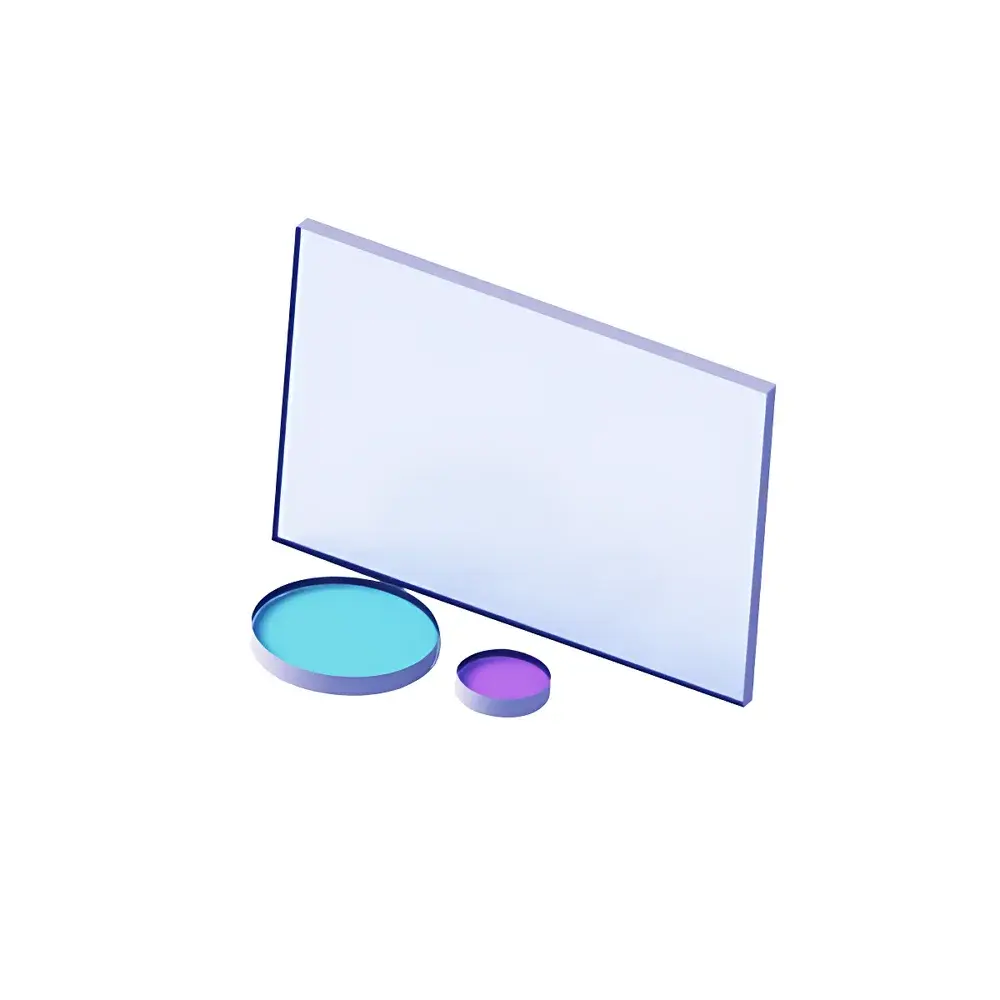
GPBS11-K9 Broadband Beamsplitter Plate
| Origin | Beijing |
|---|---|
| Manufacturer Type | Distributor |
| Origin Category | Domestic |
| Model | GPBS11 |
| Price Range | USD 1–499 |
| Component Category | Optical Element |
| Diameter/Dimensions | Φ12.5 mm, Φ25.0 mm, 12.5×17.5 mm, 25.0×36.0 mm |
| Split Ratios | 20R/80T to 80R/20T |
| Spectral Ranges | VIS (400–700 nm), NIR (700–1100 nm), SWIR (1100–2500 nm) |
Overview
The GPBS11-K9 Broadband Beamsplitter Plate is a precision optical component engineered for high-fidelity spectral separation and power division across visible (VIS), near-infrared (NIR), and short-wave infrared (SWIR) bands. Fabricated from high-homogeneity K9 borosilicate glass substrate with dielectric thin-film coatings, this beamsplitter operates on the principle of controlled interference-based amplitude division—enabling stable, polarization-insensitive splitting of incident light without significant wavefront distortion or chromatic shift. Its broadband design ensures consistent reflectance/transmittance performance across wide spectral windows, making it suitable for demanding applications in multi-spectral imaging systems, laser beam combiners, interferometric setups, and fiber-coupled sensor architectures where wavelength-agnostic power management is critical.
Key Features
- Multi-band spectral optimization: Individual variants calibrated for VIS (400–700 nm), NIR (700–1100 nm), and SWIR (1100–2500 nm) ranges—each with <±2% deviation in specified R/T ratio across its designated band.
- High surface quality: λ/10 surface flatness (per ISO 10110-3) and 10–5 scratch-dig specification ensure minimal phase error and scatter in wavefront-sensitive configurations.
- Low absorption & thermal stability: K9 substrate exhibits coefficient of thermal expansion (CTE) of 7.1 × 10⁻⁶ /°C and transmission >99.5% per surface (uncoated), minimizing thermal lensing under moderate CW laser loads (<5 W/cm²).
- Configurable geometry: Available in circular (Φ12.5 mm, Φ25.0 mm) and rectangular (12.5 × 17.5 mm, 25.0 × 36.0 mm) formats to accommodate standard kinematic mounts, lens tubes, and custom optomechanical assemblies.
- Robust coating architecture: Hard-sputtered dielectric stacks withstand cleaning with IPA/methanol and comply with MIL-C-48497A adhesion and humidity resistance requirements.
Sample Compatibility & Compliance
The GPBS11-K9 series is compatible with collimated or moderately convergent beams (f-number ≥ 4) and supports both normal and ±10° angle-of-incidence operation without measurable polarization-dependent loss (PDL < 0.15 dB). All variants meet ISO 9001 manufacturing traceability standards; coating durability conforms to ISO 9211-4 for environmental stability (40°C/90% RH, 24 h). While not certified to IEC 61215 or Telcordia GR-1221, the component satisfies baseline optical interface requirements for integration into Class 1 laser systems per IEC 60825-1 and supports GLP-aligned calibration workflows when used in metrology-grade spectrophotometer reference paths.
Software & Data Management
As a passive optical element, the GPBS11-K9 requires no embedded firmware or driver software. However, its spectral performance data—including measured R/T curves, group delay dispersion (GDD) profiles, and angular sensitivity maps—is supplied in standardized ASCII format (.csv) and NIST-compatible .spc files. These datasets are directly importable into Zemax OpticStudio (v22+), CODE V, and FRED for rigorous system-level tolerance analysis and stray-light modeling. Traceable calibration reports include serial-number-matched spectrophotometric validation at three wavelengths per band (e.g., 532 nm, 633 nm, 690 nm for VIS), supporting audit-ready documentation for FDA 21 CFR Part 11–governed analytical instrument qualification (AIQ).
Applications
- Laser cavity output coupling in dual-wavelength Nd:YAG/OPO systems requiring simultaneous VIS/NIR monitoring.
- Reference arm conditioning in Fourier-transform infrared (FTIR) spectrometers operating up to 2500 nm.
- Beam combining for multi-channel hyperspectral camera calibration sources.
- Optical coherence tomography (OCT) sample arms requiring balanced signal-to-reference power distribution across 800–1300 nm.
- Industrial machine vision illumination modules where spectral neutrality and long-term coating integrity are essential for repeatability.
FAQ
What is the maximum incident power density this beamsplitter can handle in continuous-wave operation?
For uncoated K9 substrates, damage threshold exceeds 10 J/cm² for 10 ns pulses at 1064 nm; for CW use, conservative operational limit is 5 W/cm² at ambient temperature with forced-air convection.
Are custom split ratios or non-standard dimensions available?
Yes—custom R/T ratios (e.g., 55R/45T) and dimensions (up to 50 × 50 mm) are supported under OEM agreements with minimum order quantities of 25 units.
Does the SWIR variant maintain performance beyond 2500 nm?
No—the SWIR grade is validated only up to 2500 nm; for extended IR (>2.5 µm), consider CaF₂ or ZnSe-based alternatives with appropriate anti-reflection coatings.
Can this beamsplitter be used at 45° angle of incidence?
Performance degrades significantly above ±10° due to increased PDL and spectral shift; for 45° applications, specify the GPBS11-45 variant with optimized coating design.
Is mounting hardware included with purchase?
No—standard SM1 (1.035″-40) or SM2 (2.035″-40) threaded mounts are recommended but sold separately; dimensional drawings for mechanical integration are provided in STEP and PDF formats.





