
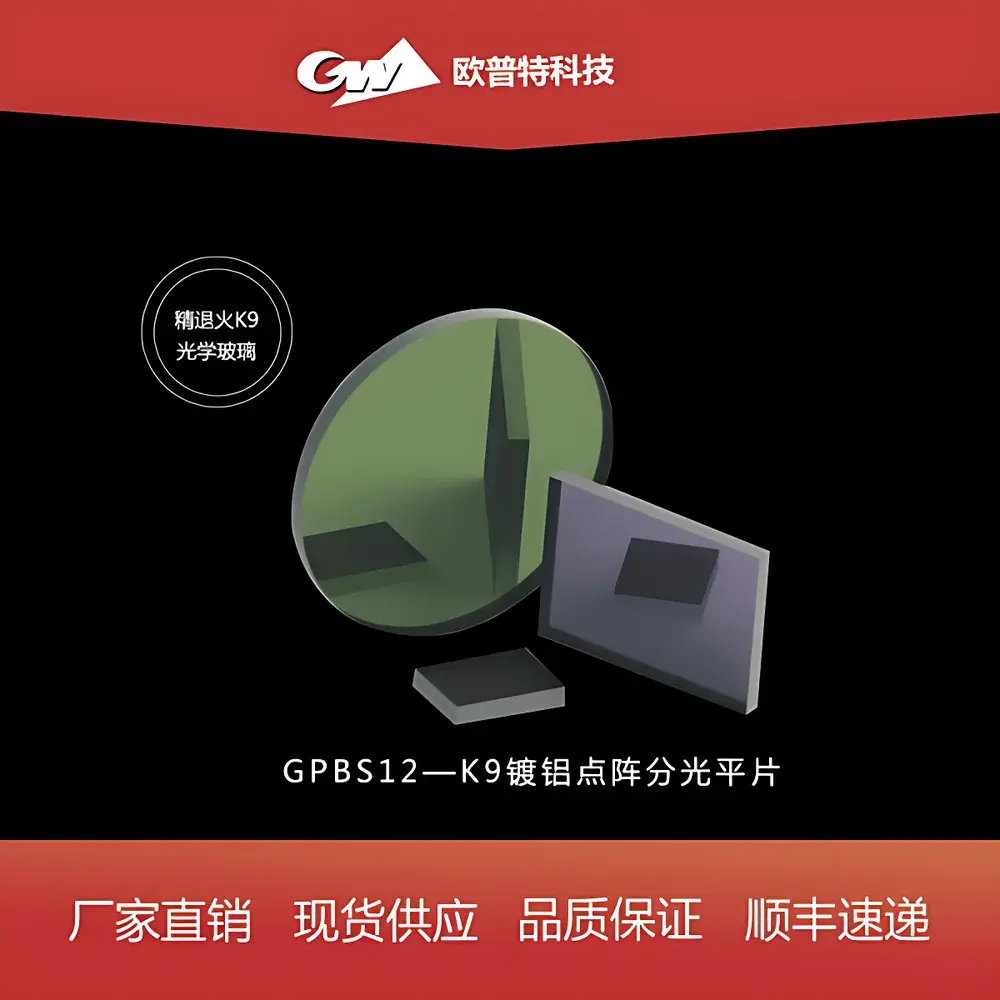
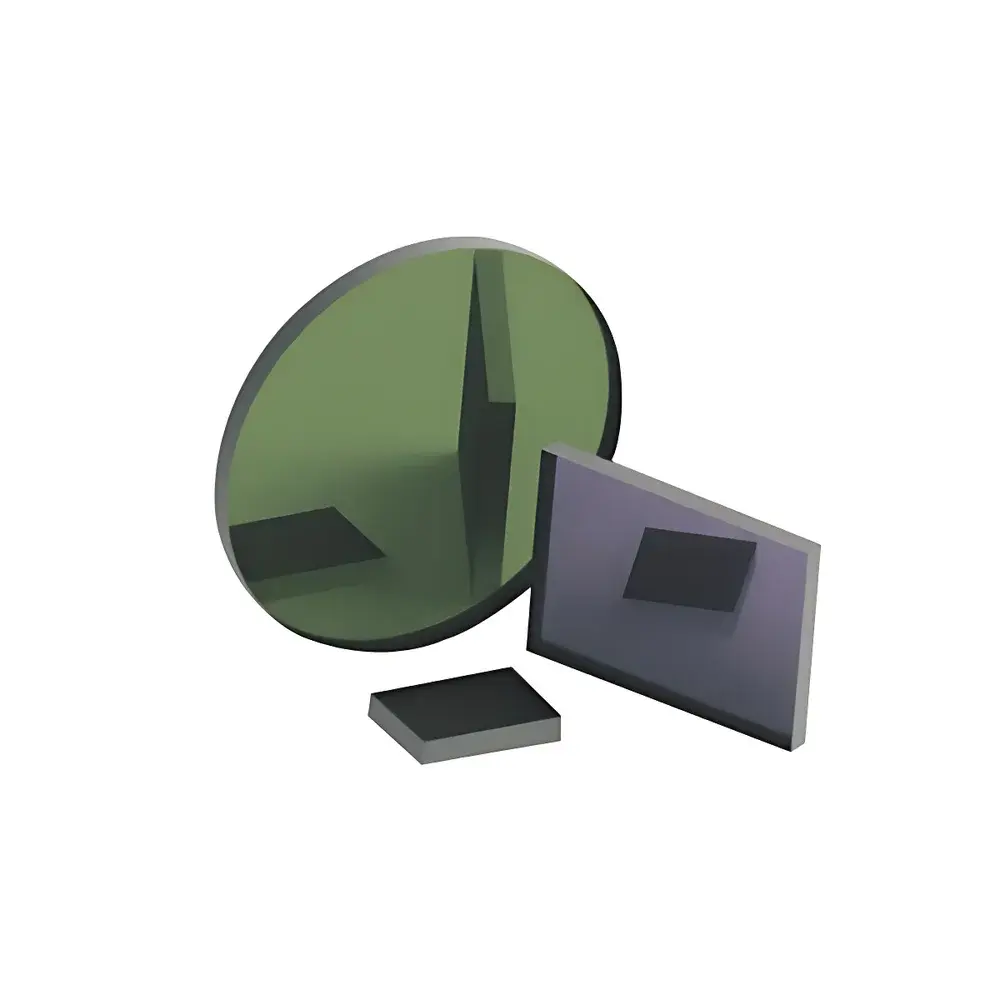
GPBS12-K9 Aluminum-Coated Beam Splitter Plate
| Origin | Beijing, China |
|---|---|
| Manufacturer Type | Authorized Distributor |
| Product Category | Optical Component |
| Model | GPBS12 |
| Price Range | USD 0.5–250 (varies by size and R/T ratio) |
| Dimensions | Ø12.5 mm to 50×72 mm |
| Thickness | 3.0 mm |
| Coating Type | Vacuum-deposited aluminum with dielectric enhancement |
| Available Split Ratios (R/T) | 30/70, 50/50, 70/30 |
| Substrate Material | Optical-grade BK7 or fused silica (standard: BK7) |
| Surface Quality | 40–20 scratch-dig |
| Flatness | λ/4 @ 633 nm |
| Parallelism | < 3 arcsec |
| AR Coating Option | Optional broadband anti-reflection coating (400–700 nm or 700–1100 nm) |
Overview
The GPBS12-K9 Aluminum-Coated Beam Splitter Plate is a precision optical component engineered for reliable amplitude division in visible and near-infrared (VIS-NIR) optical systems. Based on a high-stability K9 borosilicate crown glass substrate (Schott designation), it features a vacuum-deposited aluminum reflective layer enhanced with a protective dielectric overcoat—optimized for improved reflectance consistency, environmental durability, and reduced oxidation compared to bare aluminum. Unlike metallic mirrors, this beam splitter operates on the principle of partial reflection and transmission via controlled thin-film interference, enabling precise energy partitioning between orthogonal optical paths. Its λ/4 surface flatness and <3 arcsec parallelism ensure minimal wavefront distortion—critical for interferometry, laser cavity alignment, optical coherence tomography (OCT) reference arms, and dual-channel imaging setups requiring phase stability and low ghosting.
Key Features
- Standard 3.0 mm substrate thickness ensures mechanical rigidity and compatibility with standard kinematic mounts and lens tubes (e.g., Thorlabs SM1/SM2 series)
- Three standardized split ratios—30R/70T, 50R/50T, and 70R/30T—each calibrated at 0° angle of incidence for collimated beams; performance validated per ISO 10110-7 specifications
- K9 glass substrate offers excellent transmission homogeneity (Δn 500 MW/cm² @ 1064 nm, 10 ns pulse)
- Dielectric-enhanced aluminum coating achieves average reflectance ≥88% (400–700 nm) and ≥90% (700–1100 nm), with transmission maintained within ±2% tolerance across specified R/T variants
- Available in circular (Ø12.5–Ø50 mm) and rectangular (12.5×12.5–50×72 mm) formats—enabling integration into fiber-coupled modules, OEM spectroscopic engines, and custom optomechanical assemblies
- Surface quality compliant with MIL-PRF-13830B 40–20 scratch-dig specification; cleaned and inspected under Class 100 cleanroom conditions prior to packaging
Sample Compatibility & Compliance
The GPBS12-K9 is compatible with common VIS-NIR light sources including He-Ne lasers (632.8 nm), diode lasers (405–980 nm), LED illuminators, and broadband halogen lamps. It is suitable for use in Class I and II laser safety configurations when properly mounted and enclosed. All units are manufactured in accordance with ISO 9001-certified processes and meet RoHS 2015/863/EU directives for hazardous substance restriction. While not individually certified to ISO 10110 or ISO 14999, dimensional and coating performance data are traceable to NIST-traceable spectrophotometric and interferometric calibration standards. For GMP/GLP environments, batch-specific test reports—including spectral reflectance curves (350–1200 nm), surface flatness maps, and coating adhesion test results (ASTM D3359)—are available upon request.
Software & Data Management
No embedded firmware or proprietary software is associated with this passive optical component. However, full spectral characterization datasets (CSV and SDF format) for each R/T variant—including measured reflectance/transmission curves, polarization dependence (s/p ratio < 1.05 at 0° AOI), and angular sensitivity profiles—are provided digitally with bulk orders. These datasets integrate seamlessly into optical design platforms such as Zemax OpticStudio (ZOS), CODE V, and FRED for system-level tolerancing and stray-light analysis. Traceability documentation supports audit readiness for FDA 21 CFR Part 11–aligned quality management systems when used in regulated instrumentation (e.g., clinical spectrophotometers or analytical UV-Vis modules).
Applications
- Laser beam conditioning and power monitoring in OEM laser systems
- Reference-sample path splitting in FTIR and dispersive spectrometers
- Multi-spectral imaging dichroic routing in fluorescence microscopy and hyperspectral sensors
- Optical feedback control in cavity ring-down spectroscopy (CRDS) and frequency-stabilized laser cavities
- Alignment verification and wavefront sampling in adaptive optics testbeds
- Cost-sensitive educational optics kits and undergraduate laboratory experiments (e.g., Michelson interferometer construction)
FAQ
What is the typical damage threshold for the GPBS12-K9 under continuous-wave (CW) laser exposure?
For CW operation at 532 nm, the LIDT is rated at ≥10 MW/cm² with proper heat sinking; derating is recommended above 1 W total incident power without active cooling.
Can this beam splitter be used at non-normal angles of incidence?
Yes—but polarization-dependent shift in R/T ratio occurs beyond ±5°; s- and p-polarization divergence exceeds 8% at 45° AOI. Custom designs with compensated coatings are available.
Is fused silica available as an alternative substrate?
Yes—fused silica (Suprasil®-grade) substrates are offered for deep-UV (200–350 nm) or ultra-low thermal drift applications; lead time increases by 10–14 business days.
Do you provide mounting hardware or kinematic adapters?
Standard SM1-threaded mounts (e.g., Thorlabs B1C, KM100) and adjustable rotation stages (e.g., PRM1Z8) are compatible; CAD models and mounting recommendations are supplied with order confirmation.
Are batch-to-batch reflectance variations documented?
Yes—certificates of conformance include spectral deviation plots showing ±1.2% max reflectance variation across production lots, measured against a NIST-traceable reference standard.





