
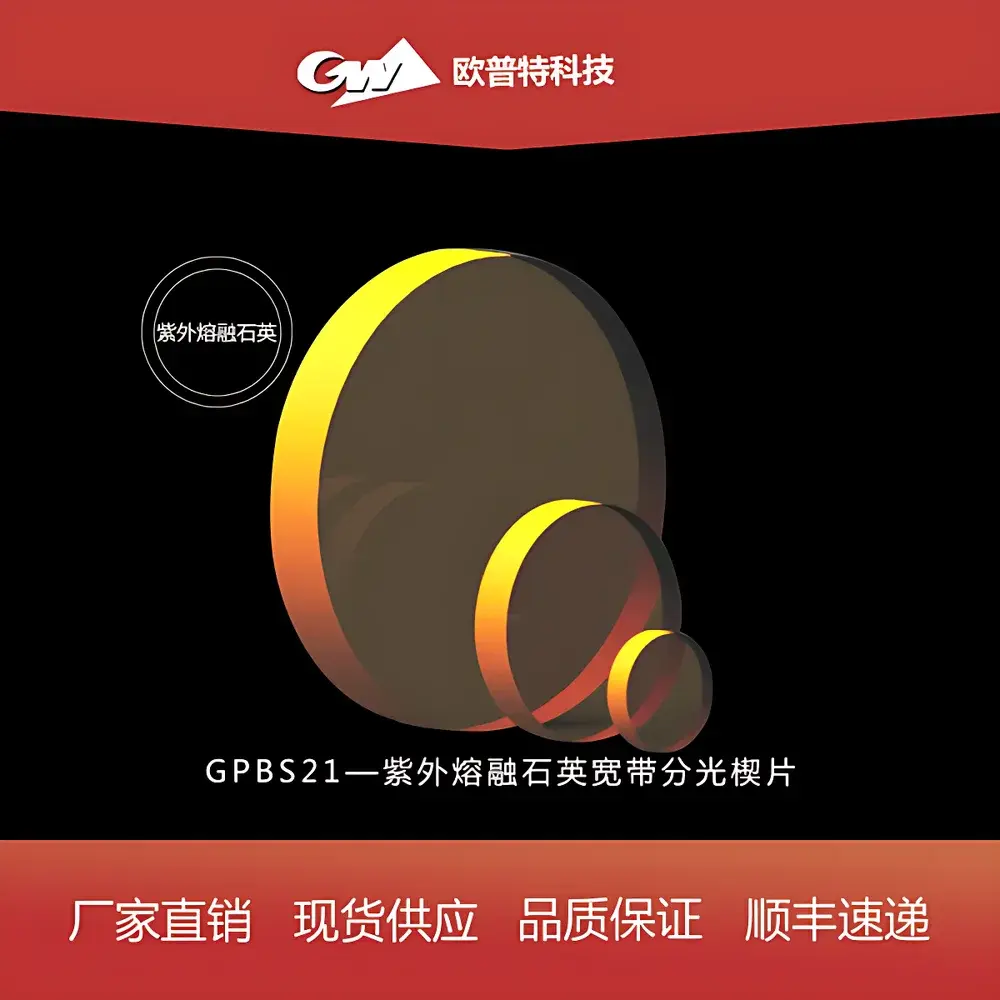
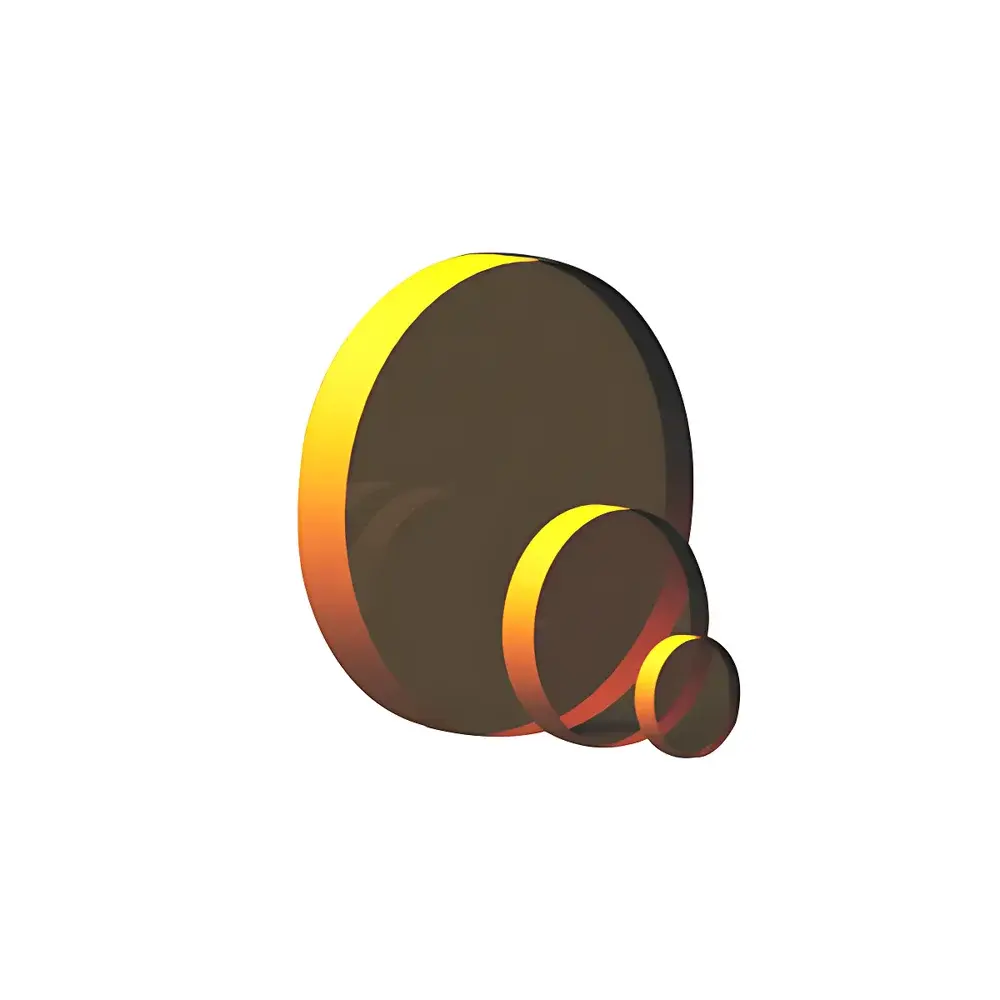
GPBS21 UV Fused Silica Broadband Beamsplitter Wedge
| Origin | Beijing |
|---|---|
| Manufacturer Type | Distributor |
| Origin Category | Domestic |
| Model | GPBS21 |
| Price Range | USD 0.15–75.00 (per unit) |
| Component Category | Optical Element |
| Substrate Material | UV-grade Fused Silica |
| Wedge Angle | 0.5° (typ.) |
| Dimensions (mm) | Customizable, Standard Options Include Ø12.7 mm, Ø25.4 mm, 12.7×12.7 mm, 25.4×25.4 mm |
| Thickness (T, mm) | 3.0–10.0 (configurable) |
| Splitting Ratio (R/T) | 50:50 (nominal, ±5% over band) |
| Coating | Dual-side AR, S2-side optimized for 250–450 nm (R_avg < 0.5% per surface) |
Overview
The GPBS21 UV Fused Silica Broadband Beamsplitter Wedge is a precision optical component engineered for high-fidelity beam division in ultraviolet and visible spectral regions. Unlike conventional flat beamsplitters, the GPBS21 incorporates a controlled wedge geometry—typically 0.5°—to eliminate interference fringes caused by back-surface reflections, making it especially suitable for demanding interferometric, spectroscopic, and alignment-critical applications. Fabricated from synthetic UV-grade fused silica (SiO₂), it delivers exceptional transmission (>95% per surface) from 250 nm to 450 nm, with negligible fluorescence, low thermal expansion (α ≈ 0.55 × 10⁻⁶ /°C), and high laser-induced damage threshold (LIDT > 5 J/cm² at 355 nm, 10 ns pulse). Its broadband anti-reflection (AR) coating on both surfaces—optimized specifically for the 250–450 nm range on the S2 face—ensures minimal ghosting and high polarization insensitivity across the operational band.
Key Features
- UV-optimized fused silica substrate with certified OH-content < 1 ppm and homogeneity Δn < 5 × 10⁻⁶
- Wedge angle of 0.5° ± 0.05°, mechanically polished to λ/10 surface flatness (per MIL-PRF-13830B)
- Double-sided broadband AR coating: S1 side broadband (250–700 nm, R_avg < 0.8%), S2 side spectrally tailored for 250–450 nm (R_avg < 0.5%)
- Nominal 50:50 (R:T) splitting ratio at 45° AOI, calibrated and verified via spectrophotometry per ISO 9050
- Scratch-dig specification: 10–5 per MIL-PRF-13830B; surface quality verified by white-light interferometry
- Available in standard diameters (Ø12.7 mm, Ø25.4 mm) and square formats (12.7 × 12.7 mm, 25.4 × 25.4 mm); thickness configurable from 3.0 mm to 10.0 mm
Sample Compatibility & Compliance
The GPBS21 is compatible with collimated or moderately convergent beams (f-number ≥ f/4) and supports both free-space and fiber-coupled configurations. It meets material traceability requirements per ISO 10110-3 for optical component certification and conforms to RoHS Directive 2011/65/EU. While not a complete system, its design aligns with optical layout best practices referenced in ISO 10110-7 (surface imperfection tolerancing) and ASTM E1331 (spectrophotometric measurement of transmittance/reflectance). The fused silica substrate complies with USP for optical-grade quartz used in analytical instrumentation housings, and the AR coating process adheres to ISO 9211-3 for thin-film durability (adhesion tested per ASTM D3359, humidity cycling per ISO 9211-4).
Software & Data Management
As a passive optical component, the GPBS21 requires no embedded firmware or driver software. However, its performance parameters—including measured spectral R/T curves, wedge-induced angular deviation data, and wavefront distortion maps—are supplied in standardized ASCII (.csv) and XML-based opto-mechanical metadata format compliant with the ISO 10110-12 schema. These files integrate directly into optical design platforms such as Zemax OpticStudio (via .ZBF import), CODE V (using .DAT tables), and FRED (through native surface property assignment). Traceable calibration reports include NIST-traceable spectrophotometer validation (PerkinElmer Lambda 1050+ with deuterium/halogen sources) and are archived with 21 CFR Part 11–compliant electronic signatures for regulated laboratory environments.
Applications
- UV-VIS spectrophotometer reference arms and sample-beam routing in double-beam architectures
- Laser cavity output coupling for excimer (248 nm, 308 nm) and frequency-tripled Nd:YAG (355 nm) systems
- Alignment fiducials in vacuum-compatible EUV metrology tooling (utilizing residual transmission at 193 nm)
- Polarization-insensitive beam sampling in real-time plasma diagnostics (e.g., Langmuir probe synchronization)
- Optical coherence tomography (OCT) source arm splitters where dispersion asymmetry must be minimized
- Calibration-grade reference elements in ISO/IEC 17025-accredited optical testing labs
FAQ
What is the maximum incident angle for specified 50:50 performance?
The nominal 50:50 R/T ratio is characterized at 45° ± 0.2° angle of incidence (AOI) for p- and s-polarized light averaged; deviation exceeds ±8% beyond 42–48° AOI.
Can the GPBS21 be used in high-vacuum environments?
Yes—UV fused silica exhibits outgassing rates < 1.0 × 10⁻¹⁰ Pa·m³/s·cm² (per ASTM E595), and the ion-assisted e-beam AR coating is rated for UHV compatibility up to 1 × 10⁻⁹ Torr.
Is custom wedge angle available?
Standard wedge is 0.5°; custom angles from 0.1° to 2.0° are available under OEM agreement with minimum order quantity of 25 units.
How is coating durability validated?
Coating adhesion is verified per MIL-C-48497A using tape test (ASTM D3359 Method B) and abrasion resistance per ISO 9211-4 (200 cycles, CS-10 wheel, 1 kg load).
Do you provide spectral measurement reports?
Yes—each batch includes full spectral R/T data from 200–800 nm (0.5 nm resolution), traceable to NIST SRM 2036 and 2068, delivered digitally with certificate of conformance.




