
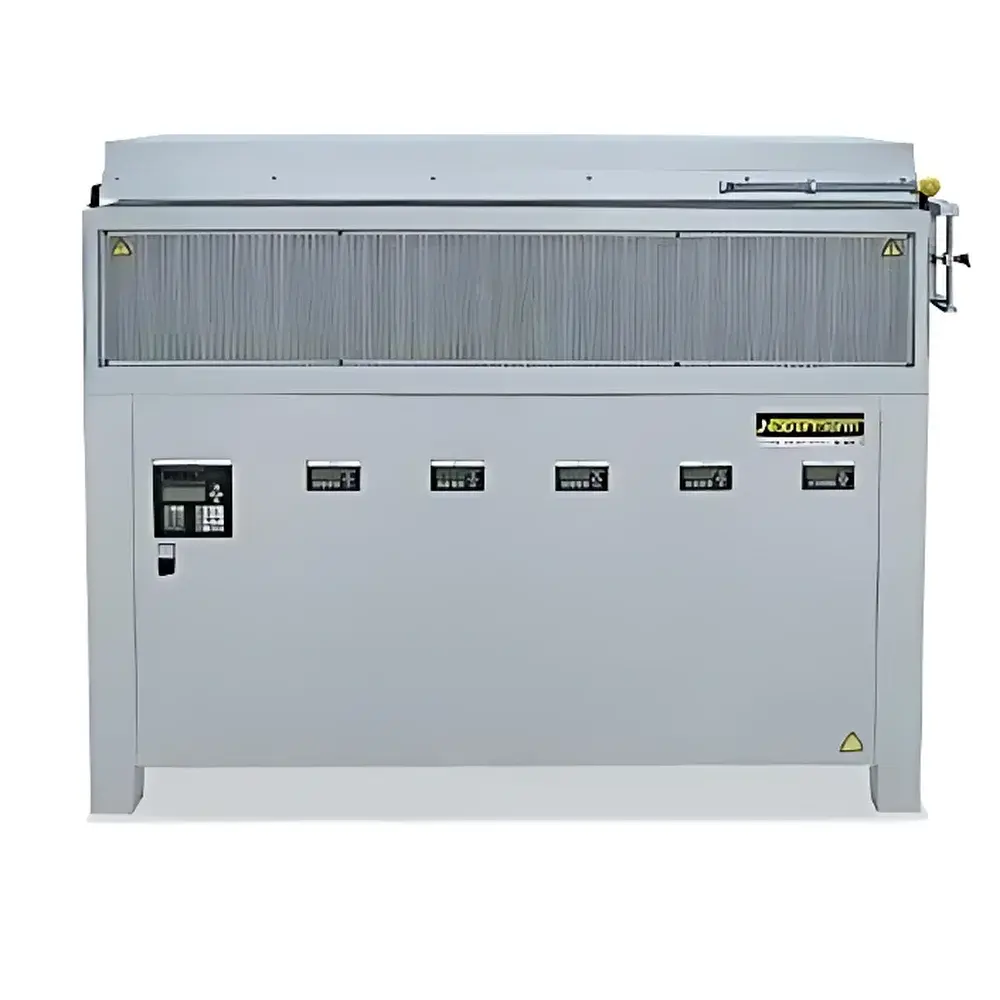
GR 1300/13 Gradient Furnace
| Origin | Germany |
|---|---|
| Manufacturer Type | Authorized Distributor |
| Origin Category | Imported |
| Model | GR 1300/13 |
| Quotation | Upon Request |
| Max Temperature | 1300 °C |
| Heating Length | 1300 mm |
| Heating Zones | 6 independent zones (each 160 mm) |
| Max Achievable Axial Temperature Gradient | 400 °C |
| Internal Dimensions (W×D×H) | 1300 × 100 × 60 mm |
| External Dimensions (W×D×H) | 1660 × 740 × 1345 mm |
| Power Rating | 18 kW |
| Electrical Supply | 3-phase |
| Net Weight | 300 kg |
| Heating Method | Radiant heating via resistance wire wound on ceramic support tubes |
| Loading Access | Top or front door |
| Optional Accessory | Ceramic fiber partition boards for zone isolation |
Overview
The GR 1300/13 Gradient Furnace is a precision-engineered, six-zone horizontal tube furnace designed for controlled thermal processing under defined axial temperature gradients. Developed in Germany and built to industrial-grade specifications, it employs radiant heating via high-stability resistance wire wound uniformly around refractory support tubes—ensuring uniform heat distribution within each zone and minimal thermal cross-talk between adjacent segments. Its 1300 mm effective heating length accommodates extended sample profiles, while the independent control of six 160 mm zones enables precise establishment of linear or stepwise temperature gradients up to 400 °C across the furnace axis. This architecture supports fundamental research and process development in materials science, including solid-state reaction kinetics, diffusion studies, thermal barrier coating evaluation, and controlled sintering of multi-layer ceramic components.
Key Features
- Six independently controllable heating zones (160 mm per zone), enabling programmable axial temperature profiles with gradients up to 400 °C over 1300 mm
- Maximum operating temperature of 1300 °C, certified for continuous operation at ≤1250 °C per IEC 60519-1 safety guidelines
- Radiant heating design: NiCr resistance wire wound on high-purity alumina support tubes ensures stable emissivity, low thermal inertia, and long-term repeatability
- Dual loading configuration—top access hatch and front hinged door—facilitates flexible sample insertion, especially for long rods, fibers, or substrate stacks
- Counterbalanced lid mechanism with hydraulic dampers ensures smooth, vibration-free opening and safe maintenance access
- Optional ceramic fiber partition boards (sold separately) allow physical thermal decoupling between zones, enhancing gradient fidelity and reducing inter-zone conduction
- Robust steel housing with double-wall construction and mineral wool insulation minimizes external surface temperature rise (<60 °C at ambient) and improves energy efficiency
Sample Compatibility & Compliance
The GR 1300/13 accommodates cylindrical, planar, and elongated samples up to 1300 mm in length and 90 mm in diameter (clear internal bore). Compatible sample carriers include high-purity alumina, silicon carbide, and molybdenum crucibles; quartz tubes may be used below 1100 °C. The furnace meets EN 61000-6-3 (EMC emission) and EN 61000-6-2 (immunity) standards. Its control architecture supports GLP-compliant operation when integrated with validated data acquisition systems, and temperature uniformity profiles can be documented per ASTM E220 or ISO/IEC 17025 requirements. No internal atmosphere control is provided; optional inert gas purging kits (N₂, Ar) are available for oxygen-sensitive applications.
Software & Data Management
The furnace is equipped with a DIN-rail-mounted PID controller featuring RS485 Modbus RTU interface for integration into centralized lab automation networks. Each zone has dedicated thermocouple inputs (Type S, class 1), with cold-junction compensation and configurable alarm thresholds (deviation, rate-of-change, over-temperature). Optional PC-based software (supplied separately) enables multi-zone ramp-soak programming, real-time gradient visualization, and CSV-exported time-temperature logs with timestamped audit trails. When configured with compliant firmware and user-access controls, the system satisfies traceability requirements under FDA 21 CFR Part 11 for electronic records in regulated environments.
Applications
- Thermal gradient sintering of functionally graded materials (FGMs) and layered oxide ceramics
- Kinetic studies of solid-state phase transformations (e.g., perovskite formation, spinel inversion)
- Controlled oxidation/reduction profiling along metal or semiconductor wire lengths
- Calibration and validation of distributed temperature sensors (e.g., fiber Bragg gratings, thermocouple arrays)
- Heat treatment optimization for brazing alloys, where localized melting must be confined to specific joint regions
- Diffusion couple experiments in metallurgy and geochemistry under steady-state thermal gradients
FAQ
What is the maximum allowable temperature gradient between adjacent zones?
The furnace supports up to ±200 °C difference between neighboring zones under stable operating conditions, provided total power draw remains within 18 kW limit and cooling airflow is unobstructed.
Can the furnace operate under vacuum or controlled atmosphere?
Standard configuration is air-atmosphere only. Vacuum or inert-gas operation requires retrofitting with flanged end caps, gas inlet/outlet ports, and compatible sealing hardware—available as factory-configured options.
Is NIST-traceable calibration documentation included?
A factory-assembled calibration certificate (per ISO/IEC 17025) is supplied with each unit, covering zone-specific thermocouple response and setpoint accuracy at 600 °C, 900 °C, and 1200 °C.
What maintenance intervals are recommended for the heating elements?
Under continuous operation at ≤1200 °C, resistance wire life exceeds 5,000 hours; visual inspection and continuity testing are advised every 1,000 operational hours.
Are custom internal dimensions or zone configurations available?
Yes—OEM modifications, including 4-zone or 8-zone variants and non-standard bore diameters (down to 50 mm or up to 150 mm), are supported upon engineering review and lead-time agreement.



