
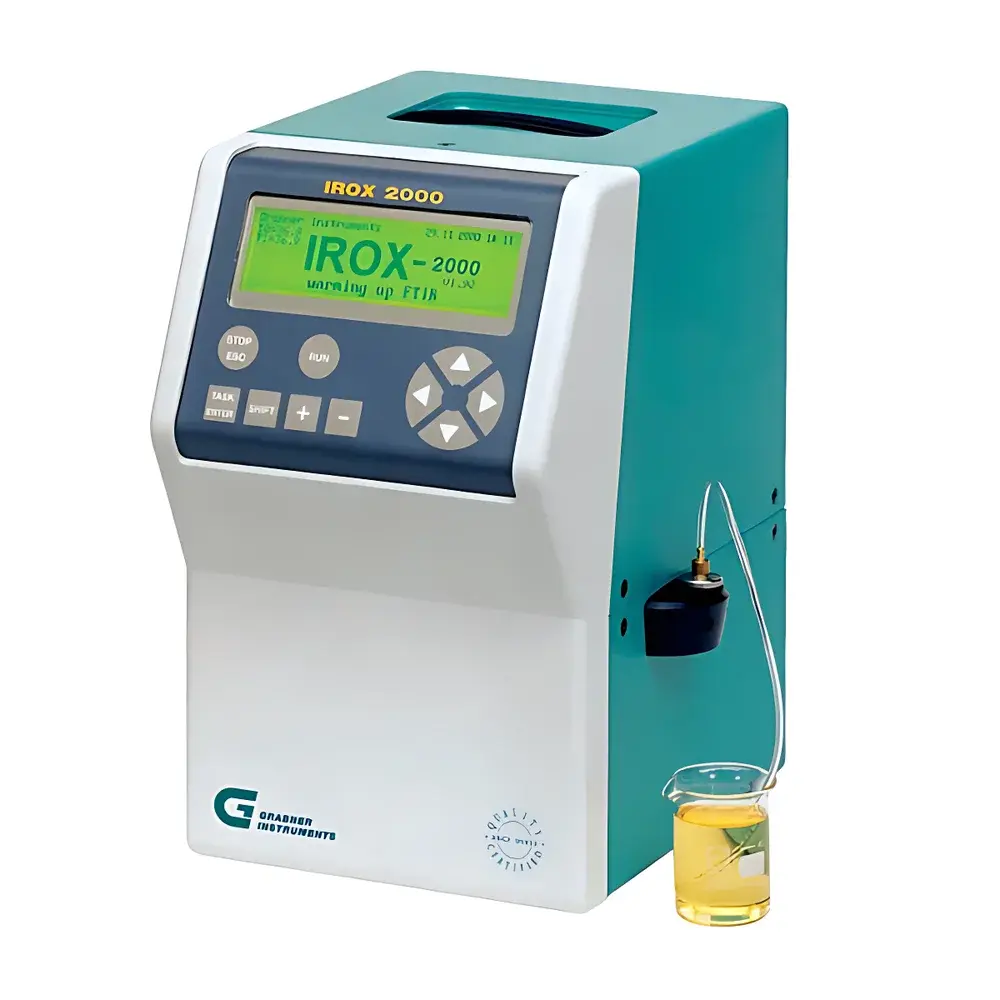
GRABNER IROX 2000 Fourier Transform Infrared (FT-IR) Gasoline Analyzer
| Brand | GRABNER |
|---|---|
| Origin | Austria |
| Model | IROX 2000 |
| Portability | Portable |
| Measurement Parameters | Octane Number, Aromatics, Olefins, Benzene, Toluene, Methanol, Ethanol, Oxygen Content, MTBE, MMT (30 parameters total) |
| Measurement Range | Octane Number 70–110 |
| Accuracy | ±0.5 ON |
| Analysis Time | <80 s |
| Sample Volume | 6 mL |
| Spectral Range | 4000–400 cm⁻¹ |
| Data Points | ~3000 per spectrum |
| Density Measurement | ±0.001 g/cm³ (integrated Anton Paar density module) |
| Power Supply | 100/200/230 V AC, 50 Hz, 65 W |
| Dimensions | 200 × 320 × 220 mm |
| Weight | 13 kg |
| Compliance | ASTM D5845 (benzene), ASTM D6277 (oxygen) |
Overview
The GRABNER IROX 2000 is a portable, benchtop-grade Fourier Transform Infrared (FT-IR) spectrometer engineered for rapid, non-destructive, and multivariate analysis of gasoline composition and performance parameters. Operating in the mid-infrared spectral region (4000–400 cm⁻¹), the instrument acquires high-resolution interferograms with up to 3000 data points per scan—enabling robust chemometric modeling of complex hydrocarbon matrices. Unlike single-parameter analyzers, the IROX 2000 simultaneously quantifies 30 critical fuel specifications—including research octane number (RON), motor octane number (MON), aromatic and olefin volume fractions, benzene and toluene concentrations, oxygenates (e.g., MTBE, ethanol, methanol), metallic additives (e.g., MMT), and total oxygen content—without solvent dilution or derivatization. Its measurement principle relies on Beer–Lambert law-based absorbance calibration against reference materials traceable to NIST and ISO 4259 standards, ensuring metrological integrity across global fuel regulatory frameworks.
Key Features
- Integrated dual-module architecture: FT-IR spectrometer coupled with an Anton Paar digital density meter (±0.001 g/cm³ accuracy), enabling simultaneous spectral acquisition and physical property determination.
- Automated fluid handling system: Precision syringe-driven sample introduction, followed by automatic liquid-phase and vapor-phase cleaning cycles to eliminate carryover between analyses.
- Field-deployable design: Compact footprint (200 × 320 × 220 mm), 13 kg mass, and dual-power capability (AC mains or 12 V DC vehicle supply) support both laboratory QA/QC and mobile refinery or terminal inspections.
- One-touch operation: Fully automated workflow—from sample loading to report generation—minimizing operator dependency and reducing training burden in high-throughput environments.
- Pre-validated Chinese gasoline database: Contains representative spectra and PLS regression models calibrated against domestic refinery streams, eliminating the need for user-developed calibration sets.
- Ruggedized military-origin platform: Originally developed under defense-grade reliability specifications, featuring shock-absorbed optical bench, temperature-stabilized interferometer, and sealed detector housing for long-term field stability.
Sample Compatibility & Compliance
The IROX 2000 is validated for undiluted, unfiltered gasoline samples meeting ASTM D4057 and ISO 3170 sampling protocols. It complies with key international test methods including ASTM D5845 (benzene by IR), ASTM D6277 (oxygenates by IR), and EN 228 Annex B (oxygen and benzene limits). All calibrations are maintained under GLP-compliant documentation, with audit trails supporting FDA 21 CFR Part 11 requirements when paired with GRABNER’s optional LIMS interface. The instrument meets CE marking directives (2014/30/EU EMC, 2014/35/EU LVD) and operates within ambient temperature ranges of 10–35 °C and relative humidity ≤80% non-condensing.
Software & Data Management
Controlled via GRABNER’s proprietary WinOctane software (Windows OS), the system provides real-time spectral visualization, peak integration, and multivariate regression diagnostics. Each analysis generates a full IR spectrum alongside quantitative results, stored with timestamp, operator ID, and instrument configuration metadata. Local storage accommodates ≥200 complete reports; export options include CSV, PDF, and XML formats compatible with enterprise LIMS platforms. Software supports method versioning, user role-based access control (administrator/operator/auditor), and electronic signature workflows compliant with ISO/IEC 17025 Clause 7.7.
Applications
- Refinery process optimization: Real-time monitoring of reformate, alkylation, and blending streams to maintain octane targets and oxygenate compliance.
- Fuel quality surveillance: On-site verification at distribution terminals, retail stations, and border checkpoints per China GB 17930, EU EN 228, and U.S. EPA Tier 3 requirements.
- Regulatory enforcement: Supporting national petroleum inspection agencies in detecting adulteration (e.g., benzene overlimit, illegal oxygenate substitution).
- R&D laboratories: Accelerating formulation development for low-carbon fuels, bio-blends, and synthetic gasoline analogs.
- Automotive OEM testing: Screening of fuel batches for engine compatibility studies related to knock resistance and emissions behavior.
FAQ
Does the IROX 2000 require daily calibration with certified reference fuels?
No—calibration models are factory-validated and stable for ≥6 months under routine use; quarterly verification using NIST-traceable check standards is recommended.
Can the instrument analyze diesel or jet fuel?
It is optimized exclusively for gasoline-range hydrocarbons (C4–C12); diesel and aviation fuels fall outside its validated spectral and chemometric scope.
Is method transfer possible between different IROX 2000 units?
Yes—GRABNER provides standardized model files and spectral alignment protocols to ensure inter-instrument reproducibility within ±0.3 ON across units.
What maintenance is required beyond routine cleaning?
Annual preventive maintenance includes interferometer alignment verification, detector dark-current assessment, and desiccant replacement in the optical compartment.
How does the system handle water-contaminated samples?
Samples with free water must be pre-filtered or centrifuged; dissolved water (<500 ppm) does not interfere with quantitation of target analytes.





