
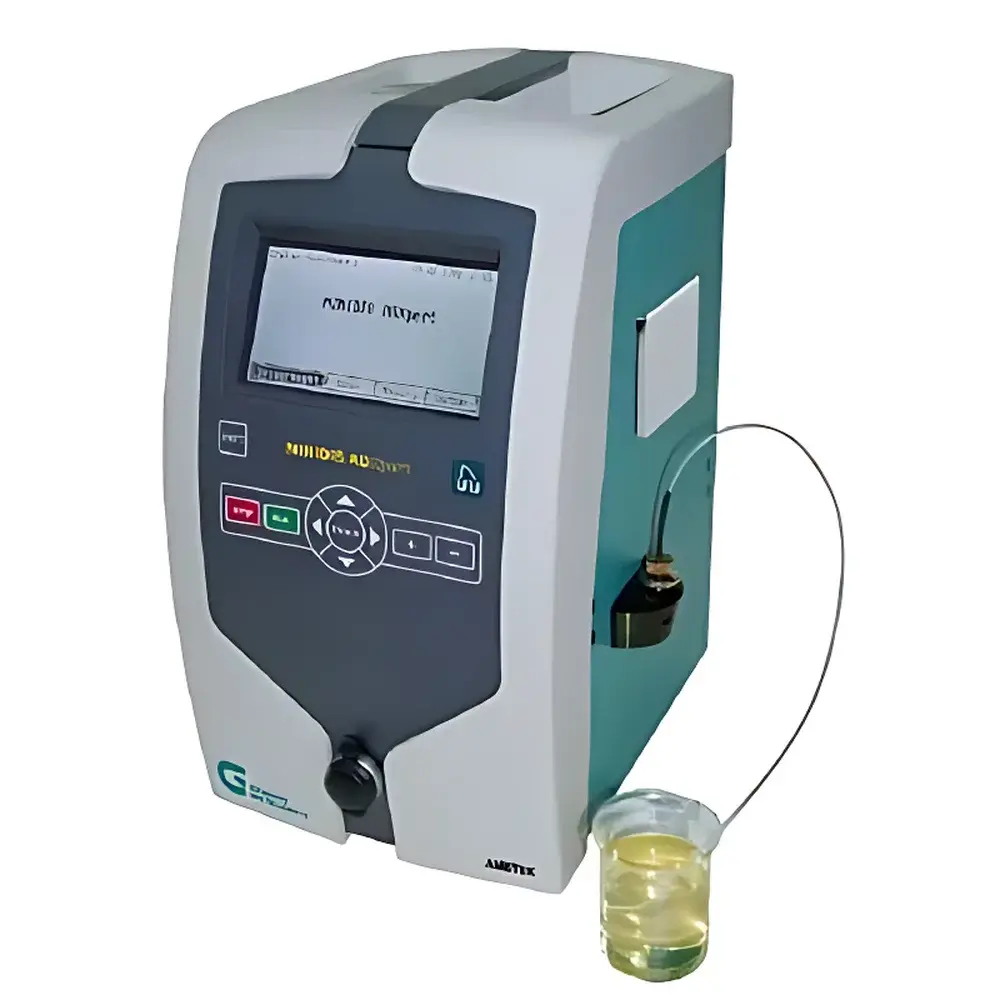
Grabner MINIDIS ADXpert Automated Micro-Distillation Analyzer
| Brand | Grabner |
|---|---|
| Origin | Austria |
| Model | MINIDIS ADXpert |
| Test Pressure | Atmospheric (0 kPa gauge) |
| Temperature Range | 0–400 °C (32–752 °F) |
| Temperature Accuracy | ±0.1 °C |
| Distillation Time (Gasoline) | 15 min |
| Sample Volume | 6 mL |
| Residue Measurement | Integrated analytical balance (±0.003 g) |
| Predefined Methods | 10 (ASTM D86 Group 0–4, ASTM D7344, ISO 3045, IP 123) |
| Cleaning Volume per Cycle | 4 mL (acetone) |
| Dimensions (W×H×D) | 200 × 320 × 220 mm |
| Weight | 13 kg |
| Power Supply | 100–240 V AC, 50/60 Hz, 150 W or 12 V DC (optional vehicle battery) |
Overview
The Grabner MINIDIS ADXpert is an automated micro-distillation analyzer engineered for precise, reproducible boiling point distribution analysis of petroleum products under true atmospheric pressure conditions. Based on the micro-distillation principle—where a small, controlled sample (6 mL) is heated at a defined rate while vapor temperature and recovered volume are continuously monitored—the instrument delivers high-fidelity distillation curves aligned with internationally recognized test methods including ASTM D86, ASTM D7344, ISO 3045, and IP 123 (Groups 0–4). Unlike conventional distillation apparatuses requiring large sample volumes and complex glassware setups, the MINIDIS ADXpert employs a sealed, metal sample cup and integrated Peltier-based temperature control to ensure thermal stability and eliminate ambient interference. Its design emphasizes metrological integrity: real-time pressure compensation via built-in absolute pressure sensing, automatic correction to standard atmospheric reference (101.325 kPa), and traceable temperature calibration across the full 0–400 °C range with ±0.1 °C accuracy. This enables reliable determination of key specification points—including initial boiling point (IBP), 10%, 50%, 90% recovery temperatures, and final boiling point (FBP)—as required for gasoline, aviation turbine fuel, diesel fuels, naphthas, and industrial solvents.
Key Features
- True atmospheric distillation: No vacuum or pressurized chamber; measurement conducted at ambient barometric pressure with continuous digital pressure compensation.
- Micro-sample operation: 6 mL sample volume reduces reagent consumption, waste generation, and exposure risk—ideal for high-throughput labs and field deployment.
- Integrated analytical balance: Measures residue mass post-distillation with ±0.003 g accuracy, enabling direct calculation of percent residue and loss.
- Peltier-controlled heating and cooling: Ensures rapid thermal response, uniform heat transfer, and stable temperature ramping without external coolant or oil baths.
- Automated acetone cleaning cycle: 4 mL solvent consumption per test; programmable cleaning sequence prevents cross-contamination between samples.
- Guided touchscreen interface: Multilingual (English/German) menu-driven workflow for method selection, calibration, validation, and result review—no operator interpretation required.
- Rugged portable form factor: Compact footprint (200 × 320 × 220 mm), 13 kg weight, and optional 12 V DC power input support mobile laboratory and refinery-side applications.
Sample Compatibility & Compliance
The MINIDIS ADXpert is validated for use with volatile and semi-volatile hydrocarbon liquids meeting the scope of ASTM D86 (Groups 0–4), ASTM D7344 (micro-method equivalence to D86), ISO 3045 (petroleum products—determination of distillation characteristics), and IP 123 (distillation of petroleum products). It accommodates gasoline (including ethanol-blended E10/E15), Jet A-1 and JP-8 aviation fuels, diesel fuels (EN 590, ASTM D975), light naphthas, and technical solvents. All measurements comply with GLP data integrity requirements: each run logs timestamp, operator ID, method version, environmental pressure/temperature, calibration status, and raw sensor outputs. The system supports audit-ready electronic records compatible with FDA 21 CFR Part 11 when connected to compliant LIMS or ELN platforms.
Software & Data Management
The embedded firmware provides local storage for up to 75 complete distillation reports, each containing full curve data (temperature vs. % recovered), residue mass, pressure-corrected endpoints, and pass/fail flags against user-defined specification limits. Export options include CSV and PDF formats via USB host port or RS-232/USB-to-serial interface. Optional PC software (Grabner DISTILSoft) enables advanced curve overlay, statistical trend analysis across batches, method customization (e.g., custom cut-point definitions), and automated report generation compliant with ISO/IEC 17025 documentation standards. All data modifications are logged with immutable timestamps and user authentication.
Applications
- Refinery process control: Real-time monitoring of crude fractionation cuts and reformulated gasoline blending.
- Fuel quality assurance: Verification of distillation specifications per ASTM D439 (gasoline), ASTM D1655 (aviation turbine fuel), and EN 590 (diesel).
- Research & development: Screening of alternative fuels, bio-blendstocks, and synthetic hydrocarbons for volatility behavior.
- Contract testing laboratories: High-reproducibility data generation for regulatory submissions (EPA, EU REACH, CARB).
- Field service: On-site verification of fuel deliveries at terminals, airports, and military depots using battery-powered operation.
FAQ
Does the MINIDIS ADXpert require external calibration gases or reference standards for daily operation?
No—temperature calibration is performed using NIST-traceable internal references; only periodic verification with certified thermometer standards (e.g., ASTM E77) is recommended per ISO/IEC 17025.
Can the instrument measure distillation curves for heavy fuel oils or lubricants?
No—it is designed exclusively for light to middle distillates (TBP 10% vol) or high viscosity (>5 cSt at 40 °C) are outside its validated operating envelope.
Is method validation documentation available for regulatory audits?
Yes—Grabner supplies IQ/OQ protocols, uncertainty budgets per EURACHEM/CITAC Guide, and test reports demonstrating conformance to ASTM D7344 repeatability criteria (≤0.5 °C for IBP, ≤1.0 °C for FBP).
How is carryover prevented between sequential tests?
The system executes a full acetone rinse cycle (4 mL) followed by hot-air drying before each new analysis; residue mass verification confirms cleaning efficacy prior to sample introduction.
What connectivity options support integration into a centralized lab informatics system?
Standard RS-232 serial output and virtual COM port over USB enable direct communication with LIMS; optional Ethernet module (sold separately) supports TCP/IP-based data streaming and remote diagnostics.






