
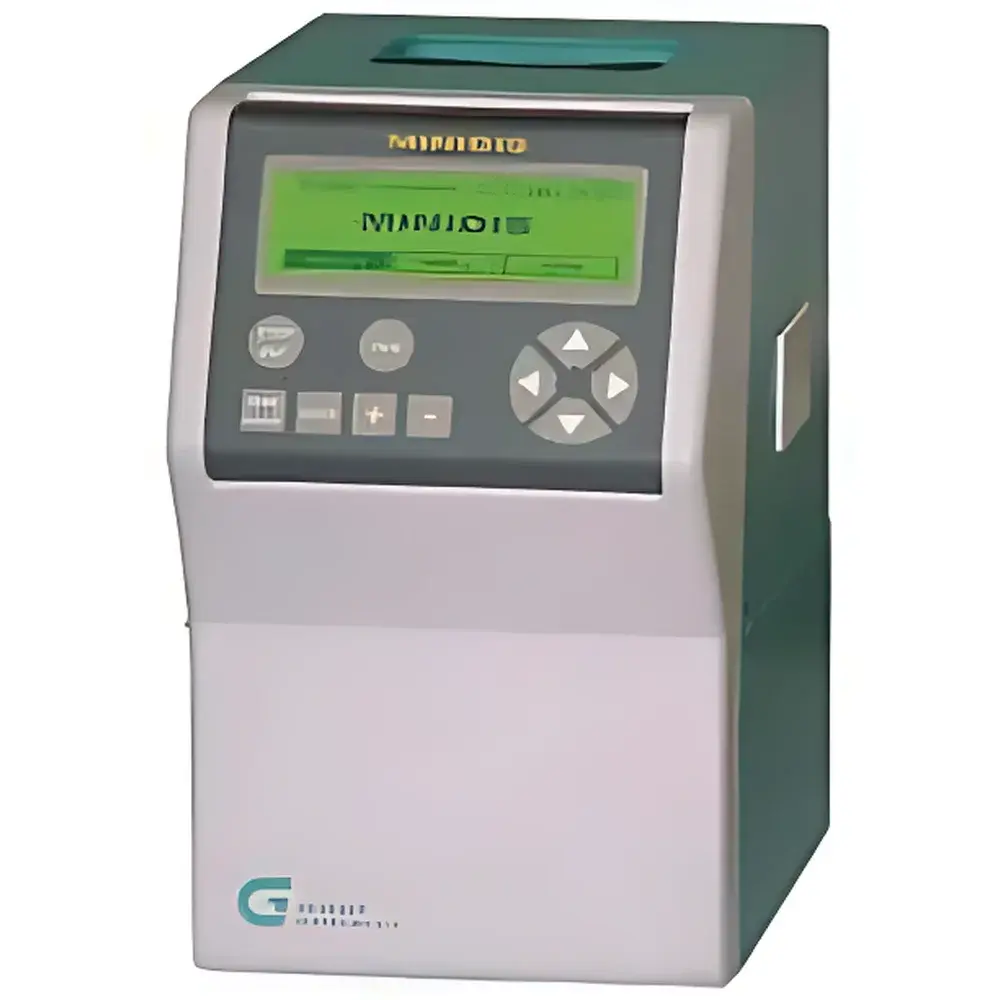
GRABNER MiniDIS Automated Micro-Distillation Analyzer
| Brand | GRABNER |
|---|---|
| Origin | Austria |
| Model | MiniDIS |
| Temperature Range | 0–400 °C |
| Temperature Accuracy | ±0.1 °C |
| Cold Bath Temperature Range | −20 °C to +60 °C |
| Distillation Rate | 1–11 mL/min |
| Volume Detection Range | 0.1 mL |
| Volume Resolution | 0.1 mL |
| Sample Volume | 6 mL |
| Residue Measurement Accuracy | ±0.003 g |
| Dimensions (W×H×D) | 200×320×220 mm |
| Weight | 13 kg |
| Power Supply | 100–240 V AC, 50/60 Hz, 150 W |
| Optional DC Input | 12 V/10 A |
| Compliance | ASTM D7344, ASTM D86, ISO 3405, IP 123, DIN 51751 (Groups 0–4) |
Overview
The GRABNER MiniDIS Automated Micro-Distillation Analyzer is an engineered solution for precise, repeatable atmospheric distillation of petroleum products in full compliance with ASTM D7344 — the internationally recognized standard for micro-distillation testing. Unlike conventional D86 apparatuses requiring large sample volumes, complex setup, and controlled ambient conditions, the MiniDIS implements a true ambient-pressure distillation process using a compact, self-contained architecture. It operates on the fundamental principle of progressive vaporization under controlled heating, with real-time monitoring of vapor temperature, condensate volume, and residual mass — all synchronized to generate standardized distillation curves (e.g., T10, T50, T90, final boiling point, and dry point). Designed for laboratory, field, and mobile deployment, the MiniDIS delivers D86-equivalent reports in as little as 15 minutes for gasoline samples, with no external cooling units, dedicated ventilation, or operator expertise in classical distillation theory required.
Key Features
- Full automation from sample aspiration to final report generation — including Peltier-controlled heating, automatic condensate volume measurement (0.1 mL resolution), and integrated high-precision balance (±0.003 g) for residue quantification
- True atmospheric distillation environment — no vacuum or pressurized systems; equipped with built-in pressure sensor for real-time barometric correction per ASTM D86 Annex A1
- Pre-programmed test methods for Groups 0–4 per ASTM D86, ISO 3405, IP 123, and DIN 51751 — selectable via intuitive graphical interface with guided workflow menus
- Disposable metallic sample cups (low-cost consumables) eliminate cross-contamination and reduce cleaning downtime
- Automated solvent rinse cycle using acetone (4 mL per wash), minimizing manual intervention and ensuring method reproducibility
- Rugged portable enclosure (13 kg, IP54-rated) with optional 12 V DC vehicle-battery operation — validated for outdoor, refinery fence-line, and mobile lab use
- Onboard data storage for up to 75 complete test records, with timestamped metadata and audit-ready export capability
Sample Compatibility & Compliance
The MiniDIS is validated for distillation characterization of light to mid-range hydrocarbon fractions, including gasoline (motor and aviation), diesel fuels, kerosene, naphthas, and industrial solvents. Its performance has been benchmarked against reference D86 methods across multiple interlaboratory studies, demonstrating statistical equivalence (per ISO 5725-2) for key endpoints (T10, T50, T90, FBPs) within specified repeatability limits. The instrument meets regulatory requirements for quality control in fuel production and trading, supporting GLP-compliant workflows through secure user authentication, electronic signatures (optional), and full audit trail logging. It satisfies data integrity expectations aligned with FDA 21 CFR Part 11 when connected to compliant LIMS environments via RS-232 or USB-to-serial interfaces.
Software & Data Management
The MiniDIS runs embedded firmware with multilingual support (English, German) and a high-contrast LCD interface optimized for glove-compatible operation. All test parameters — including custom endpoint definitions, calibration offsets, and user-defined pass/fail criteria — are configurable without programming. Raw data (vapor temperature vs. recovered volume) and calculated results (distillation curve, slope analysis, deviation flags) are exportable in CSV and ASTM D86-compliant ASCII formats. PC connectivity enables direct printing to thermal or laser printers and integration into enterprise QA/QC databases. Firmware updates are performed via USB flash drive, with version-controlled change logs retained in device memory for traceability.
Applications
- Refinery process control: Real-time verification of fractionation efficiency and cut-point accuracy during crude unit operation
- Fuel blending optimization: Rapid assessment of volatility distribution prior to additive treatment or batch certification
- Regulatory compliance testing: On-site verification of gasoline RVP, distillation range, and ethanol content impact per EPA Method IP 286 and EN 15376
- Field inspection and custody transfer: Mobile verification of fuel specifications at terminals, depots, and retail sites
- Research & development: High-throughput screening of novel biofuel blends, oxygenates, and synthetic hydrocarbons
FAQ
Does the MiniDIS generate ASTM D86-compliant reports?
Yes — it produces fully formatted D86 reports, including distillation curve plots, summary tables, and conformance statements for T10/T50/T90, initial boiling point, final boiling point, and dry point.
Can it measure residue after distillation?
Yes — the integrated analytical balance automatically weighs the residue cup post-distillation with ±0.003 g accuracy, enabling quantitative recovery calculation per ASTM D86 Section 12.
Is method validation required before routine use?
No — factory calibration against NIST-traceable standards is provided; users perform only periodic verification using certified reference materials (e.g., SRM 2722) per ASTM D7344 Section 8.
What maintenance is required?
Minimal — daily acetone rinse cycles, quarterly Peltier module inspection, and annual thermocouple calibration. No oil changes, vacuum pump servicing, or glassware replacement.
How does it handle variable ambient pressure?
The built-in absolute pressure sensor continuously monitors barometric conditions and applies real-time corrections to vapor temperature readings, ensuring compliance with ASTM D86 atmospheric compensation requirements.




