
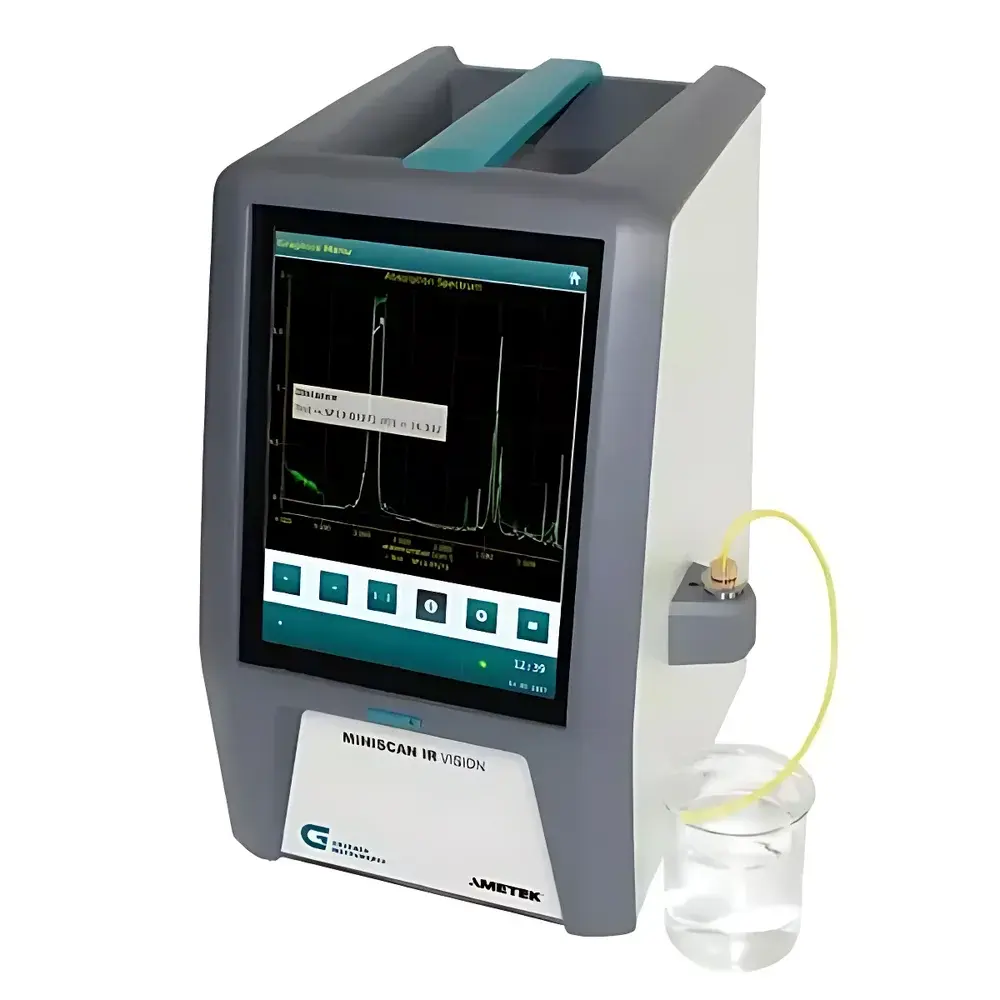
Grabner MINISCAN IR Vision Portable Mid-Infrared Fuel Analyzer
| Brand | Grabner |
|---|---|
| Origin | Austria |
| Manufacturer Type | Manufacturer |
| Origin Category | Imported |
| Model | MINISCAN IR Vision |
| Measurement Parameters | Gasoline Octane Number (RON/MON), Diesel Cetane Number |
| Portability | Portable |
| Detection Principle | Mid-Infrared Spectroscopy |
| Measurement Range | 70–110 (Octane/Cetane scale) |
| Accuracy | ±0.1 |
| Analysis Time | ≤60 s |
| Sample Volume | 6 mL |
Overview
The Grabner MINISCAN IR Vision is a portable, ruggedized mid-infrared (MIR) fuel analyzer engineered for rapid, on-site quantitative analysis of gasoline, diesel, and aviation turbine fuel. It operates on the fundamental principle of molecular absorption spectroscopy in the 4000–400 cm⁻¹ spectral range, where functional groups (e.g., C–H, C=O, O–H, aromatic C=C) exhibit characteristic vibrational transitions. By acquiring full-spectrum interferograms via a dual-mirror Michelson interferometer with integrated auto-alignment optics, the instrument enables high-fidelity spectral acquisition even after mechanical shock or thermal drift—critical for field deployment. The system employs Partial Least Squares (PLS) regression models validated against reference methods per ASTM E1655 and GB/T 29858, ensuring traceable, multivariate calibration for over 100 fuel properties—including octane number (RON/MON), cetane number, total aromatics, total olefins, oxygenates (MTBE, ethanol, methanol), benzene, FAME content, and illicit additives (e.g., dimethyl carbonate, methylal, sec-butyl acetate). Its thermoelectrically controlled sample cell, density module, and optical path deliver volume- and mass-normalized quantification compliant with ISO 4214, ASTM D1298, and EN ISO 3675.
Key Features
- Portable industrial design (12 kg, 293 × 390 × 280 mm) certified to IK08 impact and MIL-STD-810G vibration standards
- 10-inch sunlight-readable industrial touchscreen with haptic feedback, supporting English, Chinese, German, and Spanish UI
- Dual-temperature-controlled optical path: Peltier-stabilized interferometer and sample cell (±0.1 °C) for spectral reproducibility under ambient fluctuations
- Bubble-free metallic sampling system with automated priming and rinse cycles, minimizing carryover and operator dependency
- Integrated density measurement module (ASTM D1298 / EN ISO 3675 compliant) co-located with MIR cell for simultaneous physical–chemical characterization
- Onboard calibration verification using NIST-traceable polystyrene film and internal reference spectra; automatic intensity realignment post-transport
- Power flexibility: AC operation (100–264 V, 47–63 Hz, 130 W) or DC operation via 12 V vehicle adapter for mobile lab or depot use
Sample Compatibility & Compliance
The MINISCAN IR Vision accepts undiluted liquid hydrocarbon samples (gasoline, diesel, Jet A-1) with minimal preparation—no solvent dilution or filtration required. Its 6 mL sample volume accommodates standard laboratory vials and field sampling containers. All calibrations are built from >15,000 real-world fuel samples collected and analyzed by SGS laboratories, covering regional blends, biofuel admixtures (up to B30, E85), and regulatory non-conformant formulations. Method compliance includes: ASTM D5845 (oxygenates), ASTM D6277 / EN 238 / SH/T 0797 (benzene), EN 14078 / ASTM D7806 / GB/T 23801 (FAME), and GB/T 33648–2017 (non-conventional additives in automotive gasoline). Data integrity adheres to ALCOA+ principles, with audit trails, electronic signatures, and 21 CFR Part 11–ready software architecture.
Software & Data Management
The embedded firmware runs Grabner’s proprietary VisionSoft platform, featuring intuitive workflow-driven analysis, real-time spectral visualization, and automated pass/fail flagging against user-defined specification limits. All raw interferograms, processed absorbance spectra, prediction residuals, and metadata (operator ID, GPS tag, ambient T/P, calibration version) are stored in encrypted SQLite databases. Export options include CSV (results only), JCAMP-DX (spectra), PDF reports (with digital signature), and direct LIMS integration via HL7 or ASTM E1394 protocols. Data backup supports USB mass storage, network share (SMB), or scheduled cloud sync (AWS S3-compatible). Version-controlled calibration files include uncertainty budgets and cross-validation statistics (RMSEC, RMSEP, R²).
Applications
- Refinery blending control: Real-time monitoring of octane enhancers (e.g., alkylates, reformates) and cetane improvers during line blending
- Fuel terminal QA/QC: Rapid verification of batch conformity prior to dispatch, reducing hold-time and tank turnover latency
- Regulatory inspection: Field enforcement of fuel specifications (e.g., EU Directive 98/70/EC, China GB 17930–2016, US EPA Tier 3)
- Forensic fuel analysis: Detection and quantification of adulterants and illegal oxygenates in investigative workflows
- R&D formulation screening: High-throughput evaluation of novel bio-components or synthetic fuels against legacy benchmarks
- Aviation fuel acceptance testing: Simultaneous assessment of flash point proxies, aromatics, and naphthalenes per ASTM D1655 Annex A3
FAQ
Does the MINISCAN IR Vision require external standards for daily calibration verification?
No—built-in polystyrene film and reference spectrum libraries enable automated performance qualification without consumable standards.
Can the instrument be upgraded from gasoline-only to full gasoline/diesel/jet fuel capability in the field?
Yes—the MINISCAN IR Vision Professional configuration supports firmware-based expansion; hardware upgrades (e.g., extended-range detector) are performed at authorized Grabner service centers.
Is spectral data export compatible with third-party chemometric software (e.g., MATLAB, Pirouette)?
Yes—JCAMP-DX format ensures interoperability with all major spectral modeling environments; PLS model transfer requires Grabner’s licensed Model Exchange Module.
How is temperature compensation handled for density and spectral measurements?
Both the integrated density module and MIR cell are independently Peltier-regulated to ±0.1 °C, eliminating reliance on ambient correction algorithms.
What cybersecurity measures are implemented for network-connected deployments?
The device supports TLS 1.2 encryption, role-based access control (RBAC), disabled default credentials, and optional FIPS 140-2 cryptographic modules for government-class deployments.







