
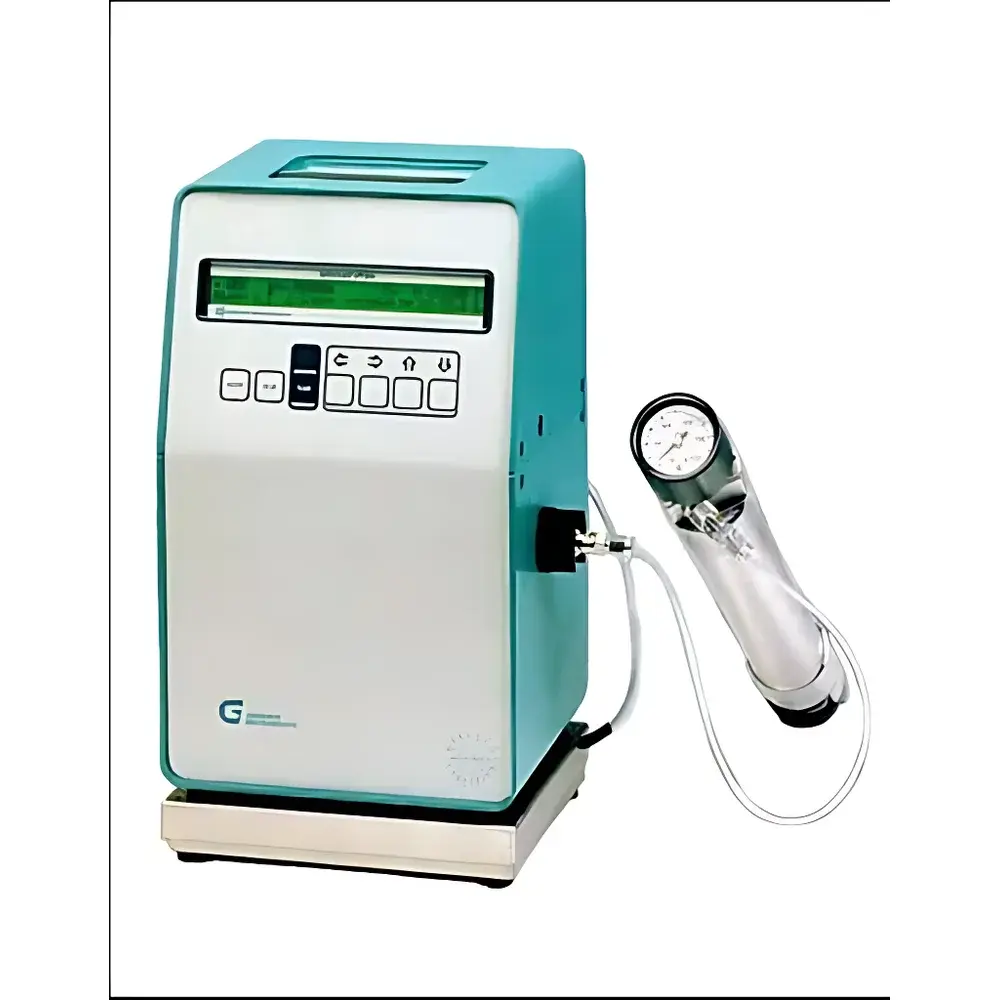
Grabner MiniVAP VPSH+ Crude Oil Package Petroleum Vapor Pressure Analyzer
| Brand | Grabner |
|---|---|
| Origin | Austria |
| Model | MiniVAP VPSH+ Crude Oil Package |
| Application | Crude oil vapor pressure (RVP/TVPR) determination per ASTM D323, D6377, and ISO 3014 |
| Sample Handling | Mobile piston cylinder sampling system with pressurized transfer and mechanical agitation |
| Automation | Fully automated measurement cycle including purge, equilibration, pressure stabilization, and cleaning |
| Compliance | Designed to meet ASTM D6377 (TVPR), ASTM D323 (RVP), ISO 3014, and EN 13016-1 requirements |
| Operating Temperature | 37.8 °C (100 °F) controlled bath |
| Pressure Range | 0–200 kPa (0–29 psi) absolute |
| Resolution | 0.1 kPa |
| Repeatability | ≤0.5 kPa (per ASTM D6377) |
Overview
The Grabner MiniVAP VPSH+ Crude Oil Package is a fully automated, benchtop vapor pressure analyzer engineered for precise and reproducible determination of true vapor pressure (TVPR) and Reid vapor pressure (RVP) of crude oils and unstabilized hydrocarbon streams. Unlike conventional static vapor pressure testers, this system integrates a mobile piston cylinder sampling module with in-situ pressurization and controlled mechanical agitation—enabling representative capture and retention of volatile light ends directly from pipeline, tanker, or storage tank sampling points. The instrument operates on the principle of equilibrium vapor pressure measurement: after sealed transfer into the thermostatted test chamber at 37.8 °C, the sample undergoes standardized oscillation to accelerate phase equilibrium between liquid and vapor phases. Pressure is monitored continuously until stabilization criteria per ASTM D6377 are met, delivering a thermodynamically valid TVPR value without extrapolation or correction assumptions.
Key Features
- Mobile piston cylinder sampling unit: Enables direct, pressurized acquisition from live process lines or static tanks—eliminating exposure to ambient conditions and preventing loss of C1–C4 hydrocarbons prior to analysis.
- Integrated agitation platform (shaking board): Provides programmable amplitude and frequency-controlled oscillation to accelerate vapor–liquid equilibration, reducing typical measurement time from >30 minutes to under 12 minutes for high-volatility crudes.
- ASTM D323-compliant RVP conversion: Built-in algorithm applies standard temperature and pressure corrections to report RVP equivalent values alongside measured TVPR, facilitating regulatory reporting and refinery blending decisions.
- Closed-loop, circulation-based sample introduction: Ensures zero atmospheric contact during transfer; piston cylinder seals automatically upon pressurization, maintaining original sample composition integrity.
- Automated post-analysis cleaning sequence: Uses solvent flush and nitrogen purge cycles to remove residual hydrocarbons from valves, pressure sensors, and chamber surfaces—minimizing carryover and ensuring inter-sample reproducibility.
- Modular thermal bath with PID-controlled heating: Maintains ±0.1 °C stability at 37.8 °C throughout the full measurement cycle, critical for compliance with ASTM and ISO thermal specifications.
Sample Compatibility & Compliance
The MiniVAP VPSH+ Crude Oil Package is validated for use with raw, unstabilized, and partially stabilized crude oils—including those containing dissolved natural gas liquids (NGLs), hydrogen sulfide, and water emulsions up to 5 vol%. It accommodates sample volumes from 50 mL to 150 mL and supports both single-point and multi-point vapor pressure profiling. Regulatory alignment includes full traceability to ASTM D6377 (Standard Test Method for Determination of Vapor Pressure of Crude Oil: VPCRx), ASTM D323 (for RVP correlation), ISO 3014 (Petroleum products — Determination of vapour pressure — Reid method), and EN 13016-1 (Petroleum products — Determination of vapour pressure — Part 1: Vapour pressure of petroleum products). Instrument firmware supports audit-ready data logging compliant with GLP and GMP environments, including user authentication, electronic signatures, and 21 CFR Part 11–compatible event history.
Software & Data Management
Control and data acquisition are managed via Grabner’s proprietary VPSH Control Software v4.x, running on Windows-based embedded PC. The interface provides real-time pressure–time curve visualization, automatic endpoint detection per ASTM-defined stabilization thresholds (e.g., <0.1 kPa/min drift over 5 min), and configurable report templates aligned with API MPMS Chapter 9.8 and ISO 4259. All raw sensor data—including temperature, absolute pressure, agitation status, and cleaning cycle logs—are stored in encrypted SQLite databases with timestamped metadata. Export options include CSV, PDF, and XML formats compatible with LIMS integration (via ODBC or REST API). Audit trails record operator actions, parameter changes, and calibration events with immutable timestamps—supporting FDA, EPA, and NOC regulatory submissions.
Applications
- Crude assay laboratories performing initial vapor pressure screening prior to fractionation or custody transfer.
- Upstream production facilities monitoring TVPR trends across wellheads, manifolds, and gathering systems to assess stabilization efficiency.
- Refinery crude evaluation units validating blendstock volatility for desalter operation and atmospheric distillation feed control.
- Third-party inspection agencies conducting independent vapor pressure verification per contractual specifications (e.g., ASTM D6377–22, API RP 2543).
- Research institutions studying vapor–liquid equilibrium behavior of heavy and ultra-heavy crudes under varying thermal and compositional conditions.
FAQ
What distinguishes TVPR (ASTM D6377) from RVP (ASTM D323)?
TVPR measures the absolute equilibrium vapor pressure of crude oil at 37.8 °C without air saturation, reflecting its intrinsic volatility. RVP, by contrast, is an empirical measure performed on gasoline-range materials using air-saturated apparatus; D6377 allows mathematically rigorous conversion to RVP-equivalent values for comparative reporting.
Can the MiniVAP VPSH+ analyze sour crudes containing H₂S?
Yes—the wetted components (316 stainless steel, PTFE, FKM elastomers) are chemically resistant to H₂S at typical crude concentrations. Optional H₂S scrubber module is available for high-H₂S applications (>500 ppm) to protect pressure transducers.
Is manual sample preparation required before loading the piston cylinder?
No—sample homogenization occurs automatically during agitation; however, gross sediment or free water should be removed upstream per API RP 1170 to avoid valve clogging.
How often does the system require calibration verification?
Grabner recommends daily zero-pressure verification and weekly span calibration using certified NIST-traceable pressure standards; full performance qualification per ASTM D6377 Annex A3 is advised every 90 days or after maintenance.
Does the software support remote monitoring and control?
Yes—VPSH Control Software includes optional Ethernet-enabled remote access with role-based permissions, enabling off-site supervision of active runs and historical data retrieval without local workstation presence.




