
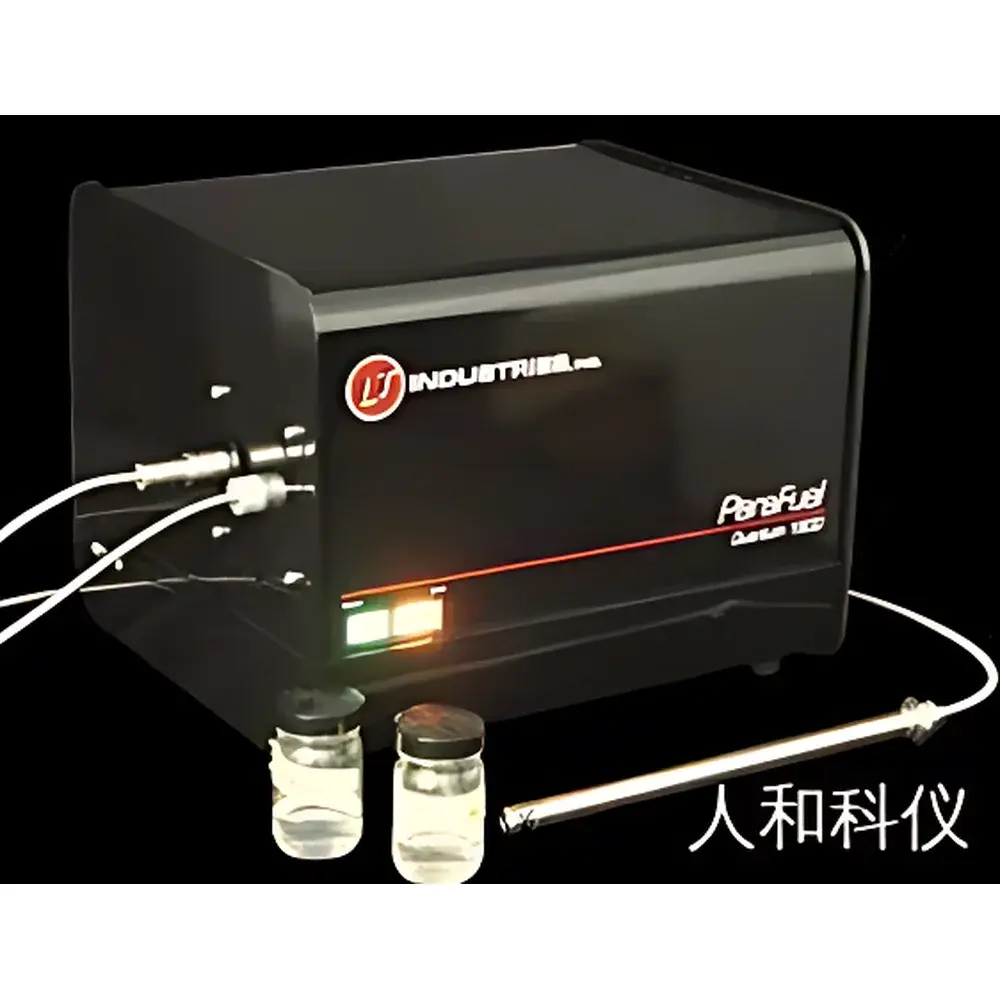
Grabner ParaFuel™ Online Near-Infrared Fuel & Crude Oil Analyzer
| Brand | Grabner |
|---|---|
| Origin | Austria |
| Model | ParaFuel™ |
| Power Supply | 100–240 VAC, 50/60 Hz |
| Scan Time | Adjustable, default 30 s |
| Communication Interface | Standard TCP/IP Ethernet, optional Modbus TCP or 4–20 mA |
| Process Points | Up to 20 via multiplexed fiber-optic probes |
| Sample Temperature Range | Up to 150 °C |
| Sample Pressure Rating | Up to 7,000 kPa |
| Fiber Optic Cable Length | Standard 3 m, extendable to 200 m |
| Enclosure Rating | IP65 (dust- and water-resistant) |
| Hazardous Area Classification | CSA C1D2 (optional C1D1) |
| Desktop Unit Dimensions | 30.5 cm × 39.7 cm × 34.9 cm (12" × 15" × 13") |
| Data Storage | Automatic local logging + LIMS integration via TCP/IP |
| Software Platform | LTBus-based Windows application with audit trail, user access levels, and FDA 21 CFR Part 11–compliant electronic signatures (optional) |
Overview
The Grabner ParaFuel™ Online Near-Infrared Fuel & Crude Oil Analyzer is an industrial-grade process analytical technology (PAT) system engineered for real-time, non-destructive quantification of physical and chemical properties in liquid hydrocarbon streams. Based on calibrated near-infrared (NIR) spectroscopy in the 1,100–2,500 nm range, the ParaFuel™ employs chemometric models validated against reference ASTM and ISO methods—including ASTM D2887 (distillation), D2622 (sulfur), D4052 (density), D5191 (RVP), D2699/D2700 (RON/MON), D613 (cetane number), and D97 (cloud point). Unlike offline GC or wet chemistry techniques, the ParaFuel™ delivers second-scale measurements directly in-process—enabling closed-loop control of blending, fractionation, desalting, and hydrotreating operations without sample extraction, dilution, or reagent consumption.
Key Features
- 24/7 robust operation in refinery and upstream environments, certified to CSA C1D2 (Class I, Division 2) hazardous area standards—with optional C1D1 configuration for higher-risk zones.
- Single-analyzer multiplexing architecture supporting up to 20 remote measurement points via ruggedized fiber-optic probes and flow cells—reducing CAPEX and calibration overhead across distillation columns, pipeline headers, storage tanks, and loading racks.
- Integrated temperature and pressure compensation: built-in Pt100 sensor for automatic thermal correction; high-pressure probe variants rated to 7,000 kPa for wellhead and HPHT applications.
- Seamless DCS/PLC integration using native Modbus TCP, 4–20 mA analog outputs, or OPC UA—enabling direct feed of validated results into APC, MES, or historian systems without middleware.
- LTBus software platform with role-based access control, full electronic audit trail, configurable alarm thresholds, and optional FDA 21 CFR Part 11 compliance for regulated environments operating under GLP or GMP frameworks.
- Remote diagnostics, firmware updates, and model recalibration via secure HTTPS tunnel—minimizing unplanned downtime and field service visits.
Sample Compatibility & Compliance
The ParaFuel™ is validated for continuous analysis of undiluted, opaque, or viscous hydrocarbon matrices—including crude oil (paraffinic, naphthenic, and heavy blends), gasoline, diesel, jet fuel (Jet A/A-1), kerosene, naphtha, reformate, alkylate, MTBE/ETBE blends, and biofuel blends (e.g., FAME, HVO). It accommodates suspended solids, emulsions, and variable water content without optical path obstruction due to its immersion probe design and adaptive spectral preprocessing. All factory calibrations are traceable to NIST-certified reference materials and verified per ASTM E1655 (standard practice for NIR quantitative analysis) and ISO 12099 (performance qualification of NIR instruments). System validation documentation supports IQ/OQ/PQ protocols required for pharmaceutical-adjacent fuel additives manufacturing or EPA Tier 3 compliance reporting.
Software & Data Management
The LTBus control and analysis suite runs on standard Windows OS and provides a unified interface for instrument configuration, method deployment, real-time trend visualization, and batch reporting. Spectral data are stored locally in HDF5 format with embedded metadata (timestamp, probe ID, temperature, pressure, operator ID). Export options include CSV, XML, and SQL-compatible dumps for integration with LIMS (e.g., LabWare, Thermo SampleManager) or cloud analytics platforms. Audit logs record all user actions—including method edits, calibration updates, and result overrides—with immutable timestamps and digital signatures. Optional 21 CFR Part 11 modules enforce electronic signature workflows, biometric authentication, and change-controlled versioning of chemometric models.
Applications
- Real-time monitoring of crude assay parameters (API gravity, sulfur, TAN, asphaltene content, Conradson carbon residue) at custody transfer points and desalter inlets.
- Blending optimization of gasoline pool components—tracking RON, MON, benzene, olefins, aromatics, ethanol, and MTBE concentrations to meet regional specifications (e.g., EU EN 228, US EPA Reformulated Gasoline).
- Distillation curve prediction (IBP–EP, T10–T90) for diesel and jet fuel to ensure compliance with ASTM D975 and D1655.
- Quality surveillance of finished fuels during loading/unloading—detecting contamination, misblends, or specification drift before shipment.
- Lab-to-process correlation: desktop ParaFuel™ units replicate field probe performance for method development, reference method cross-validation, and staff training—ensuring metrological continuity between R&D and production.
FAQ
How does the ParaFuel™ handle fouling or deposits on the optical window?
The immersion probes feature self-cleaning fluid dynamics and optional ultrasonic transducers; routine maintenance intervals exceed 6 months in typical refinery service. Spectral drift is corrected automatically via reference scans and multivariate residual monitoring.
Can existing chemometric models be imported from other NIR platforms?
Yes—models developed in GRAMS/AI, Unscrambler, or MATLAB can be converted to LTBus-compatible format using Grabner’s Model Migration Toolkit, subject to spectral resolution and wavelength alignment verification.
Is the desktop version metrologically equivalent to the online system?
Yes—the benchtop ParaFuel™ uses identical optical engines, detector arrays, and chemometric algorithms; differences are limited to sampling interface (flow cell vs. immersion probe) and environmental hardening. Cross-validation studies show ≤0.3% RSD in repeatability for key parameters like RVP and cetane number.
What cybersecurity measures are implemented?
The system supports TLS 1.2+ encryption for remote access, network segmentation via VLAN tagging, disabled default accounts, and firmware signing. Optional hardware TPM 2.0 modules enable secure boot and cryptographic key storage for Part 11 deployments.
Does ParaFuel™ support ASTM D7153 (NIR determination of biodiesel in diesel)?
Yes—factory-loaded models comply with ASTM D7153-21, including detection limits down to 0.2 vol% B100 in ultra-low-sulfur diesel (ULSD), validated across 15+ feedstock types (soy, rapeseed, tallow, UCO).
Related Products






