
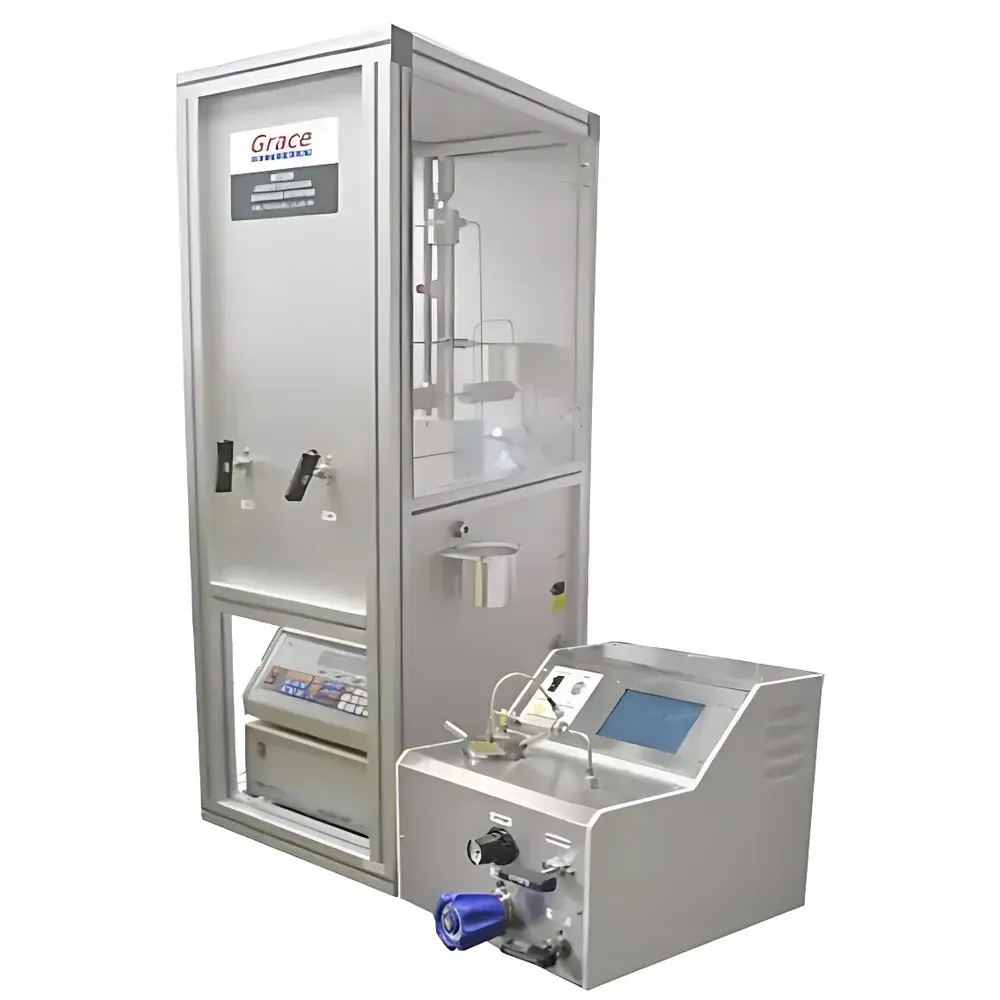
Grace M7355 Cement Volume Expansion and Contraction Apparatus
| Brand | Grace |
|---|---|
| Origin | USA |
| Manufacturer Type | Authorized Distributor |
| Origin Category | Imported |
| Model | M7355 |
| Pricing | Upon Request |
| Max Pressure | 20,000 psi |
| Full-Scale Range | ±30 mL |
| Pressure Control Accuracy | ±25 psi |
| Water Supply | Municipal tap water |
| Power | 120 V, 50/60 Hz |
| Dimensions | 19" W × 24" D × 47" H |
| Weight | 95 lb |
Overview
The Grace M7355 Cement Volume Expansion and Contraction Apparatus is an engineered accessory designed for integration with Grace’s Universal Cement Analyzer (UCA) platforms—specifically the M7350 UCA and M7360 HPHT UCA systems. It operates on a precision volumetric displacement principle, utilizing a calibrated fluid-filled chamber and high-stability pressure transduction to continuously monitor minute dimensional changes in cement slurries under controlled thermal and mechanical conditions. Unlike standalone dilatometers or manual dial-gauge methods, the M7355 enables concurrent, time-synchronized measurement of volumetric strain (expansion/contraction), temperature, elapsed curing time, and compressive strength development—all within a single test cycle. This co-located data acquisition architecture eliminates temporal misalignment between physical deformation and mechanical property evolution, a critical requirement for validating cement hydration models, evaluating expansive admixtures, and qualifying cement systems for deepwater or geothermal wellbore applications where thermal-mechanical coupling dominates performance.
Key Features
- Direct-mount modular design compatible with Grace M7350 and M7360 UCA base units, enabling seamless hardware integration without external signal conditioning or recalibration.
- Real-time, high-resolution volumetric tracking over ±30 mL full scale with pressure-controlled fluid displacement, maintaining measurement integrity across 0–20,000 psi operational range.
- Simultaneous acquisition of expansion/contraction kinetics, temperature profile, pressure history, and compressive strength progression—time-stamped to microsecond resolution.
- Integrated pressure regulation system with ±25 psi control tolerance, ensuring stable boundary conditions during isobaric or programmed pressure-ramp testing protocols.
- Dedicated Grace M4085 software suite included at no additional cost, supporting automated test sequencing, multi-parameter trend visualization, and compliance-ready audit trails.
Sample Compatibility & Compliance
The M7355 accommodates standard API RP 10B-2 and ISO 10426-1 compliant cement specimens (e.g., 2-in. diameter × 4-in. height cylinders) as well as custom geometries up to 3.5 in. in diameter. Its stainless-steel wetted components and chemically resistant seals are rated for exposure to Class G/H cement slurries, bentonite-based systems, and common retarders, accelerators, and expansive agents. The apparatus meets functional requirements outlined in ASTM C1507 (Standard Test Method for Measuring Expansion and Contraction of Cement Pastes) and supports traceable calibration per ISO/IEC 17025 when used with accredited UCA host instrumentation. Data logging adheres to ALCOA+ principles (Attributable, Legible, Contemporaneous, Original, Accurate, Complete, Consistent, Enduring, Available), satisfying GLP and GMP documentation expectations for regulatory submissions.
Software & Data Management
Grace M4085 software provides native support for defining multi-step thermal-pressure profiles (e.g., staged ramp-and-hold sequences simulating downhole thermal gradients), automatic baseline correction, and real-time derivative analysis of volumetric rate-of-change (dV/dt). All raw sensor outputs—including LVDT displacement, RTD temperature, load cell force, and pressure transducer signals—are stored in binary format with embedded metadata (operator ID, sample ID, calibration certificate IDs, environmental timestamps). Export functionality includes direct .xlsx generation with column-aligned parameters, CSV for third-party statistical packages, and PDF report templates pre-formatted for technical review. Audit trail logs record every user action—including parameter edits, calibration events, and export operations—with immutable timestamps, fulfilling FDA 21 CFR Part 11 electronic record requirements when configured with Windows domain authentication.
Applications
- Quantifying autogenous and thermal expansion/contraction behavior of oilwell cements under simulated HPHT conditions (up to 20,000 psi / 350 °F).
- Evaluating performance of expansive additives (e.g., calcium sulfoaluminate, MgO-based systems) in mitigating post-set shrinkage cracking.
- Correlating early-age volumetric stability with compressive strength gain to optimize curing schedules and slurry formulation.
- Validating numerical models of cement hydration kinetics and pore structure evolution via experimental strain-time datasets.
- Supporting API Spec 10A certification testing where dimensional stability is a mandatory reporting parameter for Class G/H cement blends.
FAQ
Is the M7355 compatible with legacy UCA instruments other than the M7350 and M7360?
The M7355 is mechanically and electrically certified only for use with the Grace M7350 and M7360 UCA platforms. Integration with earlier-generation UCAs requires formal compatibility assessment and firmware revision approval from Grace Technical Support.
Does the M4085 software support automated compliance reporting for ISO 10426-2 Annex B?
Yes—the software includes configurable report modules that auto-populate required fields per ISO 10426-2 Annex B, including specimen identification, environmental conditions, expansion/contraction curves, and uncertainty statements derived from system calibration records.
Can volumetric data be synchronized with external thermocouple arrays or ultrasonic velocity measurements?
The M4085 software accepts TTL-triggered inputs and supports RS-485/Modbus RTU protocol for time-synchronized ingestion of third-party sensor data, provided external devices are timestamp-capable and aligned to the UCA’s internal clock reference.







