
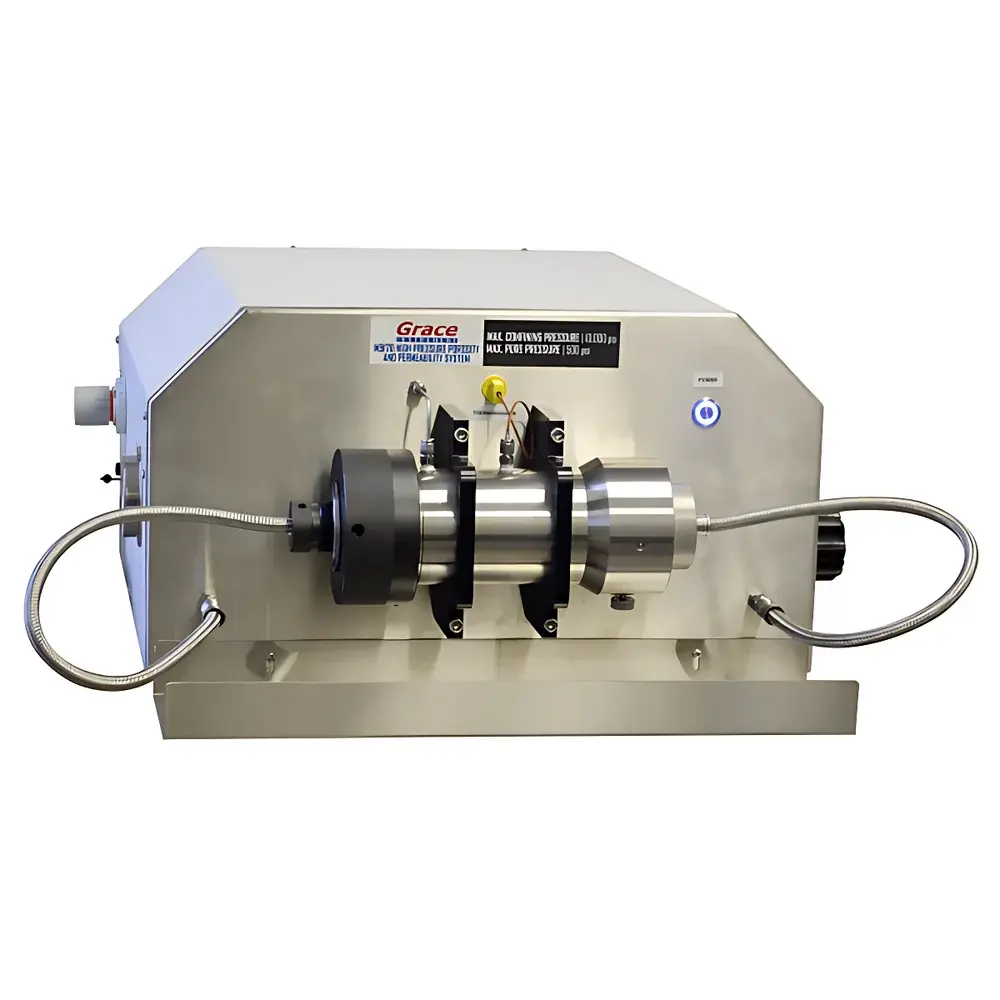
Grace M9170/M9180 Confined Porosity and Permeability Analyzer
| Brand | Grace |
|---|---|
| Origin | USA |
| Model | M9170/M9180 |
| Confining Pressure Range | 0–10,000 psi (690 bar) |
| Pore Pressure Range | 0–500 psi (34 bar) |
| Core Diameter | 1.5″ (1″ optional) |
| Core Length | Up to 3″ |
| Porosity Range | 0–60% |
| Permeability Range | 0.0005 mD to 10 D |
| Test Gases | N₂, He, dry air |
| Measurement Principles | Boyle’s Law (porosity), Unsteady-state Pulse Decay (low-perm), Steady-state Flow (high-perm) |
| Klinkenberg Correction | Yes |
| Data Output Format | CSV |
| Software Platform | Windows-based native application |
| Construction | 316 Stainless Steel pressure vessels |
| Power Supply | 110/220 VAC, 50/60 Hz |
Overview
The Grace M9170/M9180 Confined Porosity and Permeability Analyzer is a rigorously engineered dual-parameter core analysis system designed for quantitative evaluation of reservoir rock samples under simulated in-situ stress conditions. It operates on fundamental physical principles: porosity is determined via high-precision gas expansion measurements governed by Boyle’s Law, while permeability is derived using two complementary flow regimes—unsteady-state pulse decay for low-permeability formations (≤1 mD) and steady-state laminar flow for higher-permeability media (≥1 mD). The system applies controlled confining pressure up to 10,000 psi (690 bar) to replicate geomechanical stress states encountered at depths exceeding 15,000 ft, ensuring measurement integrity across tight shales, sandstones, carbonates, and unconventional reservoir analogs. All measurements are traceable to NIST-calibrated pressure transducers and temperature-stabilized mass flow controllers, supporting compliance with ASTM D3039, ISO 15148, and API RP 40 protocols for core characterization.
Key Features
- Integrated dual-mode permeability determination: pulse decay method compliant with ASTM D6520 for ultra-low permeability (<1 mD), and steady-state Darcy flow per ASTM D2340 for conventional ranges
- Automated Klinkenberg correction routine that computes slippage-corrected absolute permeability from multi-point gas permeability measurements at varying mean pore pressures
- Simultaneous calculation of grain density, inertial coefficient (β), and rock compressibility (Cb) from consolidated pressure-volume datasets
- Modular stainless steel (316 SS) pressure vessel architecture rated to 10,000 psi confining pressure and 500 psi pore pressure, with leak-tight sealing verified per ASME B16.34
- Minimal maintenance design: no oil-lubricated pumps or consumable sensors; all critical components accessible without system depressurization
- Native Windows-based control software with real-time parameter monitoring, audit trail logging, and 21 CFR Part 11–ready user authentication and electronic signature support
Sample Compatibility & Compliance
The M9170/M9180 accommodates cylindrical core plugs with diameters of 1.5″ (standard) or 1.0″ (optional), and lengths up to 3″, compatible with standard IADC core barrel recovery dimensions. Samples may be unconsolidated sands, cemented sandstones, fractured carbonates, or synthetic porous media. The system supports nitrogen and helium as inert test gases—helium preferred for its low viscosity and molecular size, enabling accurate characterization of nanoporous systems. All hardware and software comply with IEC 61000-6-3 (EMC) and UL 61010-1 safety standards. Data acquisition workflows meet GLP and GMP requirements for regulated laboratories, including full metadata tagging, version-controlled calibration records, and immutable raw data archiving in timestamped CSV format.
Software & Data Management
The proprietary Grace CoreLab™ software provides a deterministic, scriptable interface for experiment sequencing, real-time visualization of pressure transients and flow curves, and post-run parametric modeling. Each test session generates a structured dataset containing raw sensor time-series, calculated porosity, Klinkenberg-corrected permeability, grain density, and compressibility coefficients—all stored in ASCII-encoded CSV files with header-defined units and SI conventions. Export modules integrate natively with Microsoft Excel, MATLAB, and Petrel via ODBC drivers. Audit logs record operator ID, timestamp, instrument state, calibration status, and any manual overrides—fully exportable for FDA inspection or third-party QA review. Software updates are delivered via secure HTTPS with SHA-256 signature verification.
Applications
- Reservoir quality assessment for upstream E&P: quantifying poroperm relationships in unconventional plays (e.g., Eagle Ford, Bakken, Permian Wolfcamp)
- Core-flooding pre-screening: selecting representative samples for relative permeability and capillary pressure experiments
- Geomechanical modeling input: generating stress-dependent permeability and compressibility tensors for numerical simulators (CMG, Eclipse, TOUGH2)
- Enhanced oil recovery (EOR) screening: evaluating matrix response to CO₂, N₂, or surfactant flooding under confinement
- Academic research in porous media physics: experimental validation of lattice-Boltzmann simulations and pore-network models
- Regulatory submissions: generating ASTM/ISO-compliant reports for SEC Form 20-F, PRMS reserves reporting, and EPA subsurface injection permits
FAQ
What gas standards are supported for calibration and testing?
Nitrogen and helium are fully supported; both gases are traceable to NIST SRM 1680b (N₂) and SRM 1681 (He). Dry air may be used for preliminary screening but is not recommended for final reporting due to variable composition.
Is the system compatible with automated core handling robotics?
Yes—the M9170/M9180 features RS-485 and Ethernet/IP interfaces for integration into automated core labs (e.g., CoreLabs, Geoservices, or custom robotic gantries) with programmable I/O triggers for sample loading/unloading confirmation.
How is temperature stability maintained during long-duration pulse decay tests?
The instrument housing incorporates a passive thermal mass design with ±0.1°C ambient drift compensation; optional active oven modules (±0.05°C) are available for ISO 15148–compliant isothermal testing.
Can the software generate reports compliant with API RP 40 Section 5?
Yes—preconfigured report templates include all required fields: core identification, lithology description, confining/pore pressure history, raw pressure-decay curves, Klinkenberg plots, and uncertainty propagation per GUM (JCGM 100:2008).



