
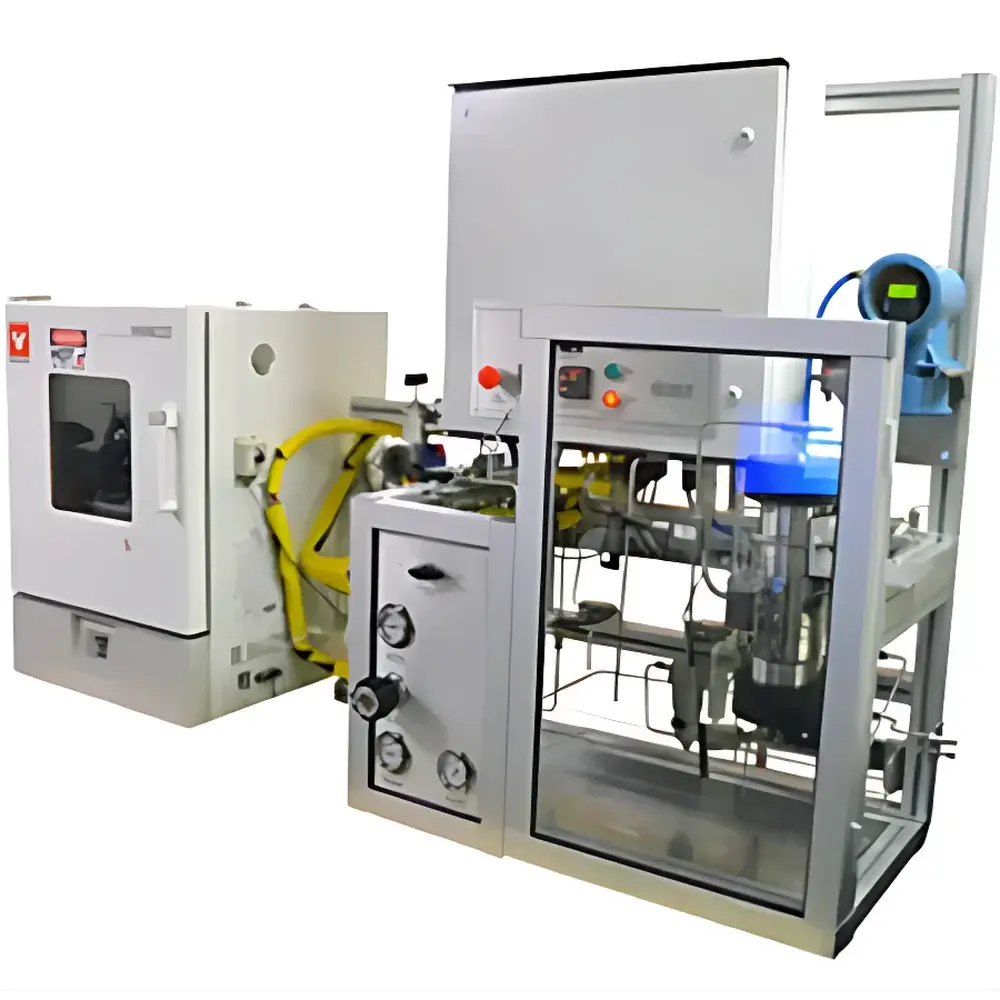
Grace M9200 High-Temperature High-Pressure Foam Rheometer
| Brand | Grace |
|---|---|
| Origin | USA |
| Manufacturer Status | Authorized Distributor |
| Origin Category | Imported |
| Model | M9200 |
| Quotation | Upon Request |
| Operating Temperature | Ambient to 177 °C |
| Maximum Working Pressure | 5000 psi |
| Shear Rate Range | 0–1500 s⁻¹ |
| Sample Volume | 115 mL |
| Intermediate Vessel Capacity | 500 mL, Rated to 6000 psi |
| Observation Chamber | Stereo Microscope with Sapphire Window |
| Foaming Gas Options | CO₂ or N₂ |
Overview
The Grace M9200 High-Temperature High-Pressure Foam Rheometer is an engineered solution for quantitative rheological characterization of foamed fluids under downhole reservoir conditions. Designed specifically for oilfield chemistry and stimulation fluid development, it implements controlled Couette flow geometry within a pressurized, thermally regulated annular gap to measure apparent viscosity, yield stress, and time-dependent structural evolution of gas-liquid dispersions. Unlike conventional rotational rheometers, the M9200 integrates real-time foam generation, in-situ optical observation, and simultaneous pressure–temperature–shear control—enabling direct correlation between foam microstructure (e.g., bubble size distribution, coalescence kinetics) and bulk rheological response. Its operational envelope—up to 177 °C and 5000 psi—covers the thermal and mechanical regime typical of deep carbonate and tight sandstone formations encountered during hydraulic fracturing and matrix acidizing operations.
Key Features
- Annular shear cell with precision-machined stainless-steel bob and cup, optimized for stable foam suspension and minimal wall slip under high shear.
- Integrated dual-gas manifold supporting programmable CO₂ or N₂ injection at precise mass flow rates, enabling reproducible foam quality (gas fraction) control from 40% to 95%.
- Sapphire-windowed observation chamber compatible with stereo microscopy (up to 100× magnification), permitting real-time monitoring of bubble nucleation, growth, and collapse dynamics during shear.
- Independent PID-controlled heating system with axial temperature uniformity ≤ ±1.5 °C across the active measurement zone.
- High-integrity pressure containment architecture: intermediate vessel rated to 6000 psi, full-system leak-tested to ASME B31.4 compliance standards.
- Modular torque transducer with resolution < 0.01 mN·m and dynamic range spanning 3 orders of magnitude, calibrated traceably to NIST standards.
Sample Compatibility & Compliance
The M9200 accommodates aqueous-based foaming systems containing surfactants (e.g., alpha-olefin sulfonates, betaines), polymers (e.g., HPAM, xanthan), nanoparticles, and acid blends (HCl, organic acids). It supports both static aging tests (foam half-life under constant P/T) and dynamic rheological sweeps (flow curves, oscillatory amplitude/frequency sweeps). All wetted components comply with NACE MR0175/ISO 15156 for sour service environments. The instrument’s pressure boundary design conforms to ASME Section VIII, Division 1, and its electrical safety architecture meets UL 61010-1 and IEC 61000-6-3 EMC requirements. Data acquisition protocols support audit-ready operation per GLP and GMP frameworks.
Software & Data Management
The proprietary FoamRheoControl™ software provides synchronized control of temperature, pressure, shear rate, gas injection, and image capture. It delivers native export of rheological datasets in ASTM D2196-compliant format, including power-law parameters (n′, k′), Herschel-Bulkley yield values, and time-resolved foam stability indices. All raw sensor data—including torque, angular velocity, chamber temperature, and back-pressure—are timestamped with microsecond resolution and stored with full metadata (operator ID, sample ID, calibration certificate references). Audit trails are enabled per FDA 21 CFR Part 11 requirements, featuring electronic signatures, user-level access controls, and immutable log files for regulatory submissions.
Applications
- Optimization of foam-based fracturing fluids for low-permeability reservoirs where water sensitivity or formation damage mitigation is critical.
- Screening of surfactant–polymer synergies under representative downhole P/T to predict foam resilience during shut-in and flowback.
- Quantitative validation of computational foam models (e.g., population balance equations, CFD–VOF coupling) using experimentally derived n′ and k′ inputs.
- Accelerated aging studies of foam stability in presence of clay swelling inhibitors or scale suppressants.
- Supporting API RP 13B-2 and ISO 10414-2 test method development for foam rheology in wellbore cleanout applications.
FAQ
What foam quality range can the M9200 reliably generate and characterize?
The system achieves repeatable foam qualities from 40% to 95% gas fraction via mass-flow-controlled CO₂ or N₂ injection, verified by inline void-fraction sensors and validated against gravimetric displacement methods.
Is the sapphire observation window compatible with high-resolution imaging techniques beyond stereo microscopy?
Yes—the window transmits >95% of visible and near-UV light (350–750 nm), supporting integration with high-speed cameras (≥1000 fps) and laser sheet illumination for PIV-based bubble tracking.
How is temperature gradient managed across the shear gap during high-temperature testing?
A dual-zone heater jacket with embedded thermocouples and adaptive thermal profiling ensures axial temperature deviation remains ≤ ±1.5 °C over the 35-mm active length of the measurement gap.
Can the M9200 be used for non-oilfield foams, such as food or pharmaceutical formulations?
While designed for downhole conditions, its modular gas delivery and optical access make it suitable for fundamental research on thermosensitive foams—provided compatibility with stainless-steel wetted parts and pressure-rated seals is confirmed for the specific formulation.
Does the system support automated cleaning-in-place (CIP) protocols between runs?
Yes—integrated solvent flush ports and programmable pressure-pulse sequences enable full-line cleaning with compatible solvents (e.g., isopropanol, deionized water), minimizing cross-contamination and reducing manual intervention.





