
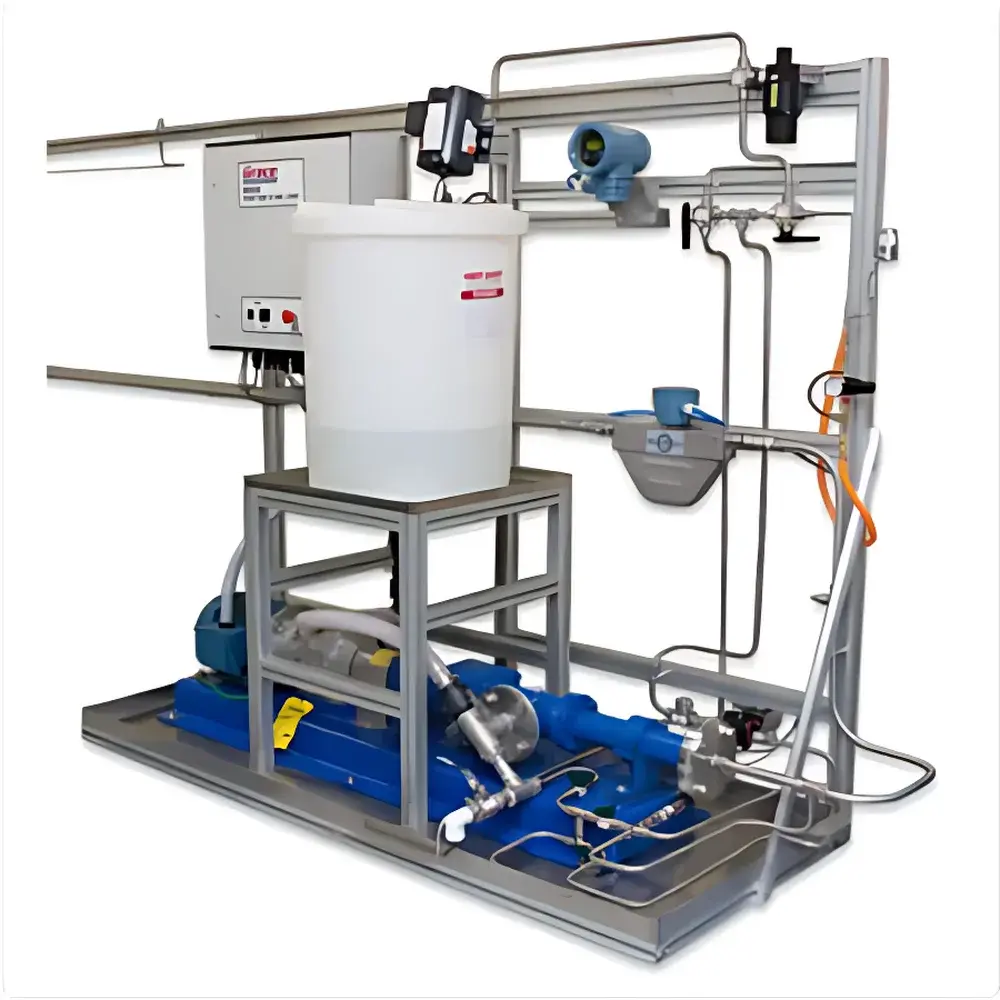
Grace M9250 / M9350 Fluid Friction Reduction Tester
| Brand | Grace |
|---|---|
| Origin | USA |
| Model | M9250 / M9350 |
| Pressure Range | 0–150 psi |
| Flow Rate | 2–15 gal/min |
| Fluid Temperature | 60–90 °F |
| Mixing Tank Capacity | 15–30 gal |
| Differential Pressure Accuracy | ±0.1% of Full Scale |
Overview
The Grace M9250 and M9350 Fluid Friction Reduction Testers are purpose-built laboratory-scale flow loop systems engineered for quantitative evaluation of drag-reducing agents (DRAs) used in oilfield applications—particularly in hydraulic fracturing, pipeline transportation, and enhanced oil recovery operations. These instruments operate on the principle of controlled turbulent flow through a calibrated straight-section pipe loop, enabling direct measurement of pressure differential across a defined test section under precisely regulated flow, temperature, and fluid composition conditions. By comparing baseline pressure drop (with base fluid only) against pressure drop with DRA additive at identical hydrodynamic conditions, users calculate drag reduction percentage with high reproducibility. The system’s modular architecture supports both standard (M9250) and compact-footprint (M9350) configurations, facilitating integration into QC laboratories, R&D facilities, and field-deployable testing units.
Key Features
- Stainless-steel flow loop with precision-machined, smooth-bore test section to minimize wall roughness effects and ensure laminar-to-turbulent transition consistency
- Integrated variable-speed centrifugal pump with closed-loop flow control, maintaining stable setpoints within ±0.2 gal/min across the full 2–15 gal/min operating range
- Dual high-stability pressure transducers (upstream and downstream) referenced to atmospheric or sealed gauge, delivering differential pressure resolution down to 0.01 psi with ±0.1% full-scale accuracy
- Recirculating thermal management system with PID-controlled heating/cooling jacket, sustaining fluid temperature within ±0.5 °F over the 60–90 °F operational window
- Modular mixing tank (15–30 gal capacity, stainless steel 316L construction) featuring top-mounted agitator with adjustable shear profile and baffles for homogeneous polymer dispersion
- Pre-wired I/O interface compliant with 4–20 mA and RS-485 Modbus RTU protocols, enabling seamless integration with external SCADA or LIMS platforms
Sample Compatibility & Compliance
The M9250/M9350 accommodates aqueous-based fracturing fluids—including linear gels, crosslinked guar, synthetic polymers (e.g., polyacrylamide, PAM), and microemulsion DRAs—as well as brine solutions up to 300,000 ppm TDS. All wetted components meet NACE MR0175/ISO 15156 requirements for sour service compatibility. System design adheres to ASME B31.4 (Liquid Transportation Systems) guidance for test loop integrity, and pressure containment complies with ASME BPVC Section VIII, Division 1. Data acquisition workflows support audit-ready documentation aligned with GLP and GMP principles; optional firmware upgrade enables 21 CFR Part 11–compliant electronic signatures and user-level access controls.
Software & Data Management
Grace FlowTest™ v3.2 software (included) provides real-time visualization of pressure, flow, temperature, and calculated drag reduction (%) across sequential test runs. Each experiment generates timestamped CSV and PDF reports containing raw sensor outputs, statistical summaries (mean, SD, CV%), and ISO/ASTM-compliant calculation templates per ASTM D3251 (Standard Test Method for Drag Reduction in Turbulent Flow). Data files are structured for direct import into third-party analysis tools (MATLAB, Python Pandas, JMP). Audit trails record all parameter changes, operator logins, calibration events, and report exports with immutable timestamps—fully traceable for regulatory review or internal QA audits.
Applications
- Screening and ranking of candidate DRAs under simulated field-relevant Reynolds numbers (Re = 10⁴–10⁵)
- Shear stability assessment via repeated high-flow cycling to quantify polymer degradation-induced loss of drag reduction
- Compatibility testing between DRAs and other additives (breakers, biocides, clay stabilizers) using sequential injection protocols
- Temperature-dependent performance mapping to optimize DRA selection for geothermal or deep-well applications
- Supporting API RP 13I and ISO 10421 viscosity correlation studies where frictional pressure loss serves as an indirect rheological proxy
- Calibration verification of full-scale field loop data using geometrically similar scaling laws (e.g., Moody chart alignment)
FAQ
What distinguishes the M9250 from the M9350 model?
The M9350 is a space-optimized variant with identical metrological specifications but reduced footprint (30% smaller), integrated pump skid, and simplified piping layout—designed for benchtop deployment or mobile lab trailers.
Can the system accommodate non-aqueous fluids such as diesel or mineral oil?
No. The M9250/M9350 is validated exclusively for water-based systems; hydrocarbon solvents require material compatibility requalification and are outside standard warranty coverage.
Is third-party calibration certification available?
Yes. Grace-certified calibration services include NIST-traceable pressure transducer verification and flow meter validation per ISO/IEC 17025 accredited procedures, with documented uncertainty budgets.
Does the system support automated multi-concentration DRA testing?
Yes. Using optional programmable dosing modules and FlowTest™ sequence scripting, users can execute unattended concentration gradients (e.g., 100–1000 ppm) with automatic data tagging and pass/fail threshold logic.
What maintenance intervals are recommended for long-term reliability?
Daily visual inspection of seals and tubing; quarterly recalibration of pressure sensors; annual bearing and seal replacement for the main circulation pump—detailed in the Maintenance Logbook included with each unit.





