
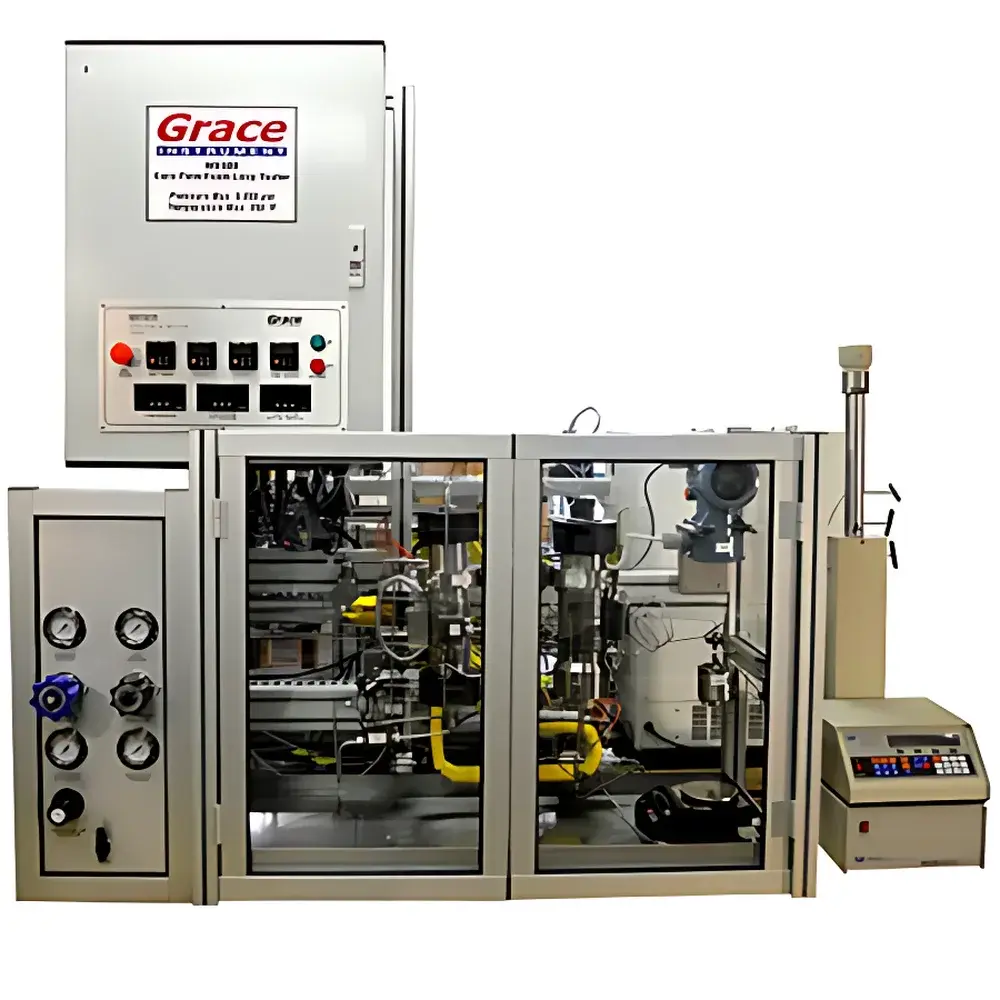
Grace M9300 Foam and Dynamic Core Evaluation System
| Brand | Grace |
|---|---|
| Origin | USA |
| Manufacturer Type | Authorized Distributor |
| Origin Category | Imported |
| Model | M9300 |
| Price | Upon Request |
| Temperature Range | 21–177 °C |
| Maximum Operating Pressure | 5000 psi |
| Maximum Confining Pressure | 5000 psi |
| Maximum Back Pressure | 10,000 psi |
| Shear Rate Range | 0–1500 s⁻¹ |
Overview
The Grace M9300 Foam and Dynamic Core Evaluation System is an integrated high-pressure, high-temperature (HPHT) laboratory platform engineered for quantitative assessment of formation damage mechanisms induced by complex fluid systems—including foams, fracturing fluids, drilling muds, completion fluids, and acidizing solutions—during dynamic core flooding experiments. It operates on the principle of controlled transient flow through consolidated or unconsolidated reservoir rock cores under geologically representative stress and thermal conditions. By simultaneously regulating confining pressure, pore pressure (via adjustable back pressure), and fluid injection rate, the system enables precise determination of absolute and effective permeability evolution in real time, capturing both reversible and irreversible damage phenomena such as fines migration, emulsion blockage, polymer adsorption, and surfactant-induced wettability alteration.
Key Features
- Modular dual-loop architecture: independent foam generation and circulation loop coupled with a fully instrumented core flooding manifold to ensure stable foam quality (gas fraction, bubble size distribution, half-life) prior to core entry.
- HPHT-rated core holder with axial load compensation, capable of maintaining uniform confining stress up to 5000 psi while accommodating standard 1.5″ or 2.5″ diameter cylindrical cores (length up to 6″).
- Programmable syringe pump and high-precision back-pressure regulator enabling accurate control of differential pressure across the core and stable flow rates from 0.001 to 10 mL/min.
- Integrated shear-controlled flow path upstream of the core, delivering defined shear rates from 0 to 1500 s⁻¹ to simulate near-wellbore rheological degradation of viscoelastic fluids.
- Real-time monitoring via calibrated differential pressure transducers, temperature sensors (±0.5 °C accuracy), and optional inline conductivity/refractometry modules for effluent composition tracking.
- Stainless steel 316 construction throughout wetted components; ASME BPVC Section VIII Div. 1 compliant pressure containment design.
Sample Compatibility & Compliance
The M9300 accommodates a broad range of reservoir lithologies—including sandstone, carbonate, shale, and synthetic proppant packs—as well as unconventional core samples requiring low-permeability measurement protocols. It supports evaluation of both aqueous and non-aqueous foams stabilized by C12–C18 surfactants, CO₂/N₂-based gas phases, and polymer-thickened base fluids. All operational procedures align with industry-standard test methodologies including API RP 42, ASTM D6988 (for permeability measurement), and ISO 17025-accredited laboratory practice guidelines. The system’s pressure and temperature control subsystems are traceable to NIST standards, and documentation packages support GLP-compliant data integrity requirements per FDA 21 CFR Part 11 when paired with validated software configurations.
Software & Data Management
The system is operated via Grace CoreFlo™ Control Suite—a Windows-based application providing synchronized control of pumps, pressure regulators, heaters, and data acquisition channels at 10 Hz sampling resolution. The software features automated test sequencing (e.g., baseline permeability → preflush → treatment injection → post-flush recovery), customizable PID tuning for pressure stability, and built-in calculation modules for Klinkenberg-corrected gas permeability, skin factor estimation, and residual resistance factor (RRF) derivation. Raw data exports comply with ASTM E1447 and ISO/IEC 17025 reporting formats (CSV, XML, PDF). Audit trails, electronic signatures, and role-based user access control are available in GxP-enabled deployment mode.
Applications
- Quantifying foam stability and propagation efficiency in low-permeability reservoirs under reservoir temperature and stress conditions.
- Evaluating formation damage potential of novel low-viscosity fracturing fluids and nano-enhanced acid systems.
- Assessing cleanup efficiency and regained permeability following matrix acidizing treatments.
- Validating compatibility between drilling/completion fluids and reactive clay-rich formations.
- Generating input parameters for reservoir simulators—particularly relative permeability endpoints, capillary number dependencies, and dynamic saturation functions.
- Supporting regulatory submissions for chemical formulation registration (e.g., EPA Subpart U, OSPAR Annexes).
FAQ
What core dimensions are supported by the M9300 system?
Standard configurations accept 1.5″ diameter × 1–6″ length and 2.5″ diameter × 1–4″ length cores; custom holders for irregular geometries or preserved whole-core sections are available upon request.
Can the system perform simultaneous gas and liquid phase injection?
Yes—the dual-loop design permits independent metering of gas (via mass flow controller) and liquid (via precision syringe pump), enabling true co-injection for foam generation directly upstream of the core inlet.
Is the M9300 suitable for CO₂-based EOR screening studies?
Absolutely—the system maintains full functionality at temperatures up to 177 °C and back pressures exceeding CO₂ critical point (1071 psi at 31.1 °C); it has been deployed in multiple tertiary recovery feasibility assessments involving miscible and near-miscible CO₂ floods.
Does Grace provide method validation support for regulatory submissions?
Yes—Grace offers application engineering services including SOP development, ICH Q2(R2)-aligned method verification, and technical documentation packages aligned with OECD TG 121 and USP <1058> analytical instrument qualification frameworks.





