
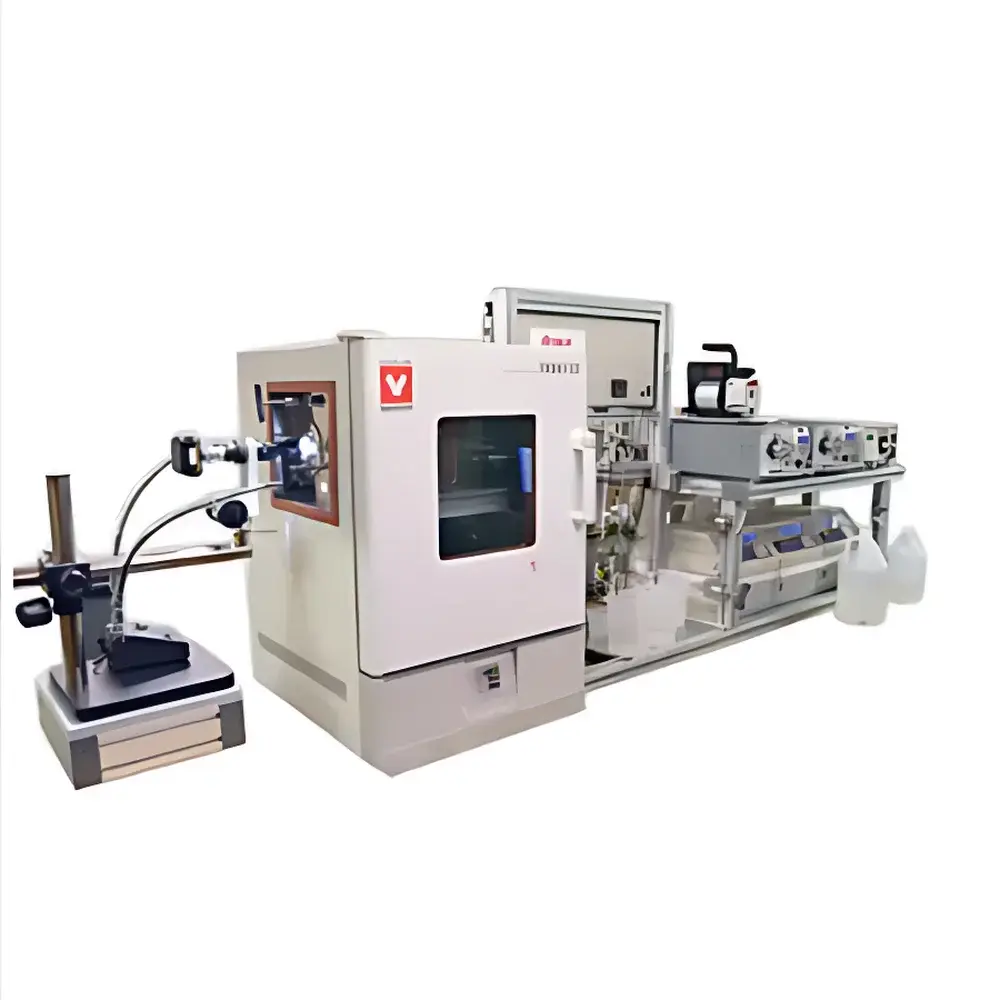
Grace M9720 Microscale Reservoir Fluid Phase Behavior and Displacement Visualization System
| Brand | Grace |
|---|---|
| Origin | USA |
| Manufacturer Status | Authorized Distributor |
| Origin Category | Imported |
| Model | M9720 |
| Pricing | Available Upon Request |
| Max Temperature | 150 °C |
| Max Pressure | 20,000 psi |
| Construction Material | Hastelloy® C-276 |
| Particle Detection Limit | ≤5 µm |
| Pressure Accuracy | ±0.1% of Full Scale |
| Temperature Accuracy | ±0.2 °C |
Overview
The Grace M9720 Microscale Reservoir Fluid Phase Behavior and Displacement Visualization System is an engineered experimental platform designed for high-fidelity observation and quantitative analysis of multiphase fluid behavior under representative reservoir conditions. It operates on the principle of real-time optical visualization coupled with precision-controlled thermobaric environments—enabling direct imaging of phase transitions (e.g., vapor–liquid equilibria, asphaltene precipitation, hydrate formation), interfacial dynamics, and pore-scale displacement mechanisms in transparent micromodels. The system integrates a high-resolution industrial camera (capable of sub-5 µm spatial resolution) with a robust Hastelloy® C-276 pressure vessel rated to 20,000 psi and 150 °C, ensuring mechanical integrity and chemical resistance during prolonged exposure to aggressive hydrocarbon–brine–gas mixtures. Unlike conventional PVT cells or bulk-phase analyzers, the M9720 provides spatially resolved, time-resolved data at the pore network level—supporting mechanistic validation of compositional simulation models and enhanced oil recovery (EOR) screening.
Key Features
- High-strength Hastelloy® C-276 pressure cell with full ASME Section VIII Div. 1 compliance and certified pressure boundary design for safe operation up to 20,000 psi.
- Thermally stable heating/cooling system with PID-controlled temperature regulation; accuracy maintained within ±0.2 °C across the full 20–150 °C operating range.
- Optical access via fused silica viewports (AR-coated, 30 mm clear aperture) optimized for visible and near-IR imaging; minimal birefringence and thermal drift.
- Integrated high-speed, monochrome CMOS camera (≥5 MP resolution, 12-bit dynamic range) with synchronized LED illumination and adjustable frame rates (1–100 fps) for capturing transient phase boundaries and capillary fingering.
- Real-time pressure monitoring using dual redundant piezoresistive transducers calibrated traceably to NIST standards; combined uncertainty ≤±0.1% FS including thermal effects.
- Modular fluid injection manifold supporting sequential or simultaneous introduction of up to four independent fluid streams with syringe pump control (flow accuracy ±0.5% FS).
Sample Compatibility & Compliance
The M9720 accommodates standard 5 cm × 5 cm silicon-based or glass etched micromodels with pore geometries ranging from 10 µm to 500 µm hydraulic diameter. Compatible fluid systems include live oils, CO₂–hydrocarbon mixtures, polymer–surfactant solutions, low-salinity brines, and gas condensates. All wetted components conform to NACE MR0175/ISO 15156 for sour service applications. The system supports ASTM D7169 (high-temperature, high-pressure distillation), ISO 12213-2 (gas compressibility), and industry-standard EOR coreflood protocol adaptations. Data acquisition and storage comply with ALCOA+ principles; audit trails, user authentication, and electronic signatures align with FDA 21 CFR Part 11 requirements when deployed in GLP/GMP-regulated laboratories.
Software & Data Management
Acquisition and analysis are managed through Grace’s proprietary VisuPhase™ software suite (v4.2+), which provides synchronized logging of pressure, temperature, flow rate, and image metadata. Image processing modules include automated edge detection for interface tracking, grayscale thresholding for saturation mapping, and particle image velocimetry (PIV) for local velocity field reconstruction. Export formats include TIFF (lossless), CSV (time-series parameters), and HDF5 (multi-dimensional structured datasets). Raw data is stored in immutable folders with SHA-256 checksums; version-controlled analysis scripts (Python API available) ensure method reproducibility across teams and regulatory submissions.
Applications
- Quantifying relative permeability hysteresis and capillary number effects in water-alternating-gas (WAG) processes.
- Validating equation-of-state (EOS) predictions for retrograde condensation and asphaltene onset pressure.
- Evaluating nanoparticle-stabilized emulsion stability under reservoir stress conditions.
- Imaging CO₂–brine–rock interactions relevant to carbon storage site selection and plume migration modeling.
- Screening surfactant formulations for ultra-low interfacial tension (IFT) and microemulsion phase behavior.
- Supporting digital rock physics workflows by generating ground-truth pore-scale boundary conditions for LBM and pore-network simulations.
FAQ
What micromodel thicknesses are supported by the M9720 cell?
Standard configurations accept 1.0 mm and 2.5 mm thick micromodels; custom spacers enable variable gap heights from 0.5–5.0 mm.
Can the system be integrated with external GC or Raman spectrometers?
Yes—optical and fluidic feedthroughs support fiber-optic coupling and auxiliary sampling lines; Grace provides mechanical mounting templates and synchronization I/O (TTL/RS-485).
Is remote operation and monitoring supported?
VisuPhase™ includes secure HTTPS-based web interface (TLS 1.2+) for real-time video streaming, parameter trending, and alarm notifications—fully compatible with corporate IT security policies.
Does the system meet explosion-proof certification requirements for offshore lab use?
The base unit is rated Class I, Division 2, Group B/C/D per NEC 500; ATEX Zone 2/22 certification is available as an optional configuration with intrinsically safe instrumentation.
What calibration documentation is provided with delivery?
NIST-traceable calibration certificates for pressure transducers and RTD sensors, plus as-built dimensional reports and viewport transmission spectra, are included in the final commissioning package.
Related Products




