
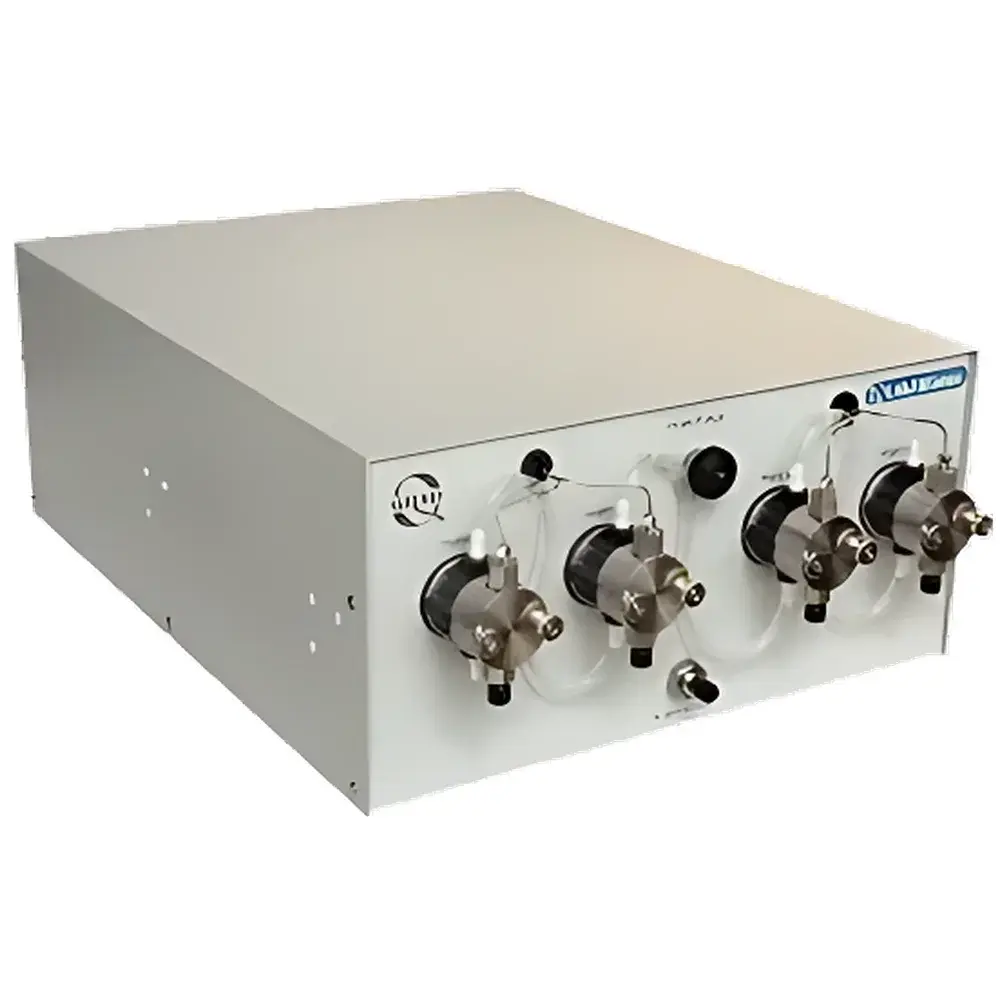
Q-Grad High-Pressure Quaternary Gradient Pump by LABA
| Brand | LABA (Tianjin Lanbo) |
|---|---|
| Origin | USA |
| Model | Q-Grad |
| Pump Type | Quaternary High-Pressure Gradient Pump |
| Flow Range | 1 µL/min – 20 mL/min |
| Gradient Composition | Up to 4 Solvents, Independently Controlled |
| Mixing Architecture | High-Pressure Binary/Quaternary Blending (No Low-Pressure Mixer or Online Degasser Required) |
| Dead Volume | Minimized via Integrated Direct High-Pressure Mixing |
| Bubble-Free Operation | Achieved through Positive-Displacement Plunger Design and Solvent Compressibility Compensation |
Overview
The Q-Grad High-Pressure Quaternary Gradient Pump is an engineered solution for precision liquid delivery in high-performance liquid chromatography (HPLC), ultra-high-performance liquid chromatography (UHPLC), and preparative-scale separations. Unlike conventional low-pressure quaternary systems that rely on proportioning valves and external degassers, the Q-Grad employs a true high-pressure gradient architecture—integrating four independently controlled, micro-stepper-driven dual-piston reciprocating pumps operating in parallel. Each pump delivers solvent at pressures up to 600 bar (8700 psi), enabling real-time, dynamic blending upstream of the injector. This design eliminates the need for post-mix degassing, reduces dwell volume to < 100 µL (typical), and ensures exceptional gradient fidelity across flow rates from 1 µL/min to 20 mL/min. The system’s pressure-balanced plunger seals and active solvent compressibility compensation algorithms deliver stable flow with ≤ 0.07% RSD (measured per ISO 13808:2017), making it suitable for method transfer between analytical and semi-preparative workflows.
Key Features
- Four independent high-pressure pumping channels, each with dual-piston geometry and ceramic-coated plungers for chemical inertness and extended service life
- No external degasser required: integrated solvent saturation control and pulse-dampening technology suppresses cavitation and bubble nucleation
- Zero dead-volume mixing: gradient formation occurs directly at the pump head junction, eliminating mixer cartridges and associated dispersion effects
- Programmable gradient profiles with ≤ 0.1% composition accuracy (v/v) over 0–100% range, verified per ASTM D7597-21 Annex A2
- Full compatibility with both isocratic and multi-step gradient methods, including shallow gradients (< 0.1% B/min) and rapid polarity transitions
- RS-232, USB, and optional Ethernet interfaces support seamless integration into LIMS and chromatography data systems (CDS)
Sample Compatibility & Compliance
The Q-Grad supports a broad range of HPLC-compatible solvents—including aqueous buffers, acetonitrile, methanol, THF, and chlorinated organics—without requiring solvent-specific hardware modifications. All fluidic pathways are constructed from PEEK, sapphire, and 316L stainless steel, ensuring resistance to pH 1–12 and common corrosive additives (e.g., TFA, HFBA, ammonium acetate). The pump meets electromagnetic compatibility requirements per IEC 61326-1:2022 and carries CE marking for use in EU-based GLP laboratories. It is validated for 21 CFR Part 11 compliance when operated with audit-trail-enabled CDS software, supporting electronic signatures, user access controls, and immutable event logging for regulated environments (e.g., pharmaceutical QC, contract research organizations).
Software & Data Management
The Q-Grad operates under LABA’s ChromoControl™ firmware v3.2+, which provides real-time pressure monitoring, automatic leak detection, and adaptive flow calibration using built-in gravimetric verification routines. Method files store complete pump parameters—including solvent viscosity compensation tables, plunger wear offsets, and pressure-dependent compressibility curves—for reproducible instrument reconfiguration. Raw pressure and flow telemetry data are streamed at 10 Hz resolution and exported in CSV or vendor-neutral ANDI format. Firmware updates are delivered via signed OTA packages, preserving cryptographic integrity and traceability in accordance with ISO/IEC 17025:2017 clause 5.9.2.
Applications
- Method development for reversed-phase, HILIC, and ion-pairing chromatography where gradient delay and composition drift impact peak symmetry and retention time stability
- Semi-preparative purification (1–10 mg injections) requiring consistent flow and composition at 5–20 mL/min without column backpressure fluctuations
- LC-MS coupling with electrospray ionization (ESI), where low dwell volume minimizes gradient delay-induced signal suppression artifacts
- Stability-indicating assays per ICH Q5C, where precise low-flow gradients (< 5 µL/min) enable high-resolution separation of degradation products
- Multi-dimensional LC (LC×LC) heart-cutting workflows demanding sub-second gradient reproducibility and minimal carryover
FAQ
Is the Q-Grad compatible with existing HPLC systems from Agilent, Waters, or Shimadzu?
Yes—the pump features universal 1/4″-28 UNF and M6 threaded fittings and outputs standard 0–5 V analog signals for pressure and flow synchronization; digital integration is supported via ASCII command protocol compliant with ANSI/AAMI EC53.
Does it require routine maintenance beyond seal replacement?
Plunger seals are rated for ≥ 5,000 hours under typical aqueous/organic conditions; no valve servicing or check-valve cleaning is required due to the absence of low-pressure proportioning valves.
Can it be used for GPC/SEC applications?
Yes—its low pulsatility (< 0.5% peak-to-peak) and linear flow response across 1–10 mL/min make it suitable for size-exclusion chromatography with refractive index or light-scattering detection.
How is gradient accuracy validated during IQ/OQ/PQ?
LABA provides a NIST-traceable validation kit including certified dye standards, gravimetric flow test vessels, and SOPs aligned with USP , EP 2.2.46, and ASTM E2655-20.





