
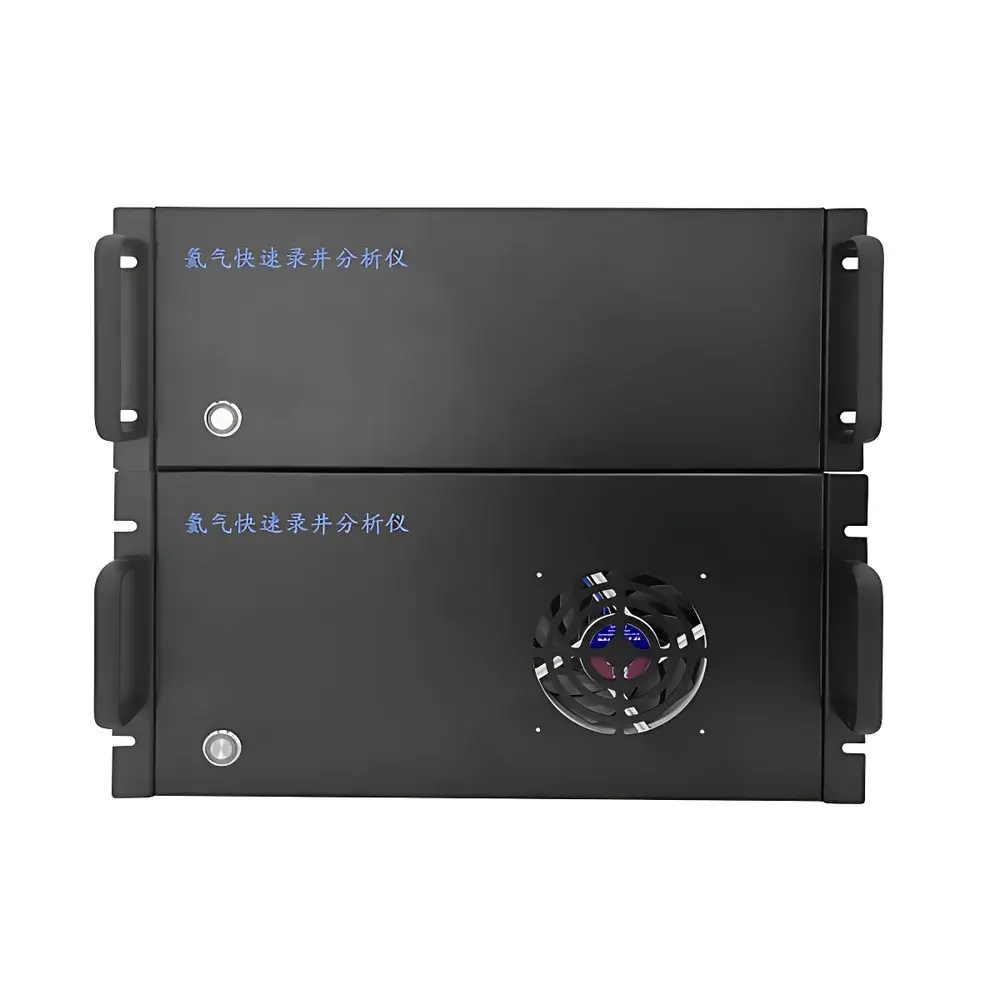
Grand Helium-Specific High-Precision Inorganic Mass Spectrometer
| Brand | Grand |
|---|---|
| Origin | Jiangsu, China |
| Manufacturer Type | OEM Manufacturer |
| Regional Classification | Domestic (China) |
| Model | Helium-Specific MS |
| Pricing | Available Upon Request |
Overview
The Grand Helium-Specific High-Precision Inorganic Mass Spectrometer is a purpose-built analytical instrument engineered for real-time, quantitative detection of helium (⁴He) in complex gas matrices—particularly in petroleum exploration and geoscience applications. Unlike general-purpose quadrupole mass spectrometers, this system is optimized for the low mass-to-charge (m/z = 4) region, where helium ionization and transmission efficiency are critically sensitive to residual background gases (e.g., H₂⁺, CH₄⁺ fragments, and Hz-related interferences). It employs a high-vacuum stainless steel (316 SS) chamber with ultra-low outgassing characteristics and proprietary flange sealing architecture to maintain base pressures below 5 × 10⁻⁸ mbar—essential for minimizing spectral overlap and ensuring sub-part-per-trillion (ppt) detection limits in continuous flow mode.
Key Features
- High-vacuum 316 stainless steel ion source and analyzer chamber, designed for long-term stability under field-deployable conditions
- Quadrupole mass filter specifically tuned for m/z = 4 with enhanced low-mass transmission efficiency and reduced Hz-induced signal suppression
- Integrated electron impact (EI) ion source with adjustable emission current and filament redundancy for extended operational uptime
- Real-time data acquisition synchronized with drilling parameters (ROP, depth, mud gas flow rate) via industry-standard Modbus TCP and RS-485 interfaces
- Onboard vacuum integrity monitoring with pressure logging and automatic bake-out protocol initiation alerts
- Ruggedized chassis rated for Class I, Division 2 hazardous area operation (ATEX/IECEx-compliant enclosure options available)
Sample Compatibility & Compliance
This instrument accepts direct gas stream input from standard mud-gas logging (MGL) systems, including heated transfer lines and hydrocarbon scrubbers. It is compatible with both continuous-flow and discrete sample introduction modes, supporting helium quantification in methane-rich, CO₂-diluted, or nitrogen-balanced gas streams typical of onshore and offshore drilling environments. The system meets ISO/IEC 17025 requirements for calibration traceability and supports GLP-compliant audit trails. Data output conforms to WITSML 2.1 schema for seamless integration into real-time geological evaluation platforms. All firmware and data handling modules are designed to comply with FDA 21 CFR Part 11 requirements for electronic records and signatures when deployed in regulated QA/QC workflows.
Software & Data Management
The proprietary GrandHelium™ acquisition and interpretation software provides real-time spectral visualization, automated baseline correction, and dynamic interference compensation algorithms calibrated against certified helium-in-nitrogen reference standards (NIST-traceable, 10–1000 ppm range). Raw mass spectra, integrated peak areas, and depth-normalized helium concentration profiles (ppm He vs. TVD) are stored in HDF5 format with embedded metadata (timestamp, sensor status, vacuum history). Export options include CSV, LAS 2.0, and SEG-Y-compatible gridded datasets for reservoir modeling. Remote diagnostics, firmware updates, and method validation reports are accessible via secure HTTPS portal with role-based access control (RBAC).
Applications
- Real-time helium profiling during wireline and LWD/MWD operations for identification of helium-bearing reservoirs and fault-seal integrity assessment
- Quantitative correlation of subsurface helium anomalies with radiogenic crustal sources (U/Th decay chains) and mantle-derived fluxes in basin-scale geochemical studies
- Discrimination between thermogenic and abiogenic hydrocarbon systems using He/CH₄ and ³He/⁴He ratios derived from sequential isotopic analysis (when configured with multi-collector option)
- Monitoring helium breakthrough during CO₂-EOR and geological carbon storage pilot projects
- Field validation of helium resource potential in unconventional plays (e.g., tight sandstones, shale gas systems) prior to dedicated helium extraction infrastructure deployment
FAQ
What is the typical detection limit for helium under standard mud-gas logging conditions?
The instrument achieves a lower limit of quantitation (LLOQ) of 50 ppq (parts per quadrillion) for helium in a 10 mL/min N₂ carrier stream at 1 s dwell time, verified per ASTM D7217-22 Annex A2.
Can the system be integrated with existing MWD/LWD telemetry networks?
Yes—it supports bidirectional communication via API RP 67-compliant protocols and can inject helium concentration values directly into downhole tool string data buffers for surface transmission.
Is routine calibration required between wells?
A full calibration is recommended before each well entry; however, the system includes an internal reference gas injection port for daily drift correction without interrupting acquisition.
Does the analyzer require liquid nitrogen or cryogenic cooling?
No—this is a room-temperature-operated quadrupole system utilizing active thermal stabilization of the RF rods and detector assembly.
How is vacuum integrity maintained during transport and rig-up?
The chamber features a sealed all-metal gate valve and auto-purge sequence that isolates the analyzer volume during movement; re-evacuation to operating pressure takes ≤25 minutes post-rig-up.





