
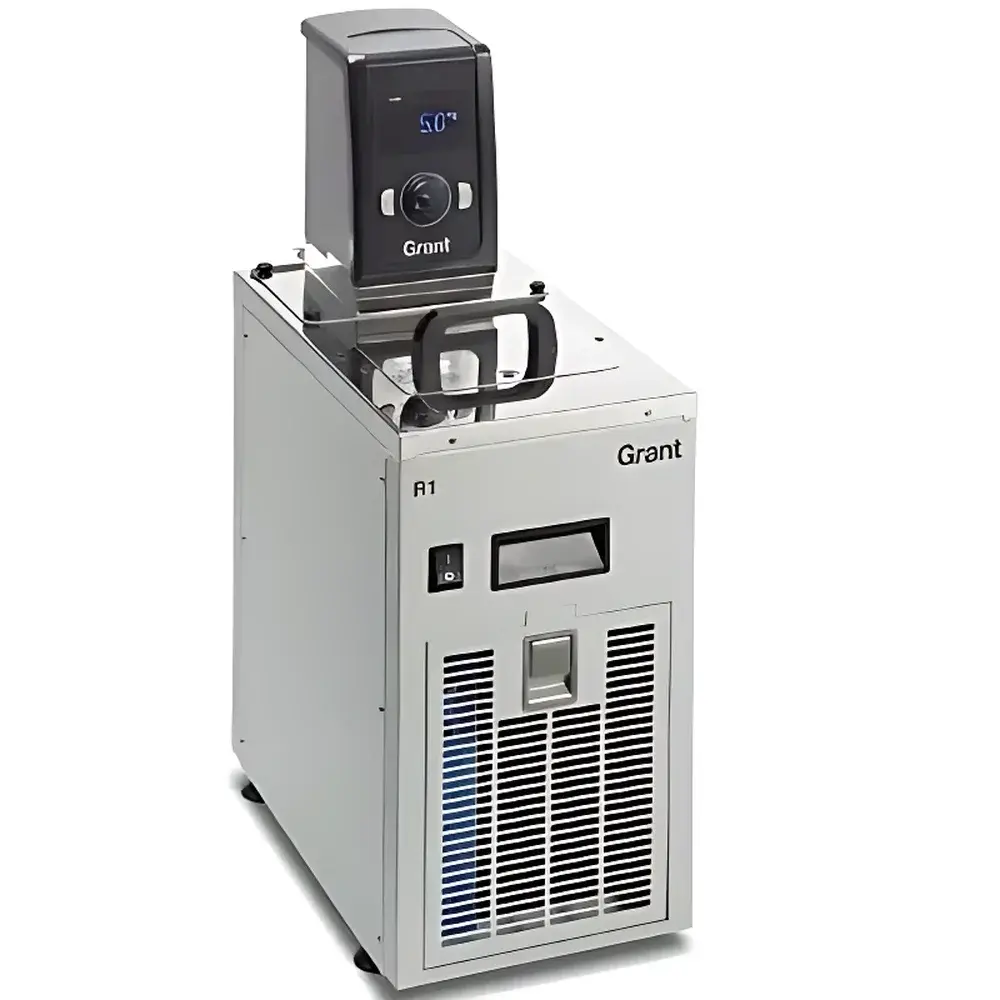
Grant Optima™ T100 R Series Refrigerated Circulating Bath
| Brand | Grant Instruments |
|---|---|
| Origin | United Kingdom |
| Model | T100 R |
| Temperature Range | 0 to 100 °C |
| Stability | ±0.1 °C (DIN 12876, water @ 10 °C) |
| Refrigerant | R134a |
| Control | Adaptive Smart PID with Intelligent Control Optimization (ICO™) |
| Display | 4-digit LED |
| Communication | USB & RS232 (TX150/TXF200 models) |
| Pump Flow Rate | Up to 23 L/min (adjustable) |
| Max Pressure | 530 mbar |
| Safety Features | Adjustable overtemperature cut-off, low-level float switch, anti-freeze protection, 100 °C hardware limit |
Overview
The Grant Optima™ T100 R Series is a family of precision-engineered refrigerated circulating baths designed for laboratory applications requiring stable, bidirectional temperature control from 0 °C to 100 °C. Unlike basic immersion heaters or passive chillers, the T100 R integrates a closed-loop circulation system with active refrigeration and high-fidelity digital temperature regulation—enabling accurate thermal management of external equipment such as spectrophotometer cells, reaction jackets, viscometers, and environmental test chambers. Its core architecture follows DIN 12876-1 compliance standards for laboratory thermostats, ensuring traceable stability (±0.1 °C in water at 10 °C) and spatial uniformity across the bath fluid volume. The system employs R134a refrigerant and adaptive PID control augmented by Grant’s proprietary Intelligent Control Optimization (ICO™) algorithm, which dynamically adjusts heating/cooling output based on load inertia, ambient drift, and fluid composition—including aqueous, ethylene glycol–water (50:50), or other low-freezing-point heat transfer media.
Key Features
- Intelligent Control Optimization (ICO™): Self-tuning PID algorithm that minimizes overshoot and accelerates thermal equilibration under variable load conditions.
- Dual-mode operation: Independent on/off control of refrigeration unit and heater—enabling energy-efficient operation when only heating or only cooling is required.
- User-accessible two-point calibration: Allows field verification and adjustment using certified reference probes, supporting ISO/IEC 17025-compliant lab practices.
- Three programmable preset temperatures: Facilitates rapid reconfiguration between common experimental setpoints without manual re-entry.
- Acoustic alert system: Configurable audible alarm for deviation from setpoint, high/low temperature thresholds, or low-fluid condition.
- Robust safety architecture: Includes fixed 100 °C hardware cutoff, adjustable overtemperature relay, float-switch–activated low-level shutdown, and anti-freeze logic preventing ice formation during sub-zero operation.
- Modular pump integration: Built-in circulation pump with flow rates up to 23 L/min (R4/R5 models) and pressure capacity up to 530 mbar—compatible with standard 6/11 mm inlet/outlet tubing.
Sample Compatibility & Compliance
The T100 R series accommodates a broad range of external devices via its recirculating fluid path. It supports thermal conditioning of glassware, jacketed reactors, analytical instrument cooling blocks, and material testing fixtures—provided fluid compatibility is maintained (e.g., avoidance of chlorinated solvents with R134a systems). All models comply with EN 61000-6-3 (Class B electromagnetic emissions) and meet essential requirements of the EU Machinery Directive 2006/42/EC and Low Voltage Directive 2014/35/EU. Temperature stability and uniformity data are validated per DIN 12876-1 Annex A, enabling use in GLP environments where documented thermal performance is required. For regulated QC/QA workflows, optional Labwise™ software enables audit-trail–capable temperature logging aligned with FDA 21 CFR Part 11 principles (electronic signatures, change history, user access control).
Software & Data Management
Higher-tier models (TX150 and TXF200) support PC-based remote operation via USB or RS232 interfaces. Labwise™ software provides real-time monitoring, multi-step temperature ramping (up to 100 segments), automated data export (CSV, Excel), and configurable alarm triggers. Each logged temperature reading includes timestamp, setpoint, actual bath temperature, pump status, and error flags—facilitating retrospective analysis and regulatory documentation. The software interface supports dual-probe validation workflows using optional external probes (TXPEP, TXSEP), allowing correlation of bath temperature against process-relevant measurement points. All communication protocols are ASCII-based and fully scriptable, enabling integration into LIMS or custom automation frameworks.
Applications
- Calibration of temperature-sensitive sensors and transducers under controlled thermal gradients.
- Cooling of HPLC column ovens, CCD detectors, and laser sources requiring vibration-free, low-noise thermal regulation.
- Stabilization of enzymatic assays and cell culture incubation accessories where ±0.1 °C consistency directly impacts kinetic reproducibility.
- Thermal cycling support for polymer rheology tests, including melt flow index (MFI) and dynamic mechanical analysis (DMA) sample conditioning.
- Pre-conditioning of reference materials prior to DSC, TGA, or thermal conductivity measurements per ASTM E1545 or ISO 11357.
- Environmental stress screening of electronic components using programmable temperature ramps and dwell cycles.
FAQ
Can the T100 R operate continuously at –40 °C?
Yes—models R4 and R5 maintain stable operation down to –40 °C (R5 extends to –47 °C), provided ambient temperature remains ≤25 °C and adequate ventilation is ensured around the condenser.
Is external fluid compatibility documented for non-aqueous media?
Grant provides chemical resistance guidance for common heat transfer fluids (e.g., silicone oils, propylene glycol blends); however, long-term compatibility with halogenated or highly aromatic solvents must be verified independently per application.
Does the system support 21 CFR Part 11 compliance out-of-the-box?
Hardware-level security features (user authentication, audit log storage) require Labwise™ software configuration and administrative setup; full Part 11 implementation depends on site-specific validation protocols.
What maintenance intervals are recommended for the R134a refrigeration circuit?
No routine refrigerant servicing is required. Annual inspection of condenser fins, pump impeller integrity, and electrical connections is advised per Grant’s Maintenance Schedule OPT-T100-R-MS-2023.
Can multiple T100 R units be synchronized for parallel temperature zones?
While no native master–slave protocol exists, time-synchronized ramp profiles can be deployed across units via Labwise™ and shared network time (NTP), enabling coordinated multi-zone thermal control in larger experimental setups.



