
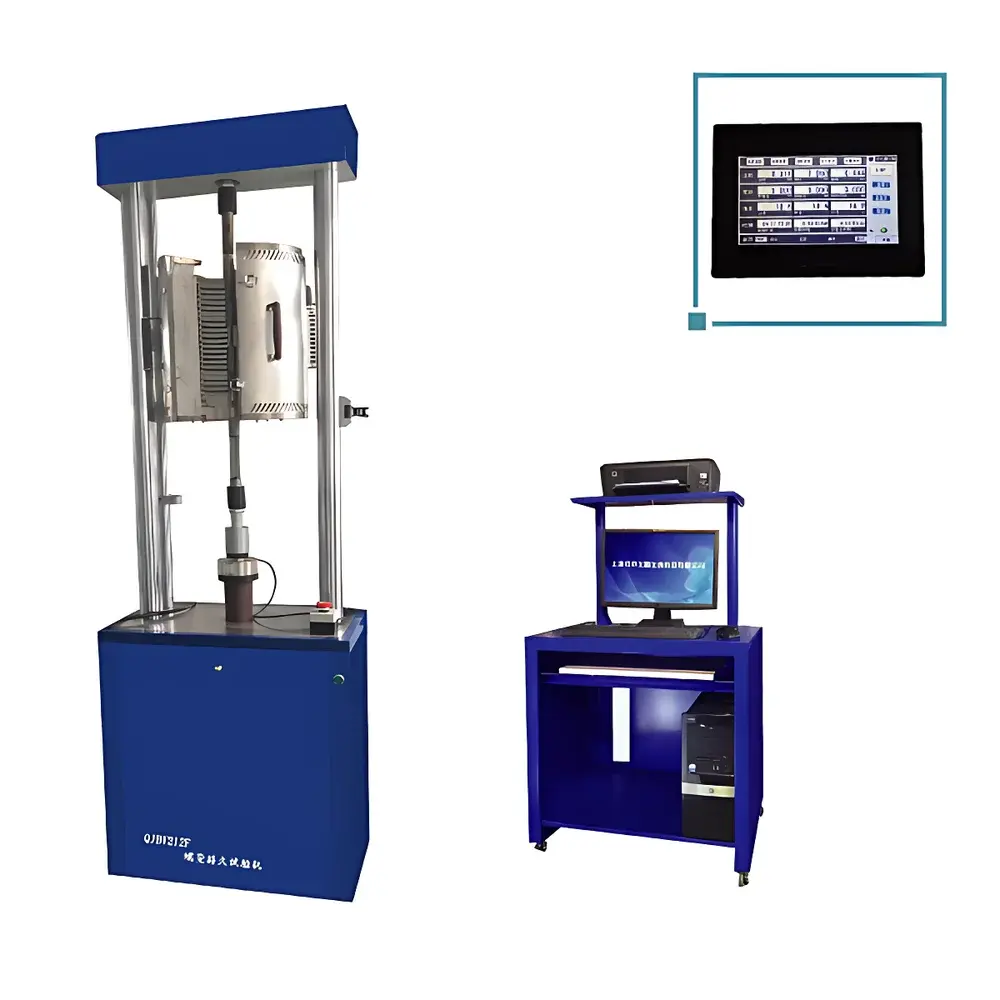
QJ Tech QJBV212F- High-Temperature Creep Tensile Testing Machine
| Brand | QJ Tech |
|---|---|
| Origin | Shanghai, China |
| Model | QJBV212F- |
| Max Test Load | 200 kN |
| Load Range | 1–200 kN (Full Scale) |
| Load Accuracy | ±0.5% FS |
| Stroke | 800 mm |
| Displacement Resolution | 0.001 mm |
Overview
The QJ Tech QJBV212F- High-Temperature Creep Tensile Testing Machine is a precision-engineered system designed for long-term mechanical characterization of metallic and advanced alloy materials under sustained uniaxial tensile loading at elevated temperatures. It operates on the fundamental principle of constant-load or constant-stress creep testing, where specimens are subjected to controlled static loads while maintained within a high-temperature furnace environment—typically ranging from ambient to 1200 °C (configurable per furnace option). The system complies with internationally recognized standards including ASTM E139, ISO 204, GB/T 2039–2012 (revised version of GB/T 2039–1997), HB 5151–1996, and JJG 276–2015 (successor to JJG 276–88), ensuring data integrity for certification, R&D validation, and regulatory submission in aerospace, power generation, and nuclear engineering applications.
Key Features
- Robust dual-column load frame with high-rigidity steel construction, engineered to minimize thermal drift and mechanical compliance during extended-duration tests (up to 10,000+ hours)
- Integrated high-temperature furnace with axial temperature uniformity ≤±3 °C over the gauge length, featuring multi-zone PID control and inert atmosphere capability (N₂ or Ar purge ports optional)
- High-resolution load measurement via calibrated 200 kN load cell with ±0.5% full-scale accuracy, traceable to national metrology institutes
- Precision displacement sensing with 0.001 mm resolution across an 800 mm stroke, enabling accurate strain rate quantification in primary, secondary, and tertiary creep regimes
- Modular controller architecture supporting both manual load application and automated ramp-hold profiles, with real-time load/strain/temperature synchronization
- Thermocouple integration (Type K or S) directly adjacent to specimen gauge section for localized temperature monitoring per ASTM E220 requirements
Sample Compatibility & Compliance
The QJBV212F- accommodates standard creep specimens per ASTM E139 (e.g., cylindrical rods, flat dog-bone geometries) with gauge lengths from 12.5 mm to 50 mm and diameters up to 12 mm. Specimen holders utilize water-cooled grips with ceramic insulation to prevent thermal conduction errors and ensure mechanical stability at interface temperatures exceeding 800 °C. All test procedures and calibration records adhere to GLP principles; audit trails, electronic signatures, and data immutability features align with FDA 21 CFR Part 11 requirements when paired with compliant software modules. System validation documentation supports IQ/OQ protocols for GMP-regulated environments.
Software & Data Management
The embedded control software provides synchronized acquisition of load, extension, and furnace thermocouple signals at configurable sampling rates (1–10 Hz). Raw data is stored in vendor-neutral ASCII (.csv) and hierarchical HDF5 formats, enabling direct import into MATLAB, Python (NumPy/Pandas), or commercial analysis tools such as OriginLab and Thermo Scientific™ Nicolet™ OMNIC. Automated reporting templates generate standardized creep curves (strain vs. time), minimum creep rate calculations, time-to-rupture summaries, and Larson-Miller parameter extractions. Optional network-enabled remote monitoring allows secure access via TLS-encrypted web interface for multi-site lab coordination.
Applications
- Creep rupture life prediction for turbine blade alloys (e.g., Inconel 718, GH4169) under simulated service conditions
- Stress rupture evaluation of pressure vessel steels per ASME BPVC Section II, Part D
- Development and qualification of next-generation Ni-based superalloys for ultra-supercritical coal-fired boilers
- Interpretation of dislocation climb kinetics and grain boundary sliding mechanisms via tertiary creep onset analysis
- Validation of constitutive models (e.g., Norton-Bailey, Garofalo equations) used in finite element simulation of high-temperature component deformation
- Supporting ISO 10993 biocompatibility assessments for implant-grade cobalt-chromium alloys under physiological thermal loads
FAQ
What temperature range is supported by the standard furnace configuration?
Standard configuration includes a split-tube muffle furnace rated to 1100 °C; optional high-temp furnaces extend to 1200 °C with tungsten heating elements and vacuum-compatible design.
Is the system compatible with third-party data acquisition hardware?
Yes—the system provides analog voltage outputs (±10 V) for load, displacement, and temperature channels, along with RS-485 and Ethernet TCP/IP interfaces for integration with LabVIEW, Beckhoff TwinCAT, or custom SCADA platforms.
How is thermal expansion of the load train compensated during testing?
The system incorporates real-time thermal drift correction using reference thermocouples mounted on the load cell housing and column structure, with compensation algorithms applied during post-processing per ISO 204 Annex B guidelines.
Can the machine perform stress relaxation tests in addition to creep?
Yes—via closed-loop displacement control mode, the system supports isothermal stress relaxation testing with programmable strain hold steps and automatic modulus decay calculation.
What calibration certificates are provided upon delivery?
Each unit ships with factory calibration reports for load cell (traceable to NIM, China), displacement encoder, and furnace temperature uniformity—valid for 12 months under normal operating conditions. On-site recalibration services are available globally through authorized QJ Tech technical partners.
Related Products



