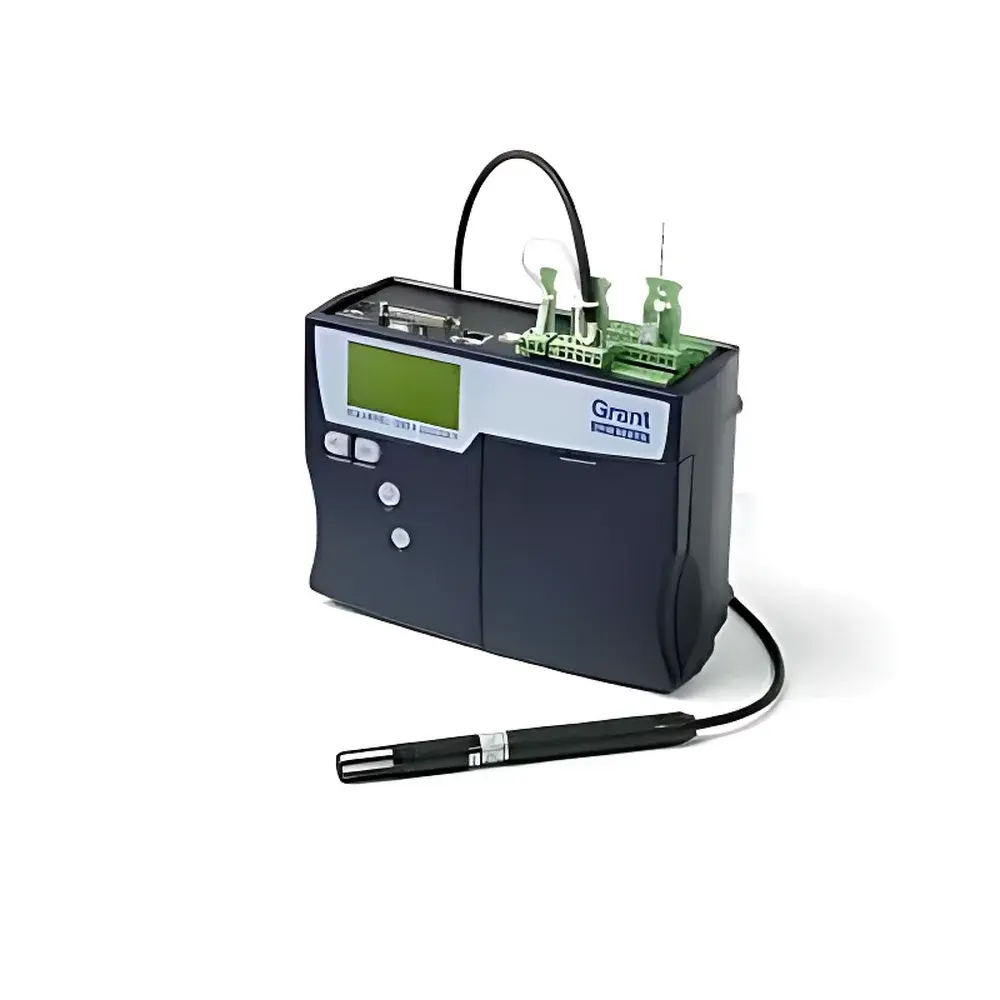
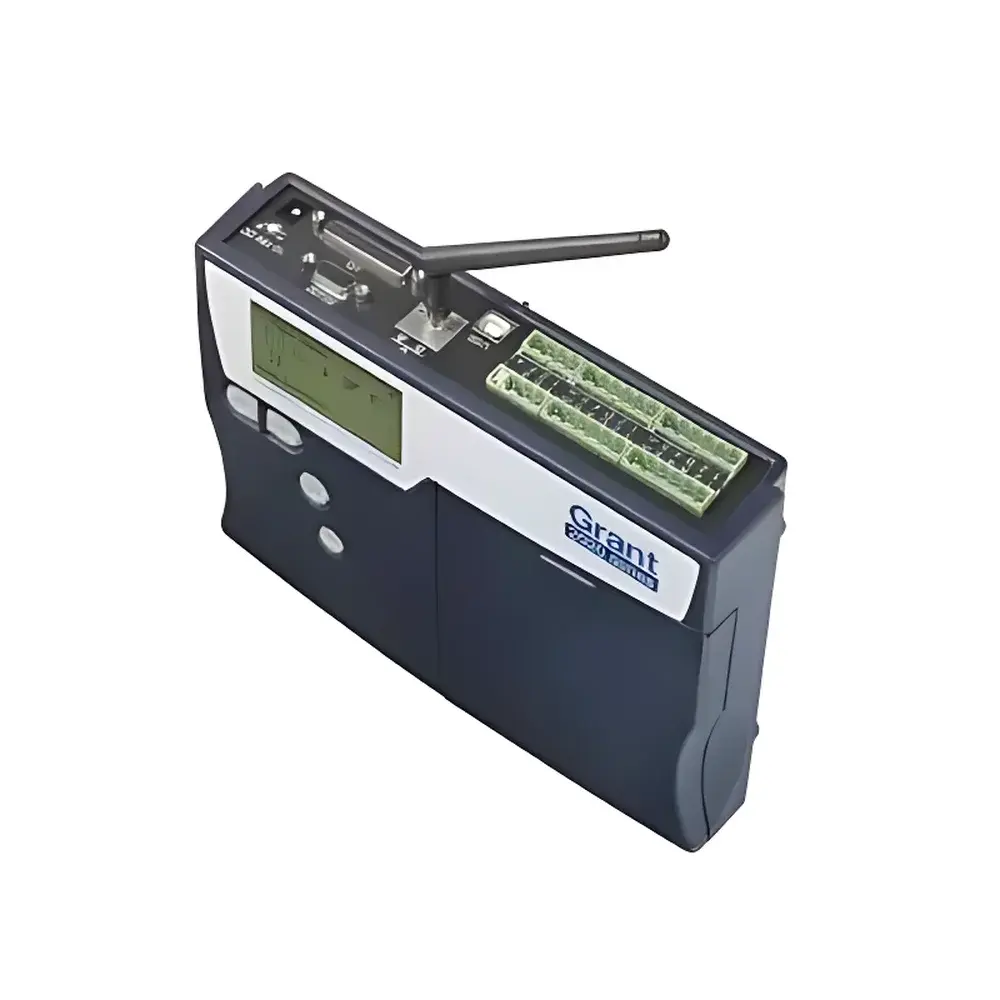
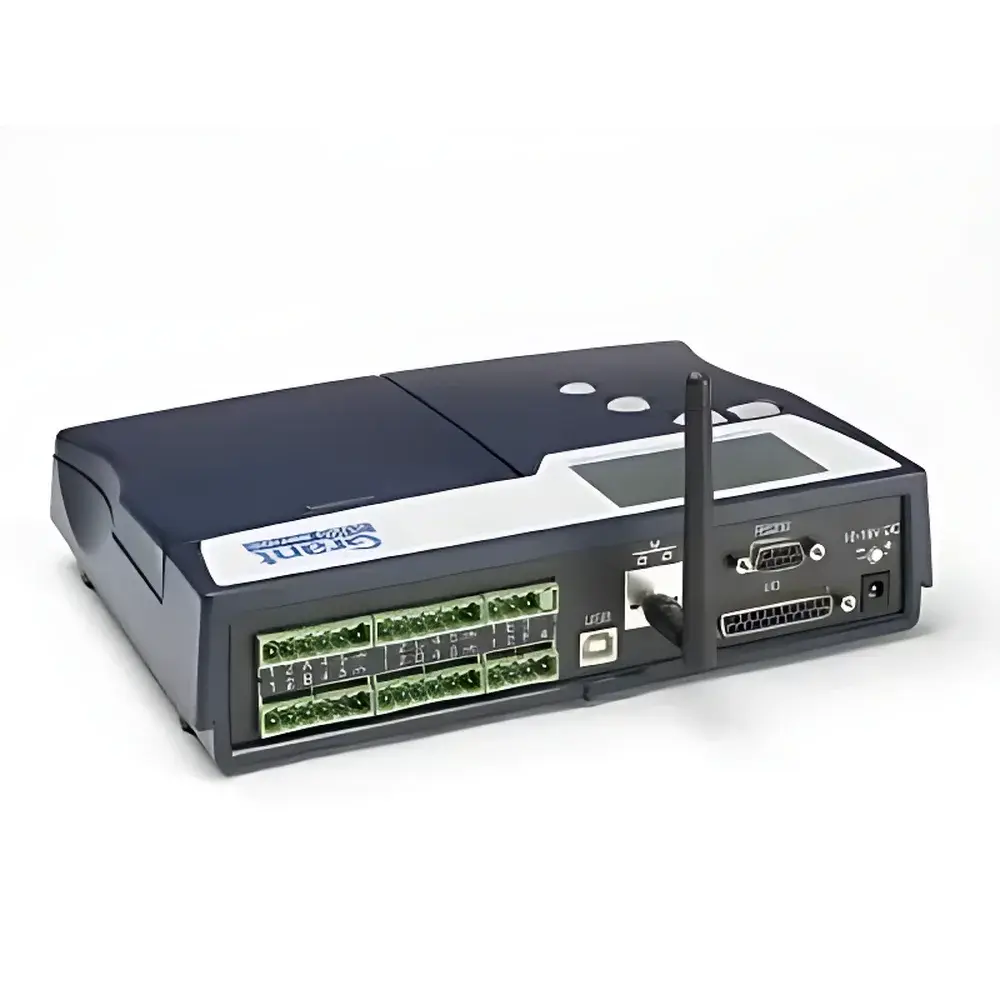
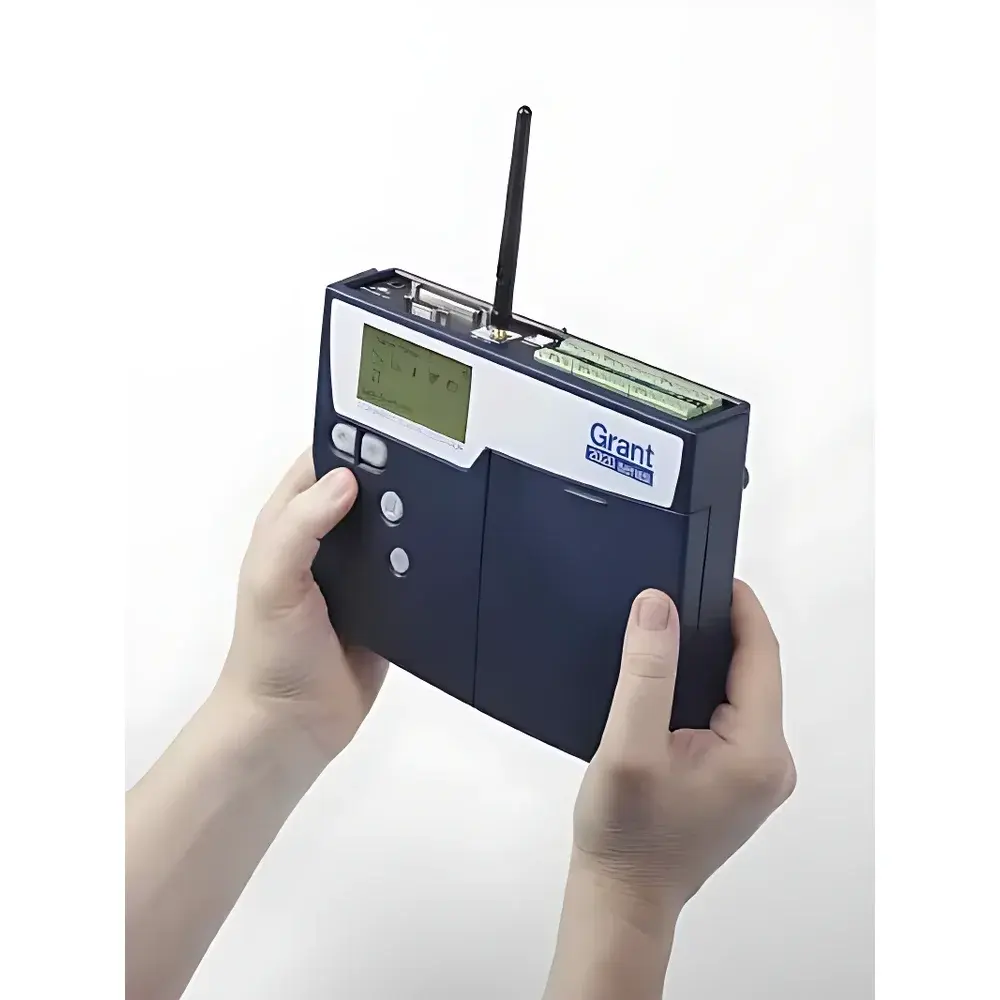
Grant Squirrel SQ2020 Wi-Fi Data Logger
| Brand | Grant |
|---|---|
| Origin | UK |
| Model | SQ2020 |
| Input Channels | 8 differential / 16 single-ended analog + 2 high-voltage + 4 pulse + 8 digital event/status |
| ADC Resolution | 24-bit sigma-delta |
| Sampling Rate | up to 100 Hz on 2 channels |
| Memory | 128 MB internal (up to 14 million readings) + MMC/SD card support (up to 1 GB) |
| Display | 128 × 64 dot-matrix LCD |
| Communication | IEEE 802.11b Wi-Fi (2.4 GHz, WEP/WPA/WPA2), USB 1.1/2.0, RS232 (auto-baud up to 115.2 kbps) |
| Power | 6 × AA alkaline batteries or 10–18 VDC external supply |
| Operating Environment | −30 to +65 °C, ≤95% RH non-condensing |
| Compliance | CE, RoHS, FCC Part 15 Class B |
Overview
The Grant Squirrel SQ2020 Wi-Fi Data Logger is a rugged, field-deployable data acquisition unit engineered for precision, flexibility, and seamless integration into distributed monitoring environments. Built upon a dual 24-bit sigma-delta analog-to-digital conversion architecture, the SQ2020 delivers high-resolution, low-noise measurement across mixed-signal inputs—including thermocouples, RTDs (Pt100/Pt1000, 2-/3-/4-wire), thermistors, voltage, current (with external shunt), resistance, high-voltage DC, pulse frequency, and digital state transitions. Its true synchronous sampling capability—enabled by independent ADCs per input group—ensures time-aligned acquisition across heterogeneous sensor types, critical for correlating dynamic physical parameters such as temperature-pressure transients or thermal-electrical response in validation protocols. Designed for unattended operation in industrial process control, environmental monitoring, laboratory QA/QC, and academic research, the SQ2020 operates reliably across −30 °C to +65 °C with robust EMC immunity and IP-rated enclosure integrity.
Key Features
- True simultaneous sampling across analog and digital channels using dedicated ADCs—no software interpolation or channel multiplexing artifacts
- Configurable input topology: 8 differential or 16 single-ended analog inputs; up to 4 × 3-/4-wire RTD sensors; 2 high-voltage inputs (4–60 V DC); 4 pulse inputs (2 × 64 kHz fast, 2 × 100 Hz slow); 8 digital event/status lines
- High-accuracy analog measurement: ±0.05% of reading + 0.025% of range (at 25 °C), 100 dB CMRR, 100 dB NMR at 50/60 Hz
- Onboard computing engine supporting up to 16 derived (virtual) channels with real-time mathematical functions: log(x), ln(x), sqrt(x), linearization, scaling, min/max/avg over user-defined intervals
- Integrated 128 × 64 graphical LCD with intuitive 4-button keypad—enables full configuration, live readout, alarm status review, and channel-by-channel calibration offset adjustment without PC dependency
- Dual storage architecture: 128 MB non-volatile internal memory (circular or stop-on-full mode) + hot-swappable MMC/SD card slot (up to 1 GB) for secure backup, firmware updates, and configuration transfer
- Four open-drain FET outputs (18 V, 0.1 A) programmable as alarm triggers, relay drivers, or sensor excitation sources
Sample Compatibility & Compliance
The SQ2020 supports direct connection to a broad spectrum of industrial and scientific sensors without external signal conditioning. Thermocouple types include K, J, T, E, R, S, B, N, C, and D—covering −200 °C to +2320 °C with cold-junction compensation accuracy of ±0.5 °C. For resistance-based sensing, it accommodates Pt100/Pt1000 RTDs per IEC 60751 (Class A/B), thermistors with user-defined Steinhart-Hart coefficients, and custom resistance ranges from 0 Ω to 300 kΩ (2-wire) or 0–4 kΩ (3-/4-wire). Voltage inputs span ±0.075 V to ±25 V; current measurement (4–20 mA) uses an integrated 10 Ω precision shunt. All analog inputs feature >1 MΩ input impedance and galvanic isolation between groups. The instrument complies with CE marking requirements (EMC Directive 2014/30/EU, LVD Directive 2014/35/EU), RoHS 2011/65/EU, and FCC Part 15 Subpart B. It is suitable for use in ISO/IEC 17025-accredited laboratories and supports audit-ready data integrity when paired with SquirrelView Plus under 21 CFR Part 11-compliant workflows.
Software & Data Management
SquirrelView—a Windows-native configuration and analysis suite—is included with every SQ2020. It provides complete device setup (channel mapping, sampling schedules, alarm thresholds, math channel definitions), real-time telemetry visualization, and structured export to CSV, Excel, or XML. SquirrelView Plus (optional licensed module) extends functionality with automated report generation, multi-device fleet management, scheduled FTP/SFTP uploads, email alerting, and secure TLS-encrypted cloud synchronization. All configuration files and raw binary datasets are digitally signed and timestamped. Internal memory logs retain native timestamps synchronized to the onboard RTC (with three selectable formats: DD/MM/YYYY, MM/DD/YYYY, YYYY-MM-DD), traceable to UTC via optional NTP over Wi-Fi. Audit trails—including user login history, parameter changes, and download events—are retained in non-volatile memory and exportable for GLP/GMP compliance reviews.
Applications
The SQ2020 serves mission-critical roles across regulated and non-regulated domains: continuous environmental chamber validation (ASTM E2874, ISO 14644); pharmaceutical stability testing per ICH Q1; HVAC system performance benchmarking (ASHRAE Guideline 1); battery thermal runaway monitoring; food processing line temperature mapping (FDA Food Code Annex 1); wind tunnel sensor arrays; and university-level physics/engineering labs requiring mixed-mode transducer interfacing. Its Wi-Fi infrastructure mode enables ad-hoc mesh deployment in remote sites where Ethernet cabling is impractical—while maintaining deterministic latency for time-sensitive trigger logic. The ability to store six independent configurations onboard allows rapid re-tasking between SOP-driven protocols (e.g., switching from autoclave cycle validation to cleanroom particle counter correlation) without laptop dependency.
FAQ
Does the SQ2020 support WPA2-Enterprise authentication for corporate Wi-Fi networks?
Yes—it implements full 802.11i/WPA2-PSK and WPA3-SAE standards, including TKIP and AES-CCMP encryption. Enterprise mode requires manual SSID and 802.1X credential entry via SquirrelView.
Can pulse inputs measure both frequency and total count simultaneously?
Yes—each of the four pulse inputs can be configured independently for high-speed frequency capture (up to 64 kHz) or cumulative event counting with rollover detection and reset-on-read functionality.
Is the internal clock traceable to national time standards?
The onboard RTC maintains ±2 ppm accuracy over temperature and supports NTP synchronization when connected to a Wi-Fi network with internet access—enabling traceable timestamping compliant with ISO/IEC 17025 clause 5.10.4.
How is data integrity ensured during power loss or SD card removal?
All writes to internal flash memory use atomic page-level commit operations. SD card transfers occur only when the device is idle or in ‘safe eject’ mode; sudden removal triggers automatic journal rollback to preserve last consistent dataset.
Are calibration certificates available with NIST-traceable uncertainty statements?
Grant Instruments offers factory calibration services with optional UKAS-accredited certificates (ISO/IEC 17025) covering voltage, temperature (thermocouple/RTD), and resistance ranges—valid for 12 months from issue date.