
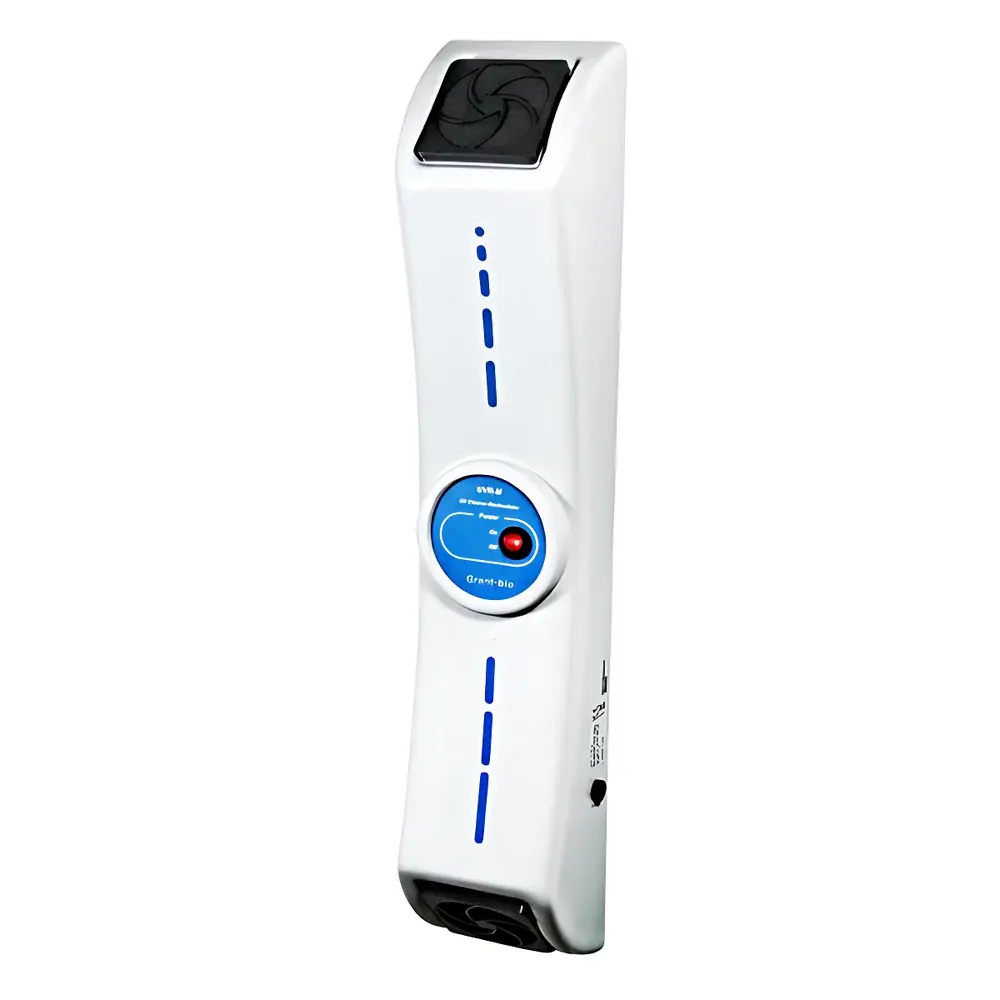
Grant UVR-M Series UV Recirculating Air Disinfector
| Brand | Grant |
|---|---|
| Origin | United Kingdom |
| Manufacturer Type | Authorized Distributor |
| Origin Category | Imported |
| Model | UVR-M Series |
| Pricing | Available Upon Request |
| UV Radiation Source | 1 lamp (UVR-M) / 2 lamps (UVR-Mi) |
| UV Airflow Rate | 14 m³/hour |
| UV Irradiance | 18 mW/cm²/s (UVR-M) / 36 mW/cm²/s (UVR-Mi) |
| Timer Range | 1 minute – 24 hours or continuous operation |
| Display | LCD |
| Power Supply | 230 V AC, 125 VA (540 mA) for UVR-M / 110 W (0.5 A) for UVR-Mi |
| Weight | 3.4 kg |
| Wall Mount Bracket | Standard |
| UV Lamp Operational Indicator | Standard |
| Lamp Life Counter | Standard |
| Auto On/Off Switch | Standard |
| Lamp Fault Detection | Standard |
| Optional Accessory | UVR-S Mobile Tripod Stand |
Overview
The Grant UVR-M Series UV Recirculating Air Disinfector is an engineered solution for continuous, non-invasive air decontamination in controlled environments where microbial load mitigation is critical. Operating on the principle of germicidal ultraviolet-C (UV-C) irradiation at 254 nm, the system draws ambient air through a primary particulate filter and circulates it across one (UVR-M) or two (UVR-Mi) low-pressure mercury vapor lamps housed within a fully shielded internal chamber. This design ensures zero direct UV exposure to personnel while maintaining effective inactivation of airborne bacteria, viruses, fungal spores, and other microorganisms via nucleic acid photodimerization. Unlike open UV irradiation systems, the UVR-M series complies with IEC 62471 (Photobiological Safety of Lamps) and EN 60335-1 (Household and Similar Electrical Appliances — Safety), making it suitable for unattended operation in occupied spaces such as laboratories, clinical preparation areas, and academic workspaces.
Key Features
- Fully enclosed UV-C chamber with interlocked safety shielding—eliminates risk of ocular or dermal UV exposure during operation
- Dual operational modes: programmable timer (1 minute to 24 hours) or continuous runtime, configurable via intuitive LCD interface
- Compact footprint (W × D × H ≈ 220 × 220 × 480 mm) optimized for benchtop, under-cabinet, or wall-mounted deployment
- Integrated wall-mount bracket included as standard; optional UVR-S mobile tripod enables flexible repositioning across multi-zone facilities
- Acoustically optimized fan assembly operating below 45 dB(A) at 1 m—designed for low-disturbance integration into quiet environments including cleanrooms and teaching labs
- Real-time lamp status monitoring: built-in irradiance decay compensation logic, lamp life counter, and automatic fault detection with visual alert
- Energy-efficient power architecture: 125 VA (UVR-M) or 110 W (UVR-Mi) consumption at 230 V AC, supporting long-duration deployment without thermal overload
Sample Compatibility & Compliance
The UVR-M series is validated for use in environments requiring routine airborne bioburden reduction—not as a sterilization device per ISO 14644-1 Class 5 criteria, but as a supplementary engineering control aligned with ISO 14698-1 (Biocontamination Control) and HTM 01-05 (UK Health Technical Memorandum for Decontamination). It is compatible with ISO/IEC 17025-accredited laboratory workflows where documented air quality management supports GLP-compliant sample handling. The unit meets CE marking requirements under the EU Machinery Directive 2006/42/EC and EMC Directive 2014/30/EU. No ozone generation occurs—the lamps are quartz-filtered to suppress 185 nm emission, ensuring compliance with OSHA PEL (0.1 ppm) and WHO indoor air quality guidelines.
Software & Data Management
The UVR-M operates as a standalone hardware-controlled system with no external software dependency. All operational parameters—including elapsed lamp hours, cumulative runtime, and last-triggered timer settings—are retained in non-volatile memory. While not equipped with network connectivity or cloud logging, its lamp life counter and fault diagnostics support scheduled maintenance planning in accordance with ISO/IEC 17025 Clause 6.4.3 (Equipment Management). Audit-ready records can be manually logged using facility-defined SOPs, and the unit’s deterministic behavior enables traceability under FDA 21 CFR Part 11–aligned documentation practices when integrated into validated environmental monitoring programs.
Applications
- Research laboratories conducting cell culture, microbiology, or molecular biology workflows where airborne contamination compromises assay integrity
- Veterinary clinics and diagnostic laboratories managing aerosol-generating procedures in proximity to immunocompromised animal subjects
- University teaching labs and school science facilities requiring consistent background air quality between instructional sessions
- Pharmaceutical QC/QA environments supplementing HVAC-based air filtration in Grade C/D anterooms and gowning areas
- Early childhood education centers seeking passive, non-chemical air hygiene solutions compliant with EN 14880 (Childcare Equipment Safety)
FAQ
Does the UVR-M generate ozone?
No. The low-pressure mercury lamps are doped quartz tubes that emit predominantly at 254 nm and are specifically designed to block 185 nm output—preventing ozone formation.
Can the unit operate continuously in occupied rooms?
Yes. Its fully shielded UV chamber and zero-leakage design meet IEC 62471 Risk Group 1 (Exempt) classification, permitting safe unattended use in occupied spaces.
What is the recommended lamp replacement interval?
Lamp output decays over time; Grant recommends replacement after 8,000 hours of cumulative operation, as tracked by the built-in lamp life counter.
Is calibration required prior to use?
No routine calibration is specified. However, users may verify irradiance performance annually using a NIST-traceable UV-C radiometer (e.g., ILT950UV) per facility QA protocols.
How does airflow rate affect disinfection efficacy?
At 14 m³/hour, the unit achieves ≥1.5 air changes per hour (ACH) in a 9 m² room with 2.6 m ceiling height—sufficient for sustained log-reduction of common airborne pathogens per ISO 15714 methodology.



