
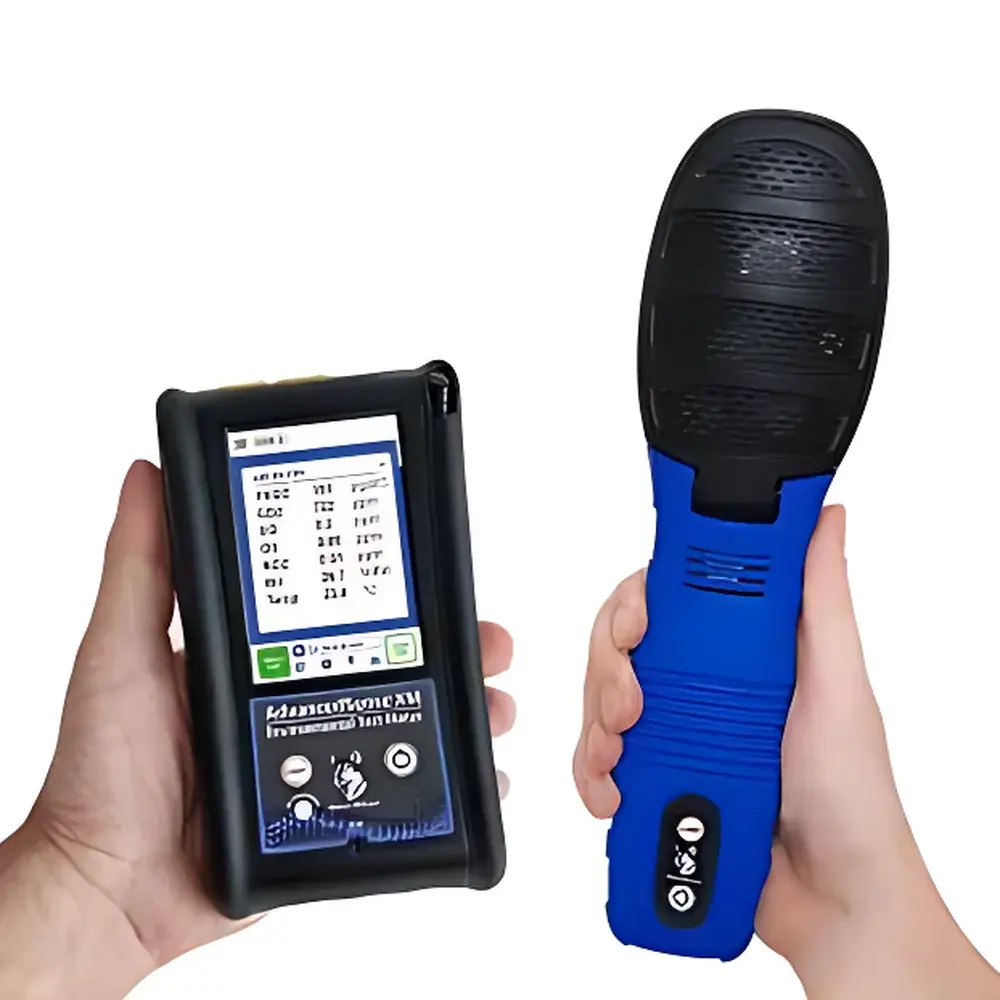
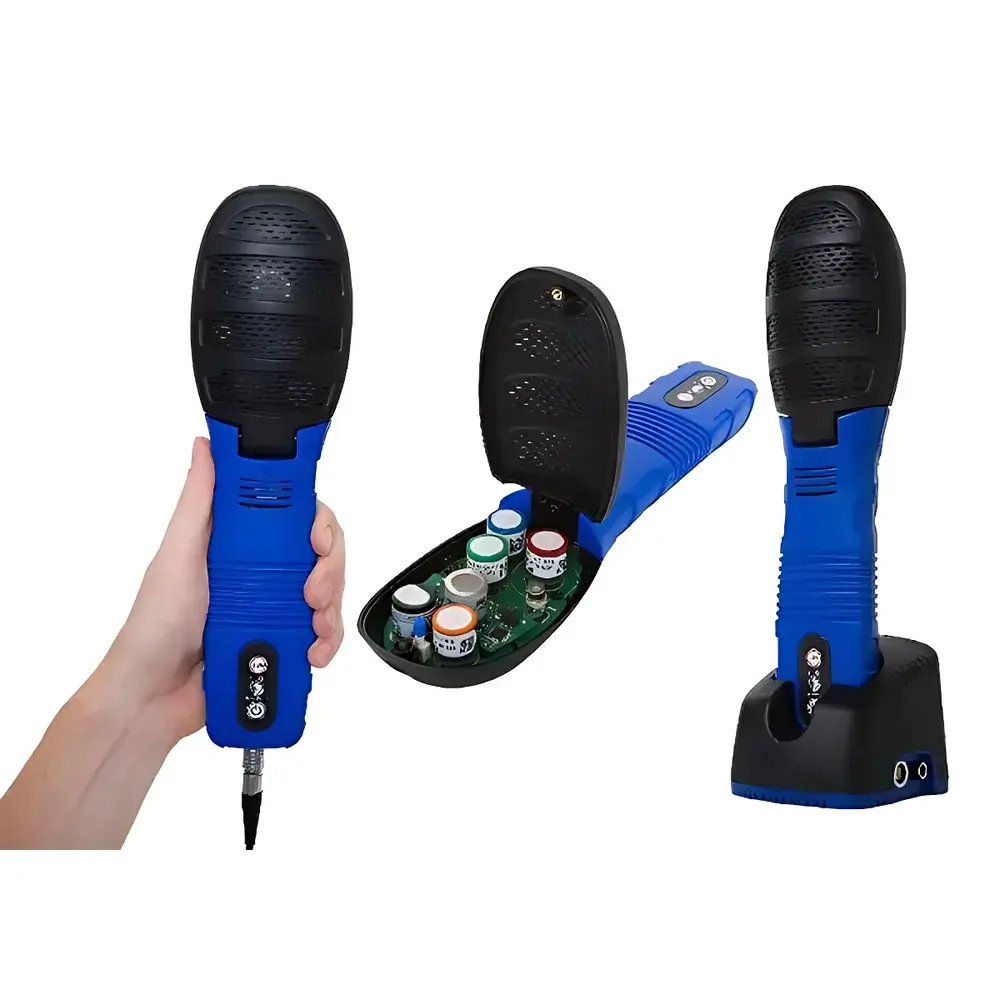
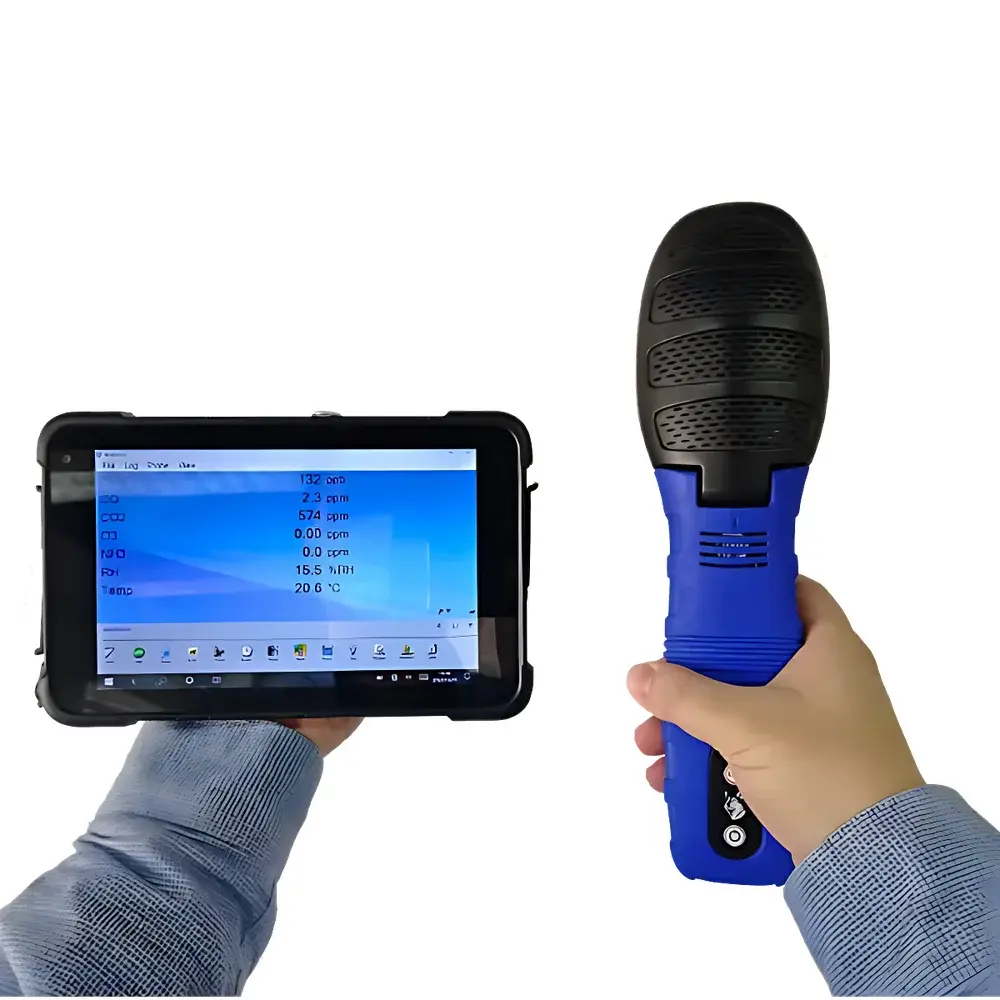
Graywolf DSII-8 Portable Indoor Air Quality Monitor
| Brand | Graywolf |
|---|---|
| Model | DSII-8 |
| Type | Portable IAQ Monitor |
| Measurement Principle | Electrochemical Sensor Technology (for gases), NDIR (CO₂), PID (TVOC), Capacitive (RH), Thermistor (Temperature) |
| Detection Parameters | Temperature, Relative Humidity, CO, CO₂, TVOC, HCHO, NH₃, and up to 20+ optional gases (e.g., O₃, NO₂, SO₂, H₂S, Cl₂, O₂, HCN, HF, PH₃, etc.) |
| Data Logging | Internal memory + SD card |
| Display | Color touchscreen interface |
| Power | Rechargeable Li-ion battery (≥12 h operation) |
| Compliance | CE, RoHS, meets ASTM D6245, ISO 16000-23, and EN 13725 for IAQ monitoring protocols |
| Software | Wolf OS v3.2 with Graywolf IAQ Suite (supports FDA 21 CFR Part 11–compliant audit trail, GLP/GMP data integrity features) |
| Connectivity | USB-C, Bluetooth 5.0, optional Wi-Fi module |
Overview
The Graywolf DSII-8 Portable Indoor Air Quality Monitor is an engineered field instrument designed for quantitative, multi-parameter assessment of indoor environmental conditions in compliance with international IAQ standards. Built upon a modular sensor architecture, it integrates electrochemical gas sensors (for CO, NH₃, H₂S, Cl₂, NO, etc.), non-dispersive infrared (NDIR) detection for CO₂, photoionization detection (PID) for total volatile organic compounds (TVOC), and high-stability capacitive and thermistor elements for simultaneous temperature and relative humidity measurement. Its real-time sampling rate of 1 Hz, coupled with low-noise analog front-end circuitry and 24-bit ADC resolution, ensures detection limits suitable for occupational exposure limit (OEL) verification and building commissioning per ASHRAE Standard 62.1 and ISO 16000-23. The DSII-8 operates as both a spot-check tool and a time-weighted average (TWA) logging platform—enabling continuous unattended deployment over 72+ hours using internal power and SD-based storage.
Key Features
- Modular probe architecture: Accepts up to eight interchangeable sensor modules simultaneously—including dual-gas electrochemical cells, PID lamps with 10.6 eV lamps, NDIR CO₂ cells, and environmental probes—enabling on-site reconfiguration without firmware changes.
- Multi-parameter synchronization: Simultaneous acquisition and timestamp alignment across all active channels (up to 20 parameters), eliminating temporal misalignment errors common in sequential-scan instruments.
- Flexible unit conversion: Real-time switching between concentration units (ppm, ppb, mg/m³, µg/m³, % vol) per parameter, with auto-scaling based on calibration certificate ranges and NIST-traceable reference values.
- Wolf OS v3.2 embedded operating system: Features intuitive touch navigation, contextual help overlays, and integrated calibration management with digital signature validation for sensor module identity and expiry tracking.
- Field annotation capability: Supports voice memos (WAV, 16-bit/44.1 kHz), geotagged JPEG capture, and freehand text notes—each embedded directly into the raw data stream with cryptographic hashing for chain-of-custody integrity.
Sample Compatibility & Compliance
The DSII-8 is validated for use in ambient air matrices ranging from 0–95% RH (non-condensing) and −10 °C to +50 °C. All electrochemical sensors are certified to IEC 60079-29-1 for intrinsic safety in non-hazardous locations and meet EN 50104 (gas detectors) for performance under variable airflow (0.1–3 m/s). Calibration protocols align with ISO 17025-accredited laboratories, and factory calibrations include NIST-traceable gas standards (e.g., CO in N₂ at 50 ppm ±2%, TVOC as isobutylene at 10 ppm ±3%). The instrument satisfies reporting requirements under EPA Method TO-15 (for VOC screening), OSHA PEL verification workflows, and EU Directive 2009/125/EC eco-design criteria for energy-efficient portable monitors.
Software & Data Management
Graywolf IAQ Suite (v5.4) provides desktop and cloud-based analysis with full 21 CFR Part 11 compliance: electronic signatures, role-based access control, immutable audit trails, and automated report generation (PDF/CSV/XLSX) with customizable templates aligned to LEED IEQ Credit 1 or WELL Building Standard v2 documentation. Raw binary files (.gwd) retain full metadata—including sensor serial numbers, calibration dates, firmware versions, GPS coordinates, and user annotations—ensuring full traceability during regulatory audits. Data export supports direct integration with LIMS platforms via HL7 or ASTM E2500-compliant XML schemas.
Applications
- Indoor Air Quality (IAQ) baseline surveys and post-remediation verification in commercial buildings, schools, and healthcare facilities.
- Ongoing occupational hygiene monitoring for compliance with ACGIH TLVs®, OSHA PELs, and EU-OELs in manufacturing, laboratories, and confined-space entry programs.
- Building commissioning and HVAC performance validation per ASHRAE Guideline 0 and ISO 16813.
- Epidemiological screening studies requiring high-temporal-resolution pollutant profiles (e.g., formaldehyde off-gassing kinetics in newly furnished spaces).
- Environmental justice assessments in residential communities near industrial corridors or transportation hubs.
FAQ
What electrochemical gases are supported out-of-the-box with the DSII-8?
The base configuration includes CO, CO₂, TVOC, HCHO, NH₃, and RH/T. Additional electrochemical sensors (e.g., H₂S, Cl₂, NO₂, O₃, SO₂) are available as plug-and-play modules—each pre-calibrated and digitally authenticated.
Does the DSII-8 support automatic zero/span calibration in the field?
Yes—via integrated push-button zeroing (ambient air) and optional automated span calibration using certified gas cylinders connected through the built-in regulator port; all calibration events are logged with operator ID and timestamp.
Can data be exported in formats compatible with statistical analysis tools like R or Python?
Raw .gwd files are convertible to CSV or HDF5 via IAQ Suite CLI tools; metadata headers follow CF-1.8 conventions for seamless ingestion into Pandas or xarray workflows.
Is the device suitable for outdoor ambient air monitoring?
It is rated for indoor and sheltered semi-outdoor use (e.g., loading docks, atriums); extended outdoor deployment requires optional weatherproof enclosure (IP54-rated accessory kit).
How is sensor cross-sensitivity managed for complex gas mixtures?
Each electrochemical module includes embedded temperature/pressure compensation and manufacturer-provided interference correction matrices; IAQ Suite applies real-time correction algorithms based on co-detected species concentrations.
Related Products







