
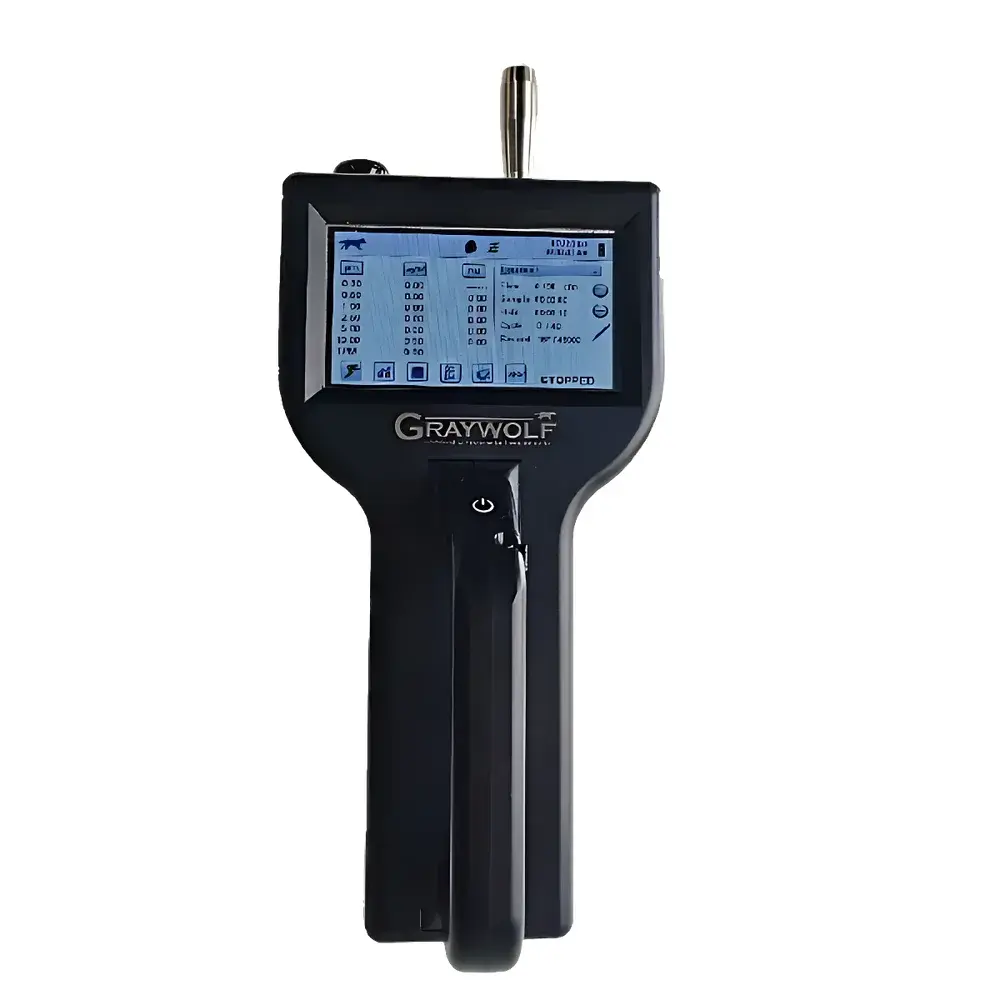
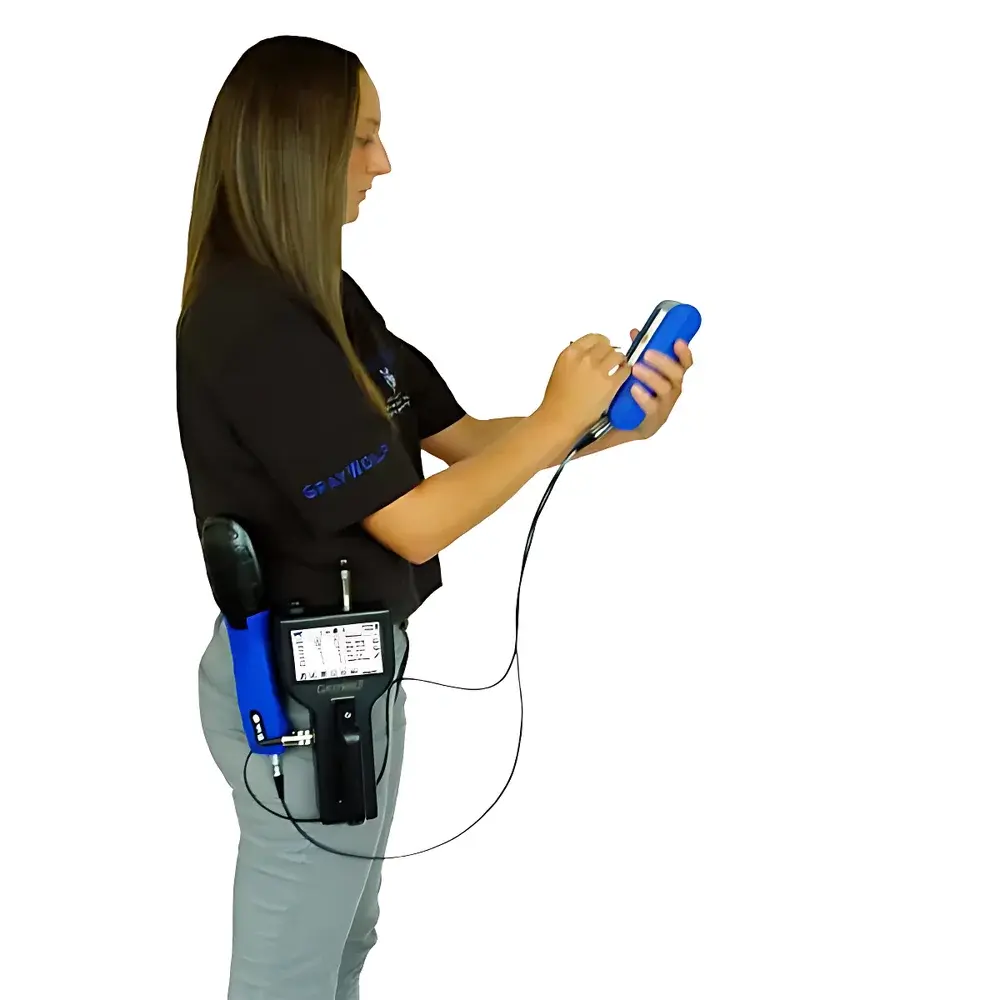
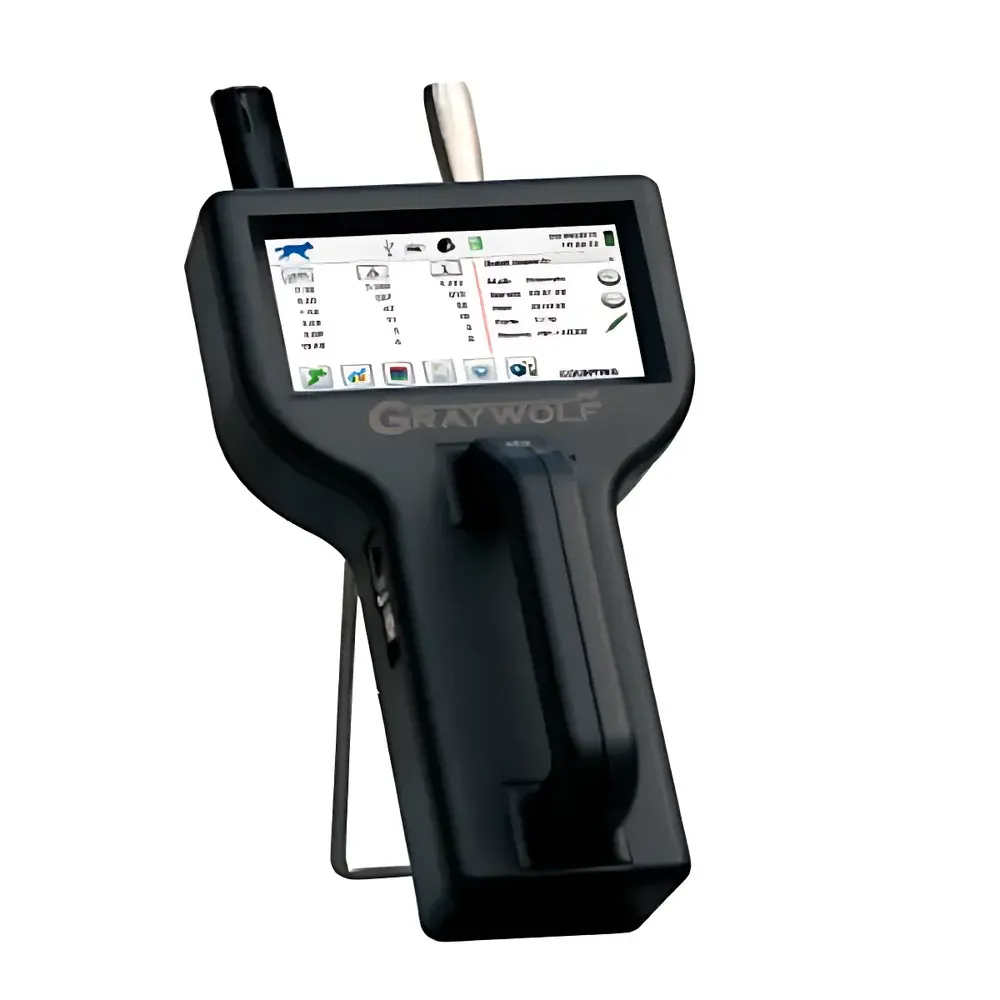
Graywolf PC3500 Portable Six-Channel Laser Particle Counter for PM1, PM2.5, PM10 & TSP Monitoring
| Brand | Graywolf |
|---|---|
| Model | PC3500 |
| Measurement Principle | Light Scattering (Laser Nephelometry) |
| Measured Parameters | TSP, PM10, PM2.5, PM1 |
| Particle Size Range | 0.3–25 µm |
| Sampling Flow Rate | 2.83 L/min |
| Measurement Interval | 1 s – 99 h |
| Laser Pulse Rate | 250,000 pulses/sec |
| Operating Temperature | 5–40 °C |
| Relative Humidity | 20–95 % RH (non-condensing) |
| Battery Life | >10 h continuous operation |
| Dimensions | 25.4 × 12.9 × 11.4 cm (with handle) |
| Weight | 1.0 kg |
Overview
The Graywolf PC3500 is a research-grade, portable six-channel laser particle counter engineered for high-fidelity quantification of airborne particulate mass concentrations—including PM1, PM2.5, PM10, and total suspended particulates (TSP)—using calibrated light scattering (laser nephelometry) principles. Unlike conventional fixed-channel monitors, the PC3500 employs a pulsed 635 nm laser diode operating at 250,000 pulses per second, enabling statistically robust particle detection across a continuous size range of 0.3 to 25 µm. Its real-time volumetric sampling at a precisely regulated flow rate of 2.83 L/min—traceable to ISO 21501-4 and aligned with EPA reference method equivalency protocols—ensures metrological consistency in both field and controlled laboratory environments. The instrument’s architecture integrates a built-in pulse height analyzer (PHA), allowing discrimination of particle size bins via scattered light amplitude calibration, and supports user-defined density and refractive index inputs to convert number concentration to mass concentration (µg/m³) with application-specific accuracy—critical for occupational hygiene, indoor air quality (IAQ) validation, cleanroom certification, and environmental epidemiology studies.
Key Features
- Six fully customizable size channels: Users define lower and upper cutoff diameters per channel within the 0.3–25 µm range—enabling alignment with regulatory cut-points (e.g., PM2.5 = ≤2.5 µm aerodynamic diameter) or research-specific aerosol classification schemes.
- Adjustable optical parameters: Independent input fields for particle density (kg/m³) and refractive index (real + imaginary components) permit correction of Mie scattering assumptions—essential when measuring bioaerosols, metallic fumes, or hygroscopic salts.
- True concurrent processing architecture: A multi-threaded embedded processor executes simultaneous data acquisition, serial/USB communication, on-device annotation, and real-time statistical computation—eliminating sampling dead time and supporting uninterrupted monitoring during configuration or telemetry upload.
- ISO 21501-4 compliant PHA: One of few handheld instruments featuring an integrated pulse height analyzer, ensuring traceable size binning resolution and automatic self-calibration against NIST-traceable latex sphere standards.
- Advanced power management: Intelligent sleep mode, adaptive backlight control, and low-power vacuum pump regulation extend battery life beyond 10 hours under continuous 1-second sampling—validated per IEC 62368-1 safety requirements.
- Integrated environmental sensing: Optional temperature and relative humidity probes (connected via dedicated analog interface) enable real-time correction of particle sizing drift due to ambient thermodynamic conditions.
Sample Compatibility & Compliance
The PC3500 is validated for use with ambient air, HVAC duct streams, cleanroom laminar flow hoods, and occupational breathing zones. Its isokinetic sampling probe (optional accessory) maintains representative particle transport efficiency across variable air velocities (0.1–3 m/s). All firmware and calibration routines comply with GLP documentation standards; audit trails for calibration events, parameter changes, and data exports meet FDA 21 CFR Part 11 requirements when used with Graywolf’s validated data management software. The device conforms to CE marking directives (EMC 2014/30/EU, RoHS 2011/65/EU), and its optical design satisfies ISO 14644-1:2015 Annex B for cleanroom particle counting performance verification.
Software & Data Management
Graywolf’s proprietary LogTrack™ PC software (Windows/macOS) provides full bidirectional communication, remote configuration, and automated report generation per ISO 14644-2:2015 and EU GMP Annex 1 templates. Raw pulse-height histograms, time-stamped concentration logs (with GPS-tagged location metadata), and annotated event markers are exportable in CSV, PDF, and XML formats. The software enforces electronic signature workflows, version-controlled calibration certificates, and immutable audit logs—supporting laboratory accreditation to ISO/IEC 17025:2017. Firmware updates preserve historical calibration constants and retain user-defined channel configurations across revisions.
Applications
- Indoor Air Quality (IAQ) Assessment: Quantifying PM2.5 infiltration in schools, hospitals, and office buildings per ASHRAE Standard 62.1 and WHO Air Quality Guidelines.
- Cleanroom & Controlled Environment Monitoring: Real-time compliance verification for ISO Class 5–8 spaces, including pharmaceutical aseptic processing suites.
- Occupational Exposure Assessment: Time-weighted average (TWA) and short-term exposure limit (STEL) calculations aligned with OSHA PELs and ACGIH TLVs® for respirable dust.
- Environmental Field Studies: Mobile mapping of urban PM gradients using geotagged sampling campaigns; integration with meteorological station data for source apportionment modeling.
- Research & Method Development: Validation of low-cost sensor networks, filter efficiency testing (per ISO 16890), and aerosol generation characterization in wind tunnels or exposure chambers.
FAQ
Does the PC3500 provide mass concentration (µg/m³) directly, or only particle counts?
It calculates mass concentration in real time using user-specified particle density and refractive index—enabling traceable conversion from number-based histograms to regulatory-relevant µg/m³ values.
Is external calibration required annually?
No. The built-in PHA and factory-installed NIST-traceable calibration spheres support automated internal verification. Annual third-party calibration is recommended for ISO/IEC 17025-accredited labs.
Can the instrument operate while charging?
Yes. Continuous operation is maintained during AC power connection without interruption to sampling or data logging.
What is the minimum detectable concentration?
At 0.3 µm, the lower detection limit is 1 particle per cubic foot (35 particles/m³) with <5% statistical uncertainty at 95% confidence, per ISO 21501-4 Annex D.
Is the HEPA exhaust filter replaceable in the field?
Yes. The integrated 99.97% @ 0.3 µm HEPA filter is user-serviceable with standard Torx tools and requires replacement every 1,000 operating hours or after exposure to high-concentration industrial aerosols.
Related Products







