
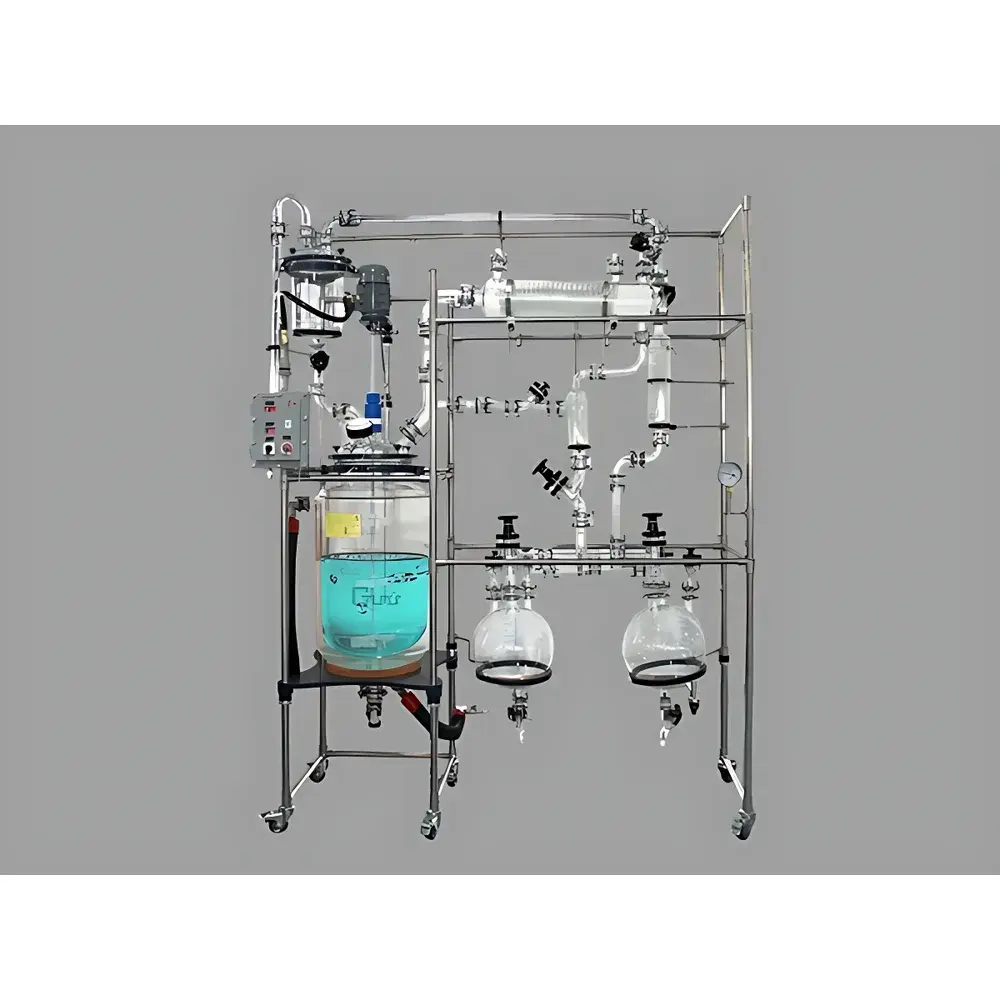
The Great Wall 100L Solvent Recovery Integrated System
| Brand | The Great Wall |
|---|---|
| Origin | Henan, China |
| Manufacturer Type | Direct Manufacturer |
| Origin Category | Domestic |
| Model | 100L |
| Price Range | USD 14,000–21,000 (FOB) |
| Instrument Classification | Integrated Solvent Recovery System |
| Usable Volume | Large-Scale |
| Construction Material | Borosilicate Glass 3.3 |
| Operating Pressure | Medium Vacuum |
| Capacity | 100 L |
| Ultimate Vacuum | -0.098 MPa (i.e., ≤ 2 kPa absolute) |
| Temperature Range | -80 °C to +200 °C |
| Jacket Volume | ~30 L |
| Condenser Heat Transfer Area | 0.954 m² |
| Feed Tank Volume | 10 L |
| Dual Collection Flasks | 2 × 20 L |
| Stirring Motor | 370 W, Explosion-Proof (Exd II BT4), 50–500 rpm, Frequency-Controlled |
| Stirrer Type | Triple-blade PTFE-coated Propeller |
| Sealing Material | PTFE |
| Frame Material | SUS304 Stainless Steel |
| Temperature Sensor | Pt100, ±0.1 °C display resolution |
| Power Supply | 220–240 V~, 50/60 Hz |
| Ambient Operating Conditions | 5–35 °C, ≤70% RH |
| Overall Dimensions (W×D×H) | ~2200 × 900 × 2800 mm |
Overview
The Great Wall 100L Solvent Recovery Integrated System is a fully enclosed, vacuum-assisted distillation and condensation platform engineered for high-efficiency solvent recycling in synthetic chemistry, pharmaceutical process development, and fine chemical manufacturing laboratories. It operates on the principle of fractional vacuum distillation under controlled negative pressure, enabling low-boiling-point solvent recovery at reduced temperatures—thereby minimizing thermal degradation of heat-sensitive compounds and improving energy efficiency. Designed for large-scale batch processing, the system integrates a 100 L borosilicate glass 3.3 reactor vessel with double-jacketed temperature control, a high-surface-area horizontal condenser (0.954 m²), dual 20 L collection flasks, and an auxiliary condenser to suppress re-volatilization. All wetted components—including reaction chamber, condensers, feed lines, and collection path—are constructed from ASTM E438 Type I, Class A borosilicate glass 3.3, ensuring exceptional resistance to thermal shock, chemical corrosion, and mechanical stress across a wide operational envelope (−80 °C to +200 °C).
Key Features
- Explosion-proof stirring system (370 W, Exd II BT4 certified) with frequency-controlled speed regulation (50–500 rpm) and triple PTFE-coated propeller blades for uniform mixing under vacuum;
- Triple-seal PTFE-stirring shaft assembly with precision-machined bearings to prevent particulate shedding and ensure long-term vacuum integrity;
- Integrated dual-collection flask configuration enabling continuous solvent withdrawal without compromising system vacuum level (≤ −0.098 MPa);
- Dedicated auxiliary condenser mounted upstream of collection flasks to capture residual vapors and reduce solvent loss by >95% compared to single-condenser configurations;
- Side-mounted corrosion-resistant PTFE-lined discharge valve (height: 385 mm) for safe, residue-free bottom discharge under inert or vacuum conditions;
- SUS304 stainless steel structural frame with locking casters for stable positioning and laboratory mobility;
- Pt100 temperature sensor with ±0.1 °C digital readout, housed in PTFE-sheathed stainless steel probe for accurate jacket and bath temperature monitoring;
- Flanged glass-to-glass connections throughout the system, facilitating rapid disassembly, cleaning, and validation-compliant inspection.
Sample Compatibility & Compliance
This system is compatible with a broad spectrum of organic solvents—including acetone, ethyl acetate, dichloromethane, toluene, THF, and alcohols—as well as aqueous-organic mixtures commonly used in extraction, crystallization, and reaction workup. Its construction adheres to ISO 3585 (borosilicate glass 3.3 specifications) and meets mechanical design requirements outlined in ASME B31.3 Process Piping Code for vacuum service. The explosion-proof motor and control cabinet carry full Exd II BT4 certification per IEC 60079-1 and GB 3836.1–2010, supporting use in Zone 1 hazardous environments. All electrical components comply with CE Low Voltage Directive (2014/35/EU) and EMC Directive (2014/30/EU). While not pre-certified for FDA 21 CFR Part 11, the system supports audit-ready operation when integrated with validated third-party data acquisition software featuring electronic signatures, change tracking, and secure user access controls.
Software & Data Management
The system operates via a local digital controller with real-time display of jacket temperature, stirring speed, and vacuum level (via optional calibrated vacuum transducer). No proprietary software is embedded; however, analog outputs (4–20 mA) are provided for jacket temperature and stirrer RPM, enabling seamless integration into existing laboratory information management systems (LIMS) or SCADA platforms. For GLP/GMP-aligned workflows, users may connect external validated data loggers (e.g., Omega OM-DAQPRO-5300 series) compliant with 21 CFR Part 11 Annex 11 requirements. All critical parameters—including setpoints, actual values, timestamps, and operator IDs—can be exported in CSV or PDF format for traceability and regulatory submission.
Applications
- Recovery and reuse of high-purity solvents from reaction quenches, extractions, and chromatographic eluents;
- Concentration of thermally labile active pharmaceutical ingredients (APIs) under mild vacuum conditions;
- Removal of low-boiling solvents prior to lyophilization or spray drying;
- Distillative purification of intermediates in multi-step synthesis where solvent cross-contamination must be avoided;
- Process safety testing of solvent compatibility under extended vacuum exposure and thermal cycling;
- Scale-up studies bridging from 5 L to 100 L batch sizes while maintaining consistent mass transfer and heat exchange characteristics.
FAQ
What is the maximum allowable temperature differential between the reactor wall and jacket?
The system is rated for a maximum ΔT of 80 °C between inner vessel surface and heating/cooling jacket to prevent thermal stress-induced cracking in borosilicate glass 3.3.
Can the system operate under positive pressure?
No. It is designed exclusively for vacuum operation (−0.1 MPa to 0 MPa gauge). Positive pressure service requires alternative pressure-rated reactors and is outside the scope of this unit’s certification.
Is the condenser cooled by circulating chiller fluid or ambient air?
The horizontal condenser is jacketed and requires external circulation of coolant (e.g., glycol/water mixture) via standard 1/2″ BSP inlet/outlet ports.
Are spare glass components available with documented calibration certificates?
Yes. All replacement glassware (vessels, condensers, adapters) is supplied with material conformance certificates referencing ISO 3585 and batch-specific hydrolytic resistance test reports (ISO 719 HGB 1).
Does the system include vacuum pump and chiller?
No. These are customer-supplied peripheral units. Recommended vacuum pump capacity: ≥12 m³/h at 1 kPa; chiller specification: −20 °C minimum setpoint, ≥2 kW cooling capacity at −10 °C outlet.
Related Products



