
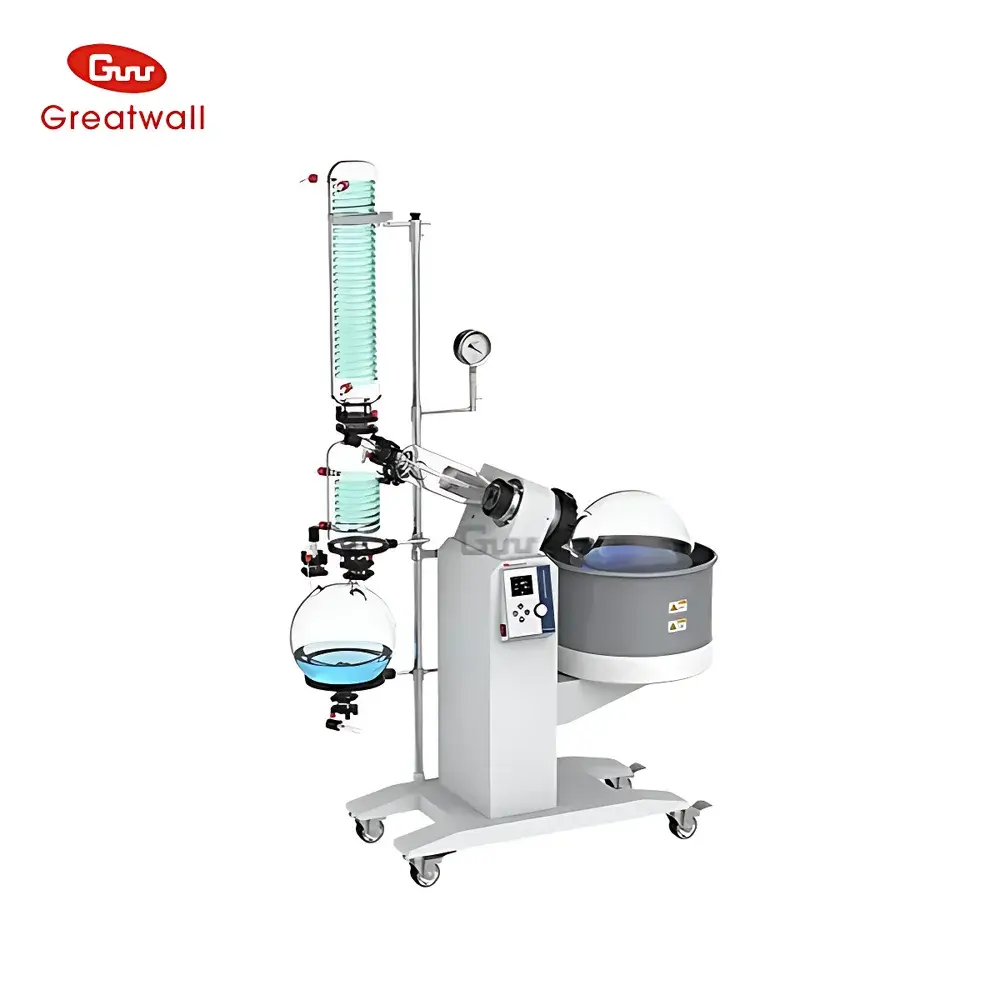
Great Wall R-1020 Large-Scale Rotary Evaporator
| Brand | The Great Wall |
|---|---|
| Origin | Henan, China |
| Manufacturer Type | Direct Manufacturer |
| Origin Category | Domestic (China) |
| Model | R-1020 |
| Capacity | 20 L |
| Rotational Speed Range | 20–130 rpm |
| Temperature Control Range | Ambient +5°C to 95°C |
| Temperature Control Accuracy | ±1.5°C |
| Condensing Area | Main Condenser: 0.948 m² |
| Auxiliary Condenser | 0.358 m² |
| Heating Power | 6000 W |
| Rotating Motor Power | 250 W |
| Total Rated Power | 6300 W |
| Display | LCD Digital Display |
| Lift Mechanism | Electric Vertical Lift (0–190 mm行程) |
| Condenser Type | High-Efficiency Triple-Return Dual-Stage Condenser (Main + Auxiliary) |
| Rotary Flask Volume | 20.0 L (DN100 Flange) |
| Collection Flask Volume | 10.0 L |
| Bath Material | 06Cr19Ni10 Stainless Steel (Φ450 × 260 mm) |
| Vacuum Seal | Modified PTFE + Fluoroelastomer Dual-Seal System |
| Discharge Valve | PTFE-Core Valve |
| Evaporation Rate (Water) | 5.0 L/h |
| Safety Protections | Leakage Current Protection, Overcurrent Protection, Overtemperature Protection, Liquid-Level Monitoring |
| Operating Ambient | 5–40°C, ≤70% RH |
| Power Supply | 3-phase, 380 V, 50 Hz |
| Dimensions (W×D×H) | 1120 × 680 × 1900 mm |
| Net Weight | 90 kg |
Overview
The Great Wall R-1020 Large-Scale Rotary Evaporator is an engineered solution for pilot-scale solvent removal, concentration, and purification in research laboratories and process development environments. Based on the fundamental principle of reduced-pressure distillation—where solvent boiling points are lowered under vacuum while rotational motion increases surface area and enhances heat transfer—the R-1020 delivers consistent, scalable performance for applications demanding higher throughput than standard benchtop systems. Its 20 L rotary flask capacity supports batch processing aligned with early-stage scale-up workflows in pharmaceutical synthesis, natural product isolation, polymer formulation, and food ingredient refinement. Designed for integration into closed-loop vacuum and cooling systems, the unit operates reliably with external vacuum pumps (typically ≤10 Pa ultimate pressure) and recirculating chillers capable of maintaining condenser inlet temperatures at or below −10°C.
Key Features
- High-efficiency dual-stage condensation system comprising a main condenser (0.948 m²) and auxiliary condenser (0.358 m²), configured in a triple-return geometry to maximize vapor path length and thermal exchange efficiency—critical for high-boiling solvents and low-vacuum operation.
- Dual-material vacuum sealing architecture: modified polytetrafluoroethylene (PTFE) combined with fluoroelastomer O-rings ensures long-term integrity and leak rates ≤0.03 kPa/min, eliminating routine application of silicone grease while maintaining system stability during extended runs.
- Electrically actuated vertical lift mechanism (0–190 mm travel) enables precise, repeatable flask positioning—essential for safe flask detachment and reproducible immersion depth control in the heating bath.
- PTFE-core discharge valve facilitates residue-free, corrosion-resistant sample recovery from the evaporating flask—particularly advantageous for acidic, alkaline, or halogenated media.
- Rapid法兰 (DIN/ISO-compliant DN100 quick-connect flange interface) allows tool-free assembly and disassembly of glassware, reducing setup time and minimizing mechanical stress on joints during repeated use.
- Stainless steel (06Cr19Ni10) heating bath with optional silicone rubber insulation sleeve mitigates surface temperature hazards and improves energy retention across the full operating range (ambient +5°C to 95°C).
Sample Compatibility & Compliance
The R-1020 accommodates a broad spectrum of thermally sensitive and chemically aggressive samples—including aqueous extracts, ethanolic botanical fractions, DMF-based reaction mixtures, and chlorinated hydrocarbon solutions—without compromising seal integrity or bath corrosion resistance. All wetted glass components conform to ISO 3585 (borosilicate 3.3) specifications. The system meets general electrical safety requirements per GB 4793.1–2019 (equivalent to IEC 61010-1) and incorporates protection circuits compliant with Class I equipment standards. While not pre-certified for GMP manufacturing, its design supports GLP-aligned documentation practices, including traceable temperature logging (via optional RS485 output), manual intervention logs, and maintenance records required for audit readiness in regulated R&D settings.
Software & Data Management
The R-1020 features an integrated LCD digital display with independent parameter controls for rotation speed (20–130 rpm, continuously variable), bath temperature (±1.5°C accuracy), and real-time vacuum status monitoring. Though it does not include embedded PC software or cloud connectivity, its analog/digital hybrid interface supports third-party data acquisition via 4–20 mA or 0–10 V analog outputs (available as factory option). Users may configure external PLCs or LabVIEW-based systems to record time-stamped operational parameters—enabling compliance with internal SOPs requiring raw data traceability. For FDA 21 CFR Part 11 alignment, supplementary electronic lab notebook (ELN) integration is recommended to capture operator ID, batch number, and run metadata alongside instrument readings.
Applications
- Pharmaceutical process development: Solvent exchange of API intermediates, removal of residual THF or dichloromethane post-coupling reactions, and concentration of peptide-containing aqueous fractions.
- Natural product isolation: Gentle recovery of volatile terpenes and essential oils from steam-distillate fractions under controlled sub-ambient bath temperatures.
- Polymer synthesis: Bulk removal of toluene or xylene from step-growth polycondensation batches prior to melt pressing or film casting.
- Food & flavor chemistry: Ethanol-based extraction concentration of botanical volatiles, decolorization of crude pigment extracts, and low-temperature dewaxing of cold-pressed oils.
- Academic & contract research: Reproducible scaling of published rotary evaporation protocols from 1 L to 20 L volumes while preserving critical process parameters (e.g., film thickness, residence time, ΔTlog-mean).
FAQ
What vacuum level is recommended for optimal performance with the R-1020?
A stable base pressure between 10–100 Pa is typical for most organic solvents; lower pressures (<10 Pa) are advised for high-boiling-point solvents (e.g., glycerol, ethylene glycol) or when maximizing evaporation rate is critical.
Can the R-1020 be operated continuously for >8 hours?
Yes—its 6000 W heating element, industrial-grade motor, and dual-stage condenser support extended duty cycles. However, continuous operation requires active vacuum pump maintenance, chiller temperature stability, and periodic inspection of PTFE seals per manufacturer-recommended intervals.
Is the heating bath compatible with silicone oil or other high-temperature heat transfer fluids?
The 06Cr19Ni10 stainless steel bath is chemically resistant to common silicone oils up to 200°C; however, the system’s maximum setpoint remains 95°C per design specification—exceeding this risks controller calibration drift and invalidates warranty coverage.
Does the R-1020 meet ISO or ASTM standards for rotary evaporation?
No single ISO or ASTM standard governs rotary evaporator construction or performance; however, its condenser geometry and leakage rate comply with principles outlined in ASTM E2654 (Standard Guide for Validation of Analytical Methods) regarding system suitability for quantitative solvent removal.
How is overload protection implemented in the electrical architecture?
Integrated thermal cutouts monitor both heating circuit and motor winding temperature; current-sensing relays interrupt power upon sustained overcurrent (>125% rated for >3 seconds), and ground-fault detection triggers immediate shutdown if leakage exceeds 30 mA.



