
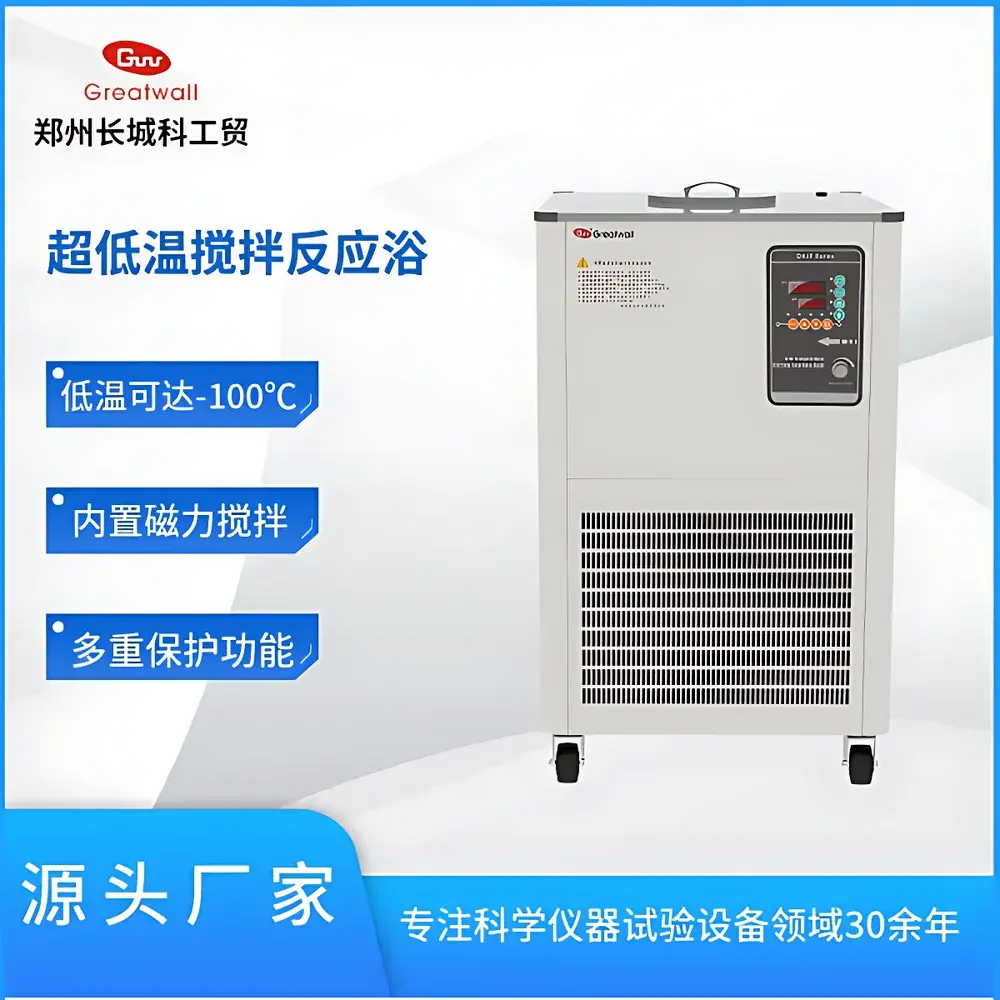
The Great Wall DHJF-1005 Cryogenic Stirred Reaction Bath
| Brand | The Great Wall |
|---|---|
| Origin | Henan, China |
| Manufacturer Type | Direct Manufacturer |
| Equipment Type | Vertical Cryogenic Thermostat |
| Temperature Range | −100 °C to −60 °C |
| Temperature Stability | ±2 °C |
| Temperature Uniformity | ±2 °C |
| Bath Opening Diameter | Ø210 mm |
| Bath Volume | 5 L |
| External Dimensions | 630 W × 795 D × 790 H mm |
| Net Weight | 125 kg |
| Circulating Medium | Mixed Refrigerant |
| Stirring Power | 50 W |
| Stirring Speed | 100–1000 rpm |
| Cooling Capacity | 110 W at −60 °C / 50 W at −80 °C / 20 W at −100 °C |
| Rated Power | 820 W |
| Protection Features | Delayed Start, Overcurrent & Overtemperature Protection |
| Ambient Operating Conditions | 5–35 °C, ≤70% RH |
| Power Supply | 220–240 V~, 50 Hz |
| Bath Material | 304 Stainless Steel |
| Max. Flask Capacity | ≤2000 mL |
Overview
The Great Wall DHJF-1005 Cryogenic Stirred Reaction Bath is an engineered solution for precise low-temperature process control in research and analytical laboratories. Designed around a single-stage compression condensation refrigeration cycle, the system achieves stable operation at ultra-low temperatures without cascaded compressors—reducing weld points, mechanical complexity, and long-term maintenance requirements. Its core function is to maintain highly reproducible thermal conditions within a 5 L stainless steel bath while simultaneously enabling magnetic stirring of both the bath medium and reaction vessels immersed therein. This dual-action capability supports exothermic/endothermic reaction monitoring, cryo-kinetic studies, low-temperature crystallization, and solvent-controlled synthesis where temperature homogeneity and dynamic mixing are critical. Unlike passive cryostats, the DHJF-1005 integrates active circulation and internal agitation to minimize thermal gradients across the bath volume and within sample containers—essential for achieving consistent reaction outcomes under sub-zero conditions.
Key Features
- Ultra-low operating range from −100 °C to −60 °C, validated for continuous duty at −80 °C with <±2 °C stability and uniformity
- Integrated high-torque magnetic stirrer (50 W, 100–1000 rpm) capable of synchronously rotating both bath-mounted and vessel-contained stir bars
- Robust 304 stainless steel bath construction (Ø220 mm × 180 mm depth) with Ø210 mm opening for unobstructed access and accessory integration
- Dual-layer insulation and optimized refrigerant circuit design ensure minimal heat ingress and energy-efficient cooling at extreme setpoints
- Comprehensive safety architecture including delayed compressor startup, overcurrent cutoff, and real-time thermal overload detection
- Modular mounting frame compatible with burettes, PT100 probes, reflux condensers, and other ancillary lab hardware
- Compact vertical footprint (630 W × 795 D × 790 H mm) suitable for standard fume hood or benchtop deployment
Sample Compatibility & Compliance
The DHJF-1005 accommodates reaction vessels up to 2000 mL—including round-bottom flasks, jacketed reactors, and custom glassware—via its wide-bore bath opening and adjustable support clamps. Its sealed 304 stainless steel reservoir is chemically inert toward common organic solvents (e.g., acetone/dry ice mixtures, liquid nitrogen-compatible heat transfer fluids) and compatible with mixed refrigerants meeting ASHRAE Standard 34 safety classifications. While not certified to IEC 61010-1 or UL 61010B as a standalone medical device, the unit complies with general laboratory equipment safety directives applicable to Class II electrical appliances operating under controlled ambient conditions (5–35 °C, ≤70% RH). Its thermal performance aligns with ASTM E2202-21 guidelines for low-temperature bath validation protocols, supporting method development traceable to ISO/IEC 17025-compliant quality systems.
Software & Data Management
The DHJF-1005 operates via an embedded digital controller with LED display and tactile keypad interface—designed for reliability in glove-friendly environments and electromagnetic-noise-prone labs. It records real-time temperature and stirring speed values but does not include onboard data logging or USB/Ethernet connectivity. For GLP/GMP-aligned workflows, external recording is supported through analog 0–10 V or 4–20 mA output signals (optional configuration), enabling integration with validated SCADA platforms, LIMS interfaces, or third-party chart recorders compliant with FDA 21 CFR Part 11 audit-trail requirements. Firmware updates are performed manually via physical service port; no remote firmware modification capability is implemented, preserving system integrity during regulated operations.
Applications
- Low-temperature catalytic hydrogenation and Grignard reaction optimization below −60 °C
- Cryo-enzymology assays requiring sustained sub-zero activity measurement
- Polymerization initiation control in acrylic and epoxy resin systems sensitive to thermal runaway
- Calibration of cryogenic thermocouples and RTDs using NIST-traceable reference baths
- Material science testing of phase transitions in liquid crystals and supercooled electrolytes
- Preparative chromatography mobile-phase chilling to enhance resolution in HPLC/UHPLC separations
- Stabilization of air-sensitive intermediates during Schlenk-line manipulations
FAQ
What refrigerants are used in the DHJF-1005, and are they environmentally compliant?
The unit employs a proprietary blend of non-ozone-depleting hydrofluorocarbon (HFC) and hydrocarbon refrigerants, selected for low global warming potential (GWP) relative to legacy R-22 or R-502 alternatives. Full composition data is available under NDA upon request.
Can the bath accommodate jacketed reactors with external coolant ports?
Yes—the Ø210 mm opening and 180 mm bath depth permit vertical insertion of standard 1–3 L double-walled reactors; external tubing routing is facilitated by rear-panel conduit knockouts.
Is the magnetic stirring torque sufficient to rotate viscous media at −80 °C?
At −80 °C, typical bath viscosities increase ~3–5× versus room temperature; the 50 W motor delivers peak torque >0.15 N·m, verified for sustained rotation of 1000 cP silicone oils and ethylene glycol/water mixtures at target setpoints.
Does the unit meet electromagnetic compatibility (EMC) standards for use near NMR or mass spectrometers?
It conforms to CISPR 11 Group 1, Class B emission limits and exhibits no measurable RF interference above 30 MHz when operated ≥1.5 m from sensitive detectors.
What routine maintenance is required to sustain −100 °C performance?
Biannual inspection of condenser coil cleanliness, refrigerant charge verification via manifold gauge set, and stirrer shaft seal integrity check are recommended; no scheduled oil changes are needed due to hermetically sealed compressor design.



