
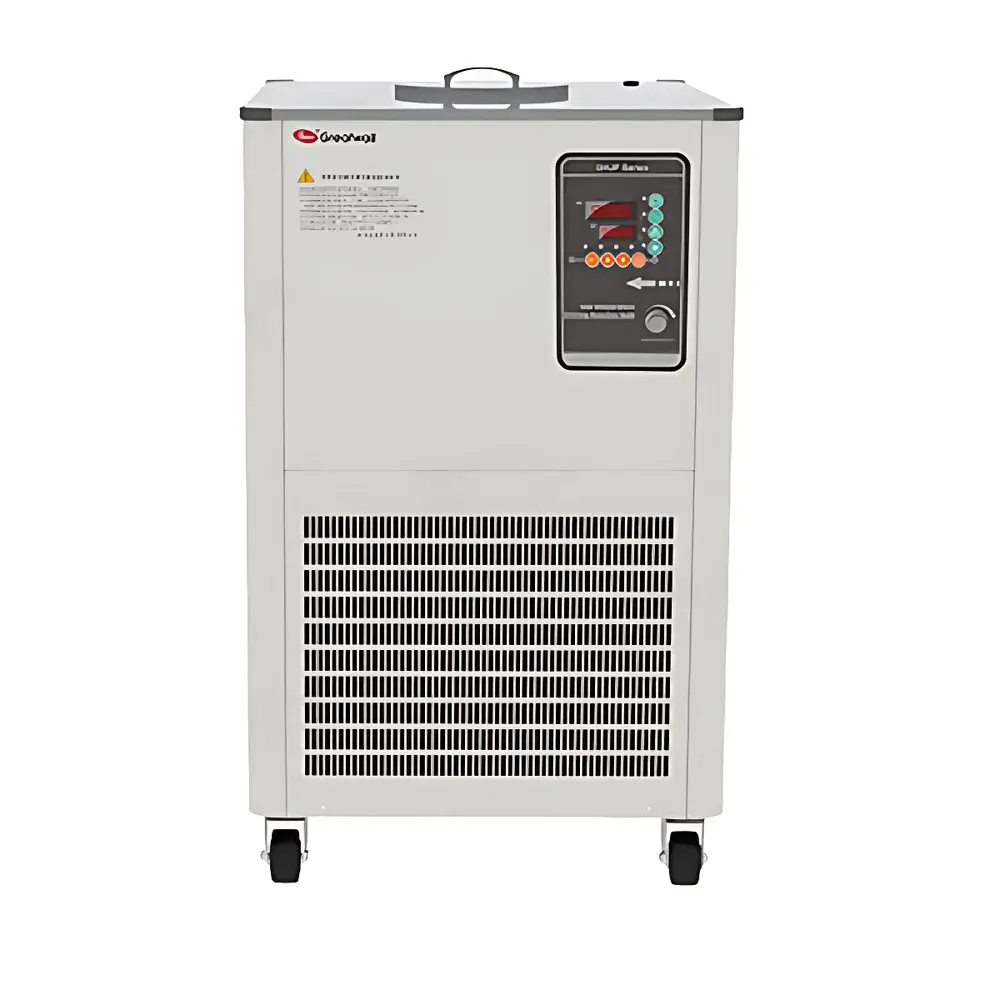
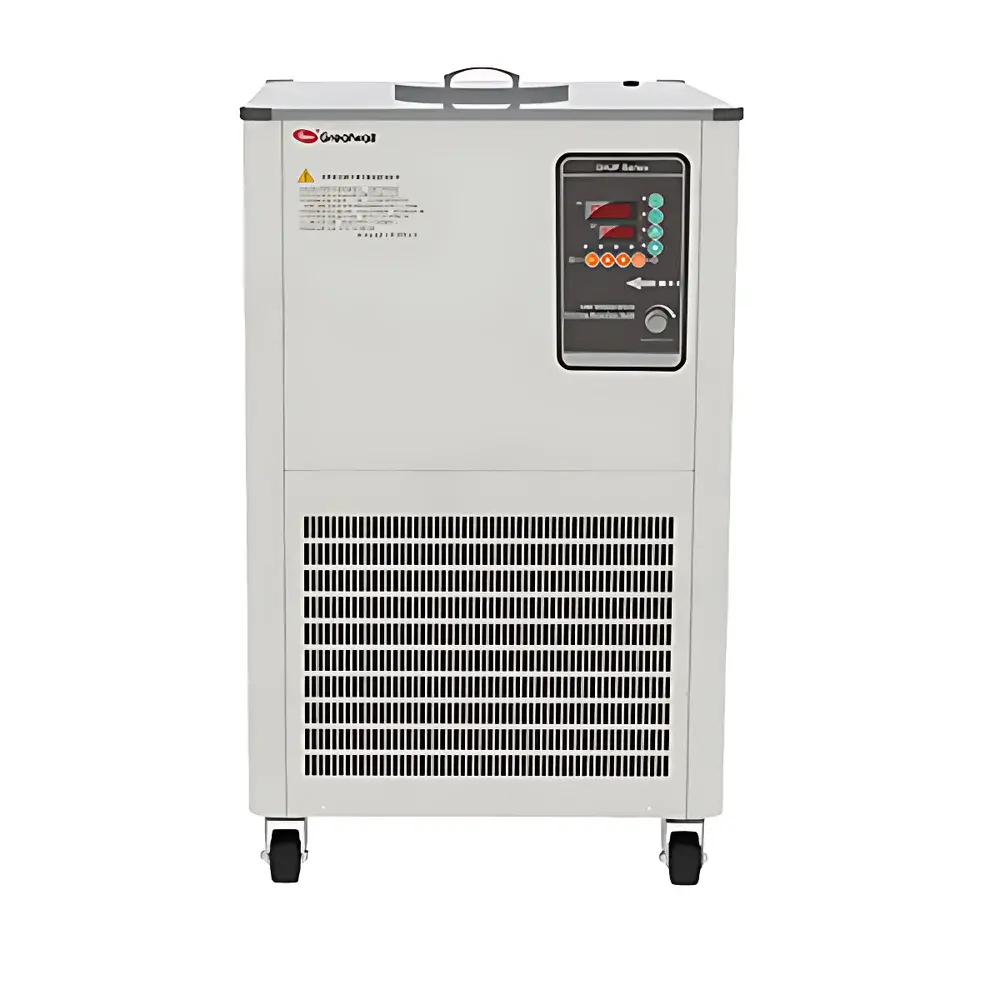
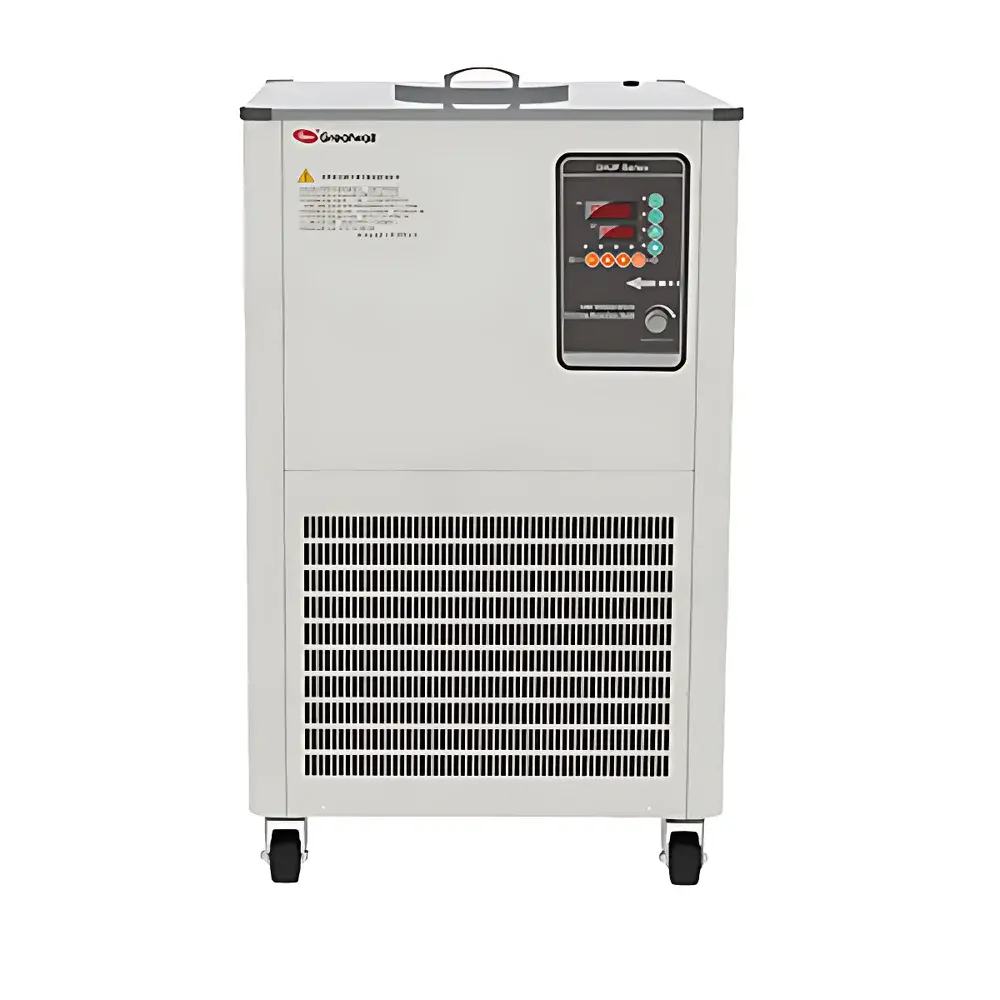
The Great Wall DHJF-1210 Low-Temperature Constant-Temperature Stirred Reaction Bath
| Brand | The Great Wall |
|---|---|
| Origin | Henan, China |
| Manufacturer Type | Authorized Distributor |
| Origin Category | Domestic (China) |
| Model | DHJF-1210 |
| Pricing | Upon Request |
| Refrigeration Principle | Single-Stage Compressor with Cascade Subcooling |
| Temperature Range | −120 °C to −60 °C |
| Bath Volume | 10 L |
| Temperature Stability | ±2 °C |
| Refrigerant | Mixed Cryogenic Refrigerant |
| Cooling Capacity | 160 W at −60 °C, 70 W at −80 °C, 40 W at −100 °C, 20 W at −120 °C |
| Stirring Power | 50 W |
| Stirring Speed | 100–1000 rpm |
| Display Resolution | 0.1 °C |
| Power Supply | 3-phase, 380 V, 50 Hz |
| Protection | Delayed Start, Overcurrent, Overtemperature |
| Bath Material | 304 Stainless Steel |
| Dimensions (W×D×H) | 670 × 780 × 1085 mm |
| Net Weight | 154 kg |
| Drain Port | 1/2″ NPT |
| Flask Capacity Support | Up to 3000 mL |
| Ambient Operating Conditions | 5–35 °C, ≤70% RH |
Overview
The Great Wall DHJF-1210 Low-Temperature Constant-Temperature Stirred Reaction Bath is an engineered solution for precise cryogenic reaction control and temperature-stable sample conditioning in laboratory-scale synthesis, material characterization, and low-temperature catalysis studies. It operates on a single-stage compressor architecture enhanced with cascade subcooling technology—enabling stable operation across a demanding range of −120 °C to −60 °C without requiring liquid nitrogen or multi-compressor systems. This design integrates a hermetically sealed Tecumseh piston compressor, air-cooled copper-tube condenser, series-connected heat exchangers, capillary throttling, and a submerged coil-type evaporator housed within a 10 L 304 stainless steel reservoir. The system delivers reproducible thermal environments essential for kinetic studies, polymerization initiation, superconductivity precursor handling, and low-temperature spectroscopy sample preparation.
Key Features
- Single-stage compressor with cascade subcooling architecture—achieves −120 °C using mixed refrigerants while maintaining mechanical simplicity and serviceability
- Submerged helical evaporator fully immersed in the bath fluid; designed to withstand freeze-thaw cycling without structural compromise
- Intelligent digital controller with 0.1 °C display resolution, real-time temperature logging, and programmable ramp/soak profiles
- Integrated magnetic stirrer (50 W, 100–1000 rpm) with adjustable torque output for homogeneous mixing under cryogenic viscosity conditions
- Air-cooled condenser with oxygen-free phosphor bronze threaded tubing—optimized for high heat transfer coefficient and resistance to corrosion
- Full-welded refrigerant circuit with minimal brazed joints—enhancing leak integrity and long-term reliability in continuous operation
- Comprehensive safety suite including delayed compressor restart, overcurrent cutoff, and dual-stage overtemperature monitoring
Sample Compatibility & Compliance
The DHJF-1210 accommodates standard laboratory glassware up to 3000 mL via its 210 mm aperture and 250 mm diameter bath chamber. Its 304 stainless steel reservoir resists corrosion from common organic solvents (e.g., THF, acetone, toluene), chlorinated media, and low-temperature brines. While not certified to UL/CE for standalone medical or industrial process use, the unit conforms to general electrical safety principles aligned with IEC 61010-1 for laboratory equipment. Its operational envelope (5–35 °C ambient, ≤70% RH) complies with ISO/IEC 17025 environmental preconditioning guidelines for analytical instrument stability verification. Data logging outputs support traceability requirements under GLP-compliant workflows when paired with validated external software.
Software & Data Management
The onboard controller supports RS-485 serial communication (Modbus RTU protocol) for integration into centralized lab automation platforms. Temperature setpoints, actual bath readings, stirrer speed, and alarm status are exportable as CSV-formatted time-series logs via USB interface. No proprietary cloud platform is required; raw data files are compatible with MATLAB, Python (Pandas), and LabVIEW for post-acquisition analysis. Audit trails—including operator ID (via optional keypad login), parameter changes, and fault events—are retained locally for ≥30 days, satisfying basic FDA 21 CFR Part 11 record-keeping expectations when deployed in non-GMP research settings.
Applications
- Low-temperature organic synthesis requiring strict thermal control below −80 °C (e.g., organolithium reactions, cryo-Grignard additions)
- Pre-cooling of NMR probe inserts and cryostat sample holders prior to insertion into magnet bores
- Thermal aging studies of battery electrolytes and solid-state electrolyte films at sub-glass transition temperatures
- Calibration reference baths for thermocouple and RTD verification per ASTM E220 and ISO 17025 calibration protocols
- Controlled crystallization of pharmaceutical intermediates where metastable polymorph selection depends on precise nucleation temperature
- Material testing of elastomers and composites under sustained cryogenic strain conditions
FAQ
What refrigerant blend is used in the DHJF-1210?
The system employs a proprietary zeotropic mixture compliant with current F-Gas Regulation (EU No. 517/2014) and EPA SNAP program requirements—designed to balance low global warming potential (GWP) with effective cascade subcooling performance across the full operating range.
Can the unit operate continuously at −120 °C?
Yes—continuous operation at −120 °C is supported provided ambient conditions remain within specification (≤30 °C, ≤60% RH) and the bath fluid level is maintained above the minimum fill line to ensure evaporator immersion.
Is third-party calibration documentation available?
Factory calibration certificates (traceable to NIM, China) are supplied with each unit. Optional UKAS-accredited calibration services can be arranged through authorized regional partners upon order placement.
Does the magnetic stirrer function reliably below −100 °C?
The stirrer motor and coupling assembly are rated for continuous operation down to −120 °C; however, effective mixing efficiency depends on bath fluid viscosity—low-pour-point silicone oils or specialized cryo-fluids are recommended for optimal torque transmission.
What maintenance intervals are recommended?
Compressor oil inspection every 12 months; condenser coil cleaning every 6 months in dusty environments; refrigerant pressure verification annually by certified HVAC-R technician using manifold gauge set and digital leak detector.



