
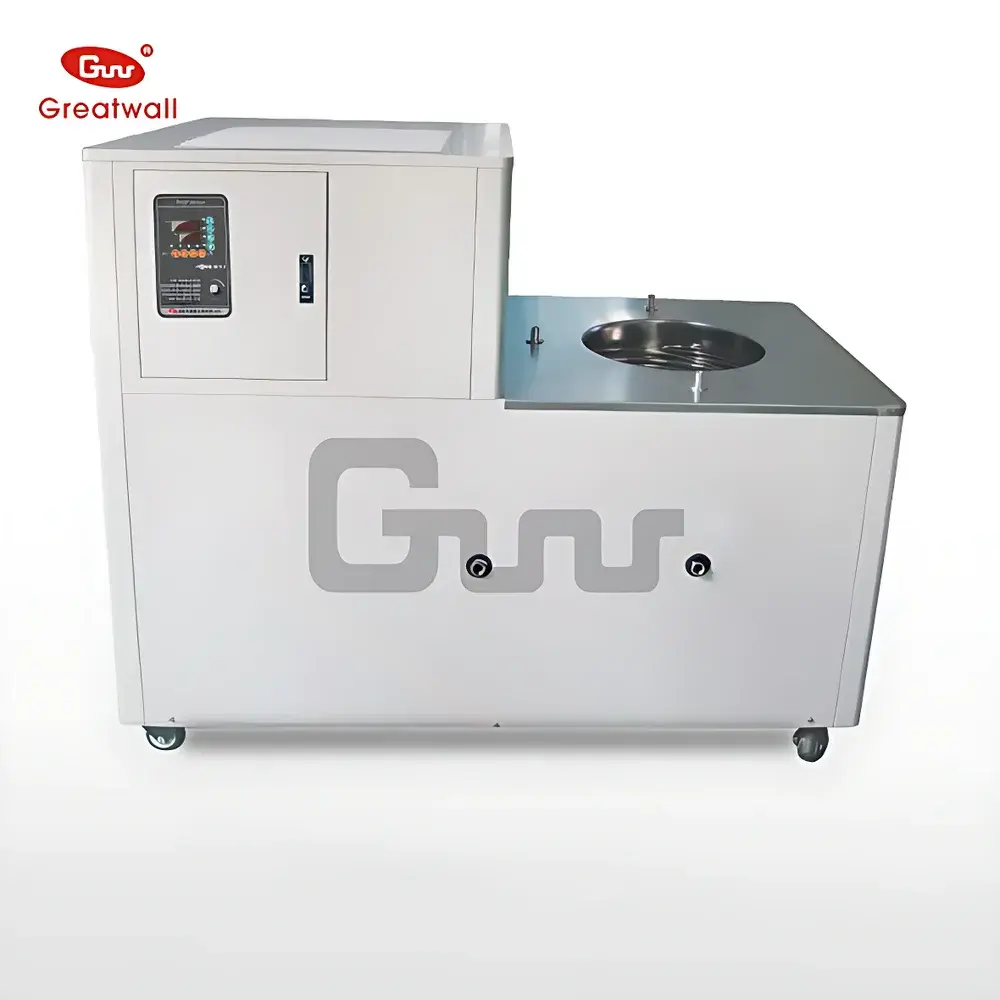
The Great Wall DHJF-1230 Ultra-Low Temperature Stirred Reaction Bath
| Brand | The Great Wall |
|---|---|
| Origin | Henan, China |
| Manufacturer Type | Direct Manufacturer |
| Country of Origin | China |
| Model | DHJF-1230 |
| Price | Upon Request |
| Temperature Range | −120 °C to −60 °C |
| Ambient Temperature Range | 5–25 °C |
| Temperature Stability | ±2 °C |
| Power Supply | 3-phase, 380 V, 50 Hz |
| Bath Capacity | 30 L |
| Bath Dimensions (Ø × H) | 400 mm × 235 mm |
| Opening Diameter | 320 mm |
| Cooling Capacity | 620 W at −60 °C |
| Max Flask Size | 10,000 mL |
| Total Power Consumption | 3234 W |
| Housing Material | Cold-Rolled Steel with Electrostatic Powder Coating |
| Overall Dimensions (L×W×H) | 1160 × 800 × 1310 mm |
| Net Weight | 190 kg |
Overview
The Great Wall DHJF-1230 Ultra-Low Temperature Stirred Reaction Bath is an engineered thermal management system designed for demanding low-temperature synthetic chemistry, cryogenic reaction control, and material property testing in research laboratories and pilot-scale production environments. It employs a single-stage compression fractional condensation refrigeration cycle—optimized for extended operation down to −120 °C—without requiring liquid nitrogen or cascade multi-stage compressors. This architecture enables stable, continuous cooling across the −120 °C to −60 °C range while maintaining mechanical robustness and long-term operational repeatability. Unlike conventional cryobaths limited by bath fluid freezing points or external coolant dependency, the DHJF-1230 integrates a sealed, corrosion-resistant circulation loop with proprietary heat-exchange geometry to ensure uniform thermal distribution and minimal temperature gradient across the bath volume. Its design conforms to IEC 61000-6-2 (immunity) and IEC 61000-6-4 (emission) standards for laboratory equipment, and meets structural safety requirements per ISO 13857 for accessible hazardous zones.
Key Features
- Single-stage compression fractional condensation refrigeration system enabling sustained operation at −120 °C—validated per ASTM E742 for low-temperature stability verification protocols.
- Critical components—including hermetic scroll compressors, expansion valves, and condenser fans—sourced from Tier-1 suppliers in the United States, Germany, and France to ensure MTBF >15,000 hours under continuous load.
- Digital PID temperature controller with membrane keypad interface and high-contrast LED display; supports setpoint ramping, hold functions, and real-time deviation monitoring.
- 304 stainless steel bath tank combined with chemically inert polymer-lined circulation tubing and pump housing—resistant to methanol, ethanol, acetone, and chlorinated solvents commonly used as secondary coolants.
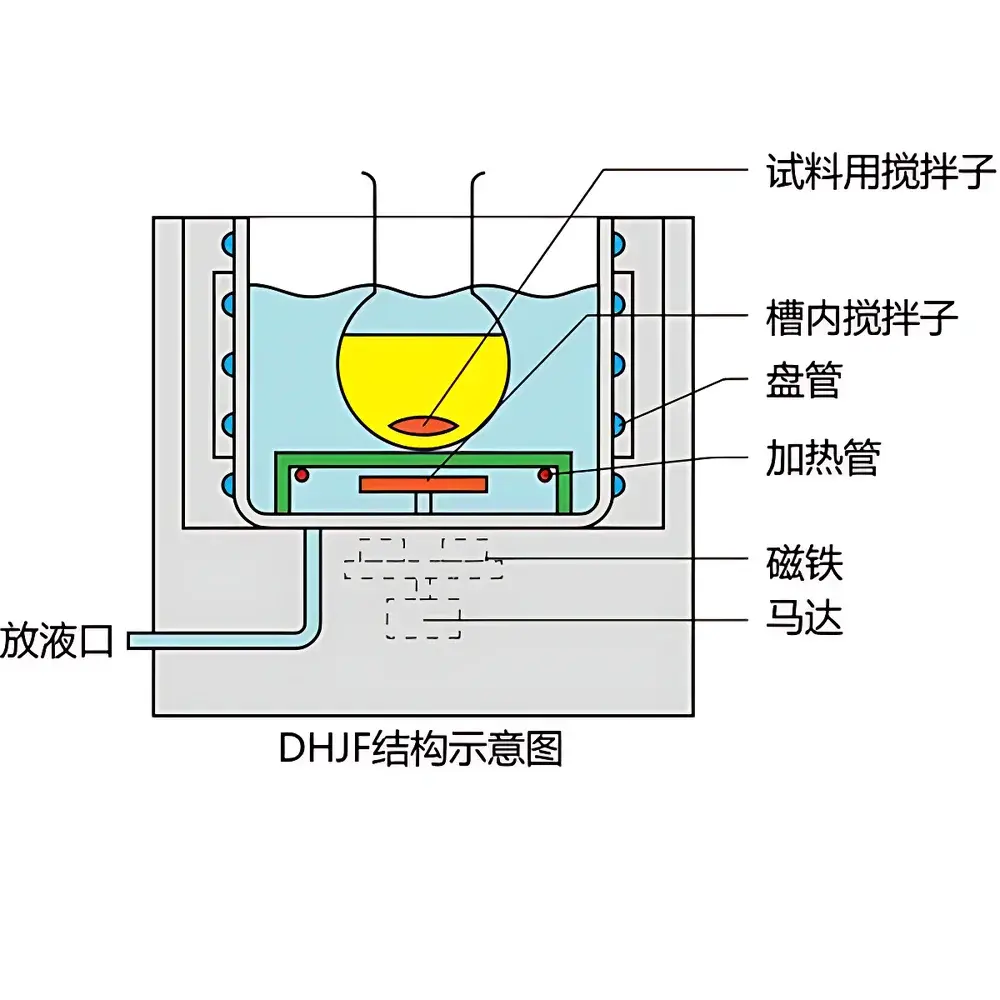
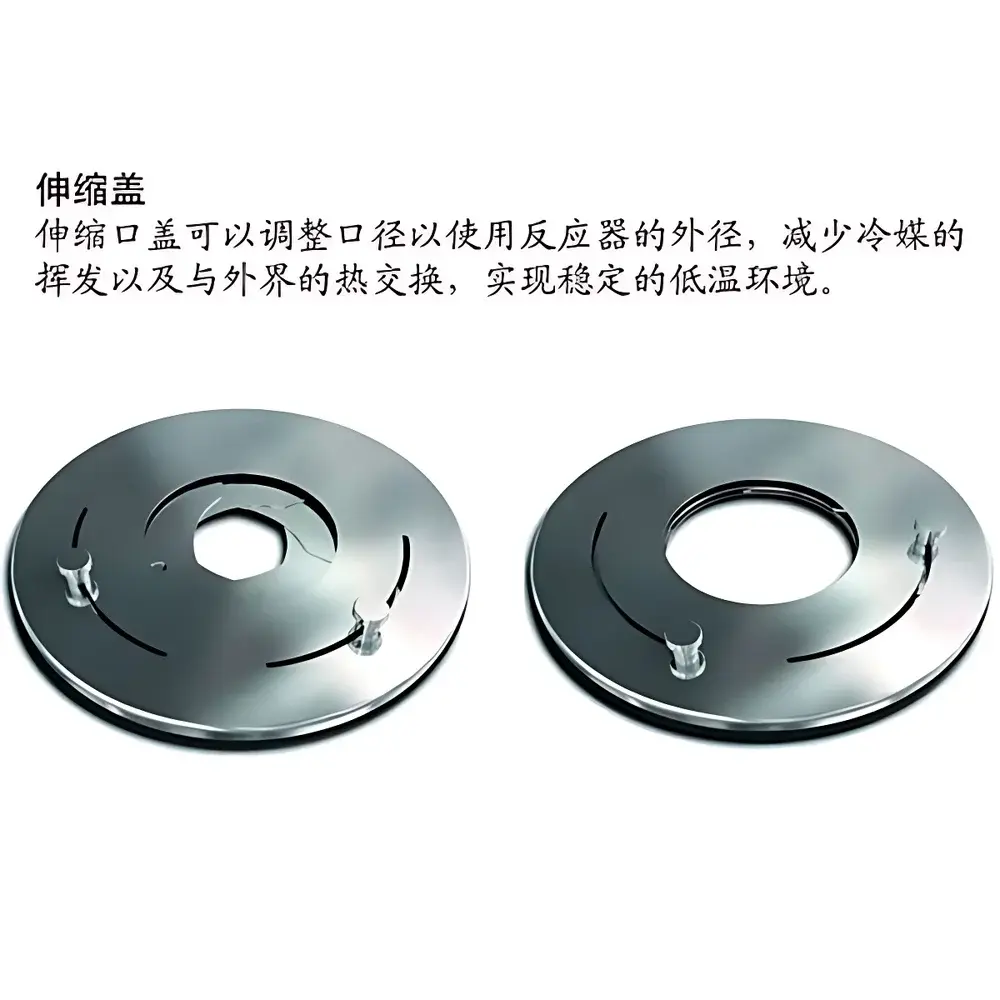
- Integrated mechanical stirring mechanism (optional shaft coupling) compatible with standard overhead stirrers; bath opening diameter (Φ320 mm) accommodates jacketed reactors up to 10 L capacity.
- Thermal insulation using vacuum-enhanced polyurethane foam (λ = 0.022 W/m·K) minimizes ambient heat ingress and reduces energy consumption during prolonged dwell at −100 °C.
Sample Compatibility & Compliance
The DHJF-1230 is intended for use with glass, stainless steel, and PTFE-lined reaction vessels operating under atmospheric or reduced pressure. It is not rated for flammable solvent immersion below their flash points without additional engineering controls (e.g., explosion-proof motor integration or inert gas purging). The unit complies with CE marking requirements under the EU Machinery Directive 2006/42/EC and Low Voltage Directive 2014/35/EU. All electrical interfaces meet IP20 ingress protection classification. For GLP/GMP-regulated environments, optional audit-trail-enabled firmware (v3.2+) supports 21 CFR Part 11-compliant electronic records when paired with validated data acquisition software.
Software & Data Management
While the base configuration operates via front-panel controls, optional RS485 Modbus RTU or Ethernet TCP/IP communication modules enable integration into centralized lab infrastructure. Compatible with LabVIEW™, MATLAB® Instrument Control Toolbox, and SCADA platforms for remote setpoint adjustment, real-time temperature logging, and alarm event forwarding. Data export formats include CSV and XML; time-stamped logs include ambient temperature, compressor discharge pressure, and bath sensor variance—supporting root-cause analysis per ISO/IEC 17025 Clause 7.7 on measurement uncertainty documentation.
Applications
- Low-temperature Grignard, organolithium, and lithiation reactions requiring precise thermal control between −110 °C and −70 °C.
- Cryogenic crystallization studies of pharmaceutical intermediates where polymorph selection is temperature-dependent.
- Calibration of infrared detectors and bolometers in metrology labs operating under ISO/IEC 17025-accredited conditions.
- Material testing of elastomers, composites, and battery electrolytes at sub-100 °C thermal states per ASTM D1043 and ISO 6722.
- Stabilization of enzymatic assays sensitive to thermal drift during extended kinetic profiling.
FAQ
Does the DHJF-1230 support continuous circulation below −100 °C?
No. As specified in the technical datasheet, the internal circulation system is disabled below −100 °C to prevent pump cavitation and fluid phase separation. Operation in this range requires static bath mode only.
What coolant fluids are recommended for use with this bath?
A mixture of 60% ethylene glycol and 40% deionized water is standard. For temperatures below −80 °C, certified low-viscosity silicone oils (e.g., Dow Corning® 200 Fluid, 50 cSt) are required. Methanol-based coolants are prohibited due to material compatibility risks.
Is external stirring synchronization supported?
Yes—via optional analog 0–10 V or 4–20 mA input for speed correlation with bath temperature, enabling closed-loop reaction control strategies.
Can the unit be integrated into a building management system (BMS)?
Yes, through Modbus TCP gateway modules supporting BACnet/IP mapping for HVAC-level environmental monitoring and fault reporting.



