
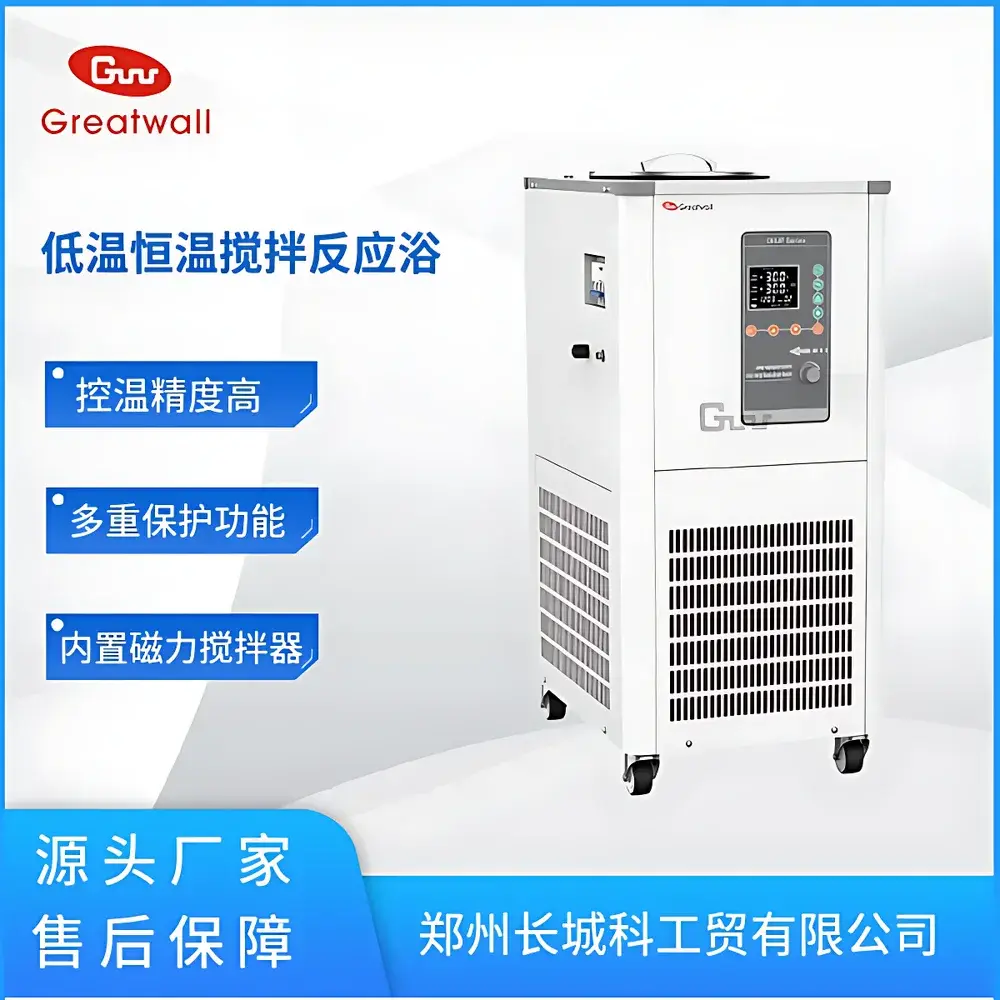
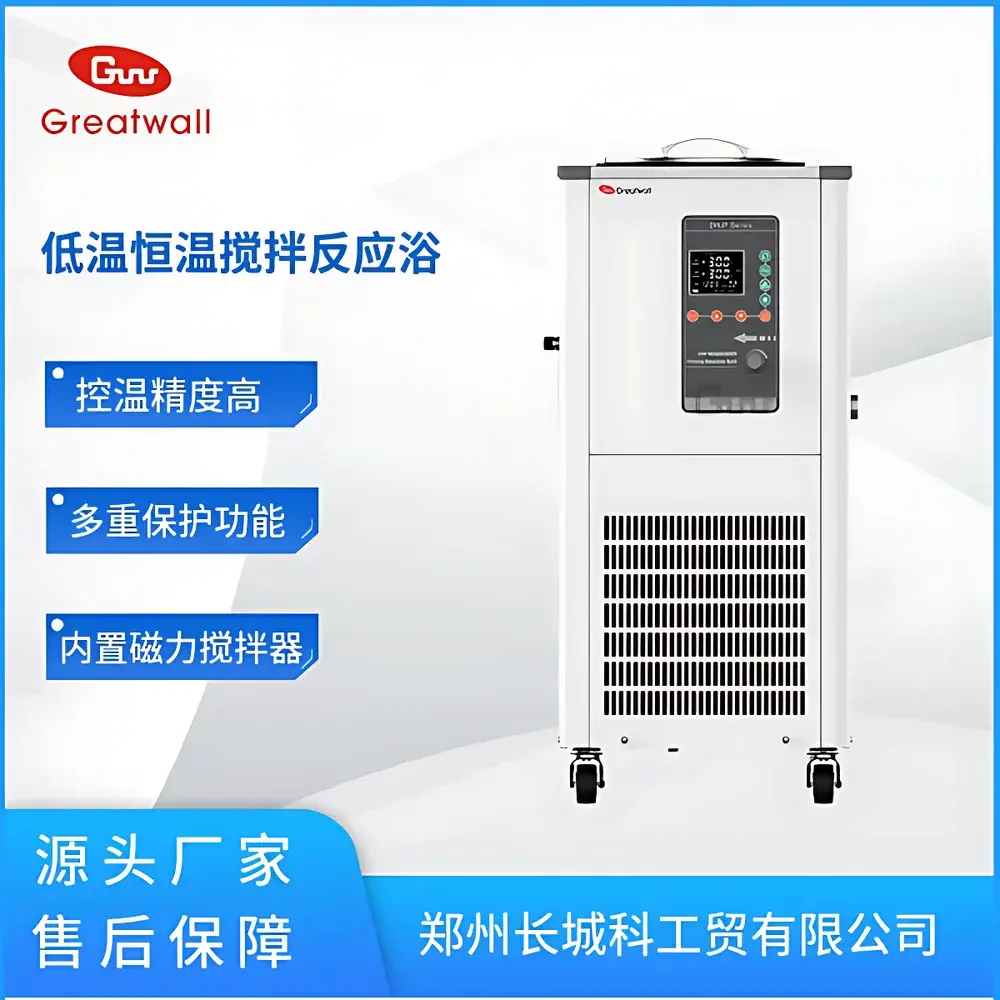
The Great Wall DHJF-3010 Low-Temperature Constant-Temperature Stirring Reaction Bath
| Brand | The Great Wall |
|---|---|
| Origin | Henan, China |
| Manufacturer Type | Manufacturer |
| Product Category | Domestic |
| Model | DHJF-3010 |
| Instrument Type | Constant-Temperature Bath |
| Circulation Mode | Internal & External |
| Temperature Control | Refrigeration & Heating |
| Bath Volume (L) | 10 |
| Temperature Range (°C) | −30 to 99 |
| Temperature Stability (°C) | ±0.5 |
| Total Power Input (W) | 2400 |
| Voltage/Frequency | 220 V~, 50 Hz |
| Heating Power (W) | 1500 |
| Magnetic Stirring Power (W) | 50 |
| Stirring Speed (rpm) | 100–1000 |
| Refrigerant | R410A |
| Cooling Capacity (W) @ 10°C/0°C/−10°C/−20°C/−30°C | 1700/1250/800/300/150 |
| Pump Flow Rate (L/min) | 20 |
| Pump Pressure (bar) | 0.4 |
| Opening Diameter (mm) | Φ210 |
| Bath Dimensions (mm) | Φ250 × 250 |
| Overall Dimensions (mm) | 395 W × 505 D × 825 H |
| Net Weight (kg) | 60 |
| Ambient Operating Temperature (°C) | 5–35 |
| Ambient Relative Humidity | ≤70% |
| External Circulation Port | 1/2" NPT |
Overview
The Great Wall DHJF-3010 Low-Temperature Constant-Temperature Stirring Reaction Bath is an integrated thermal management system engineered for precision temperature control and active mixing in laboratory-scale chemical synthesis, kinetic studies, and material characterization workflows. It operates on a dual-mode thermoelectric refrigeration and resistive heating architecture, utilizing R410A refrigerant in a hermetically sealed vapor-compression cycle combined with high-efficiency immersion heaters. This enables stable operation across a wide working range from −30 °C to +99 °C — a critical capability for exothermic reaction quenching, cryogenic catalysis, or high-temperature polymerization studies. Unlike passive baths, the DHJF-3010 integrates a built-in magnetic stirrer (50 W, 100–1000 rpm) that simultaneously agitates both the bath fluid and reaction vessels via coupling with external stirring bars — ensuring uniform thermal distribution throughout sample volumes up to 3 L. Its 10 L stainless-steel (AISI 304) reservoir provides sufficient thermal mass for low-drift operation, while the ±0.5 °C temperature stability meets ISO/IEC 17025 requirements for calibration traceability in accredited QC laboratories.
Key Features
- Intelligent PID temperature controller with auto-tuning algorithm, enabling rapid setpoint attainment and minimal overshoot under dynamic load conditions
- Dual-circulation design: internal recirculation maintains bath homogeneity; external 1/2″ NPT port supports closed-loop cooling/heating of auxiliary equipment (e.g., condensers, spectrophotometer cells, or jacketed reactors)
- Adjustable telescopic lid with Φ210 mm aperture minimizes evaporation loss of ethylene glycol/water or silicone oil mixtures and reduces ambient heat exchange — essential for long-duration low-temperature experiments
- Integrated support rod system accommodates standardized lab hardware including burettes, pH electrodes, PT100 probes, and reflux condensers without requiring additional clamps
- Comprehensive safety architecture: dry-run protection for heater elements, overtemperature cutoff (hardware-based independent sensor), ground-fault circuit interruption (GFCI), thermal fuse, and current-limiting circuitry compliant with IEC 61010-1 Edition 3
Sample Compatibility & Compliance
The DHJF-3010 accommodates standard laboratory glassware including round-bottom flasks (up to 3000 mL), test tubes, crystallization dishes, and jacketed reaction vessels. Its open-bath geometry and adjustable lid allow direct insertion of temperature-sensitive probes or optical fibers for in situ monitoring. The AISI 304 stainless-steel reservoir resists corrosion from common heat-transfer fluids (e.g., 50/50 ethylene glycol–water, mineral oil, or silicone oil), supporting GLP-compliant documentation of fluid change intervals and maintenance logs. All electrical components meet CE marking requirements per EN 61326-1 (EMC) and EN 61010-1 (safety). While not FDA 21 CFR Part 11–certified out-of-the-box, the system’s analog temperature output (0–10 V or 4–20 mA optional) supports integration into validated data acquisition systems with audit trail and electronic signature capabilities.
Software & Data Management
The DHJF-3010 operates as a standalone instrument with front-panel digital interface and real-time LED display of setpoint, actual temperature, and stirring speed. For automated data logging, optional RS485 Modbus RTU or USB-to-serial interface enables bidirectional communication with third-party SCADA platforms (e.g., LabVIEW, MATLAB, or custom Python scripts). Temperature and RPM values can be sampled at user-defined intervals (1–60 s) and exported in CSV format. When deployed in regulated environments, users may implement procedural controls — such as mandatory operator ID entry prior to parameter modification — to satisfy ALCOA+ principles (Attributable, Legible, Contemporaneous, Original, Accurate, Complete, Consistent, Enduring, Available) during IQ/OQ/PQ validation protocols.
Applications
- Controlled-rate crystallization and polymorph screening in pharmaceutical development
- Low-temperature Grignard or organolithium reactions requiring precise thermal ramping and inert atmosphere compatibility
- Calibration of differential scanning calorimeters (DSC) and thermogravimetric analyzers (TGA) using NIST-traceable reference materials
- Thermal stress testing of nanomaterial dispersions and colloidal stability assessment
- Enzyme kinetics assays where activity must be measured across defined temperature gradients (e.g., 10–45 °C)
- Supporting cold-trap operation in rotary evaporation systems via external circulation
FAQ
What types of heat-transfer fluids are compatible with the DHJF-3010?
Recommended fluids include aqueous ethylene glycol solutions (for −30 °C to +60 °C), silicone oils (for +60 °C to +99 °C), and specialized low-viscosity synthetic esters for extended low-temperature operation. Avoid chlorinated solvents or acetone due to material compatibility risks with seals and pump components.
Can the unit maintain −30 °C continuously when operating in a 35 °C ambient environment?
Continuous operation at −30 °C requires ambient temperatures ≤30 °C and adequate ventilation around the rear condenser coils. At 35 °C ambient, sustained operation is limited to ≥−20 °C; consult the derating curve in Section 4.2 of the technical manual for precise capacity mapping.
Is the magnetic stirring function isolated from the refrigeration system?
Yes. The stirrer motor is magnetically coupled through the bath bottom plate and electrically insulated from the coolant loop. No fluid contact occurs between the drive mechanism and thermal fluid, eliminating contamination risk and ensuring long-term reliability.
Does the DHJF-3010 support remote start/stop via digital signal?
Standard configuration includes dry-contact terminals for external TTL-level start/stop triggering. Optional programmable logic controller (PLC) interface modules provide 0–10 V analog setpoint modulation and status feedback signals (ready, fault, temperature alarm).
What documentation is provided for regulatory compliance purposes?
Each unit ships with Factory Calibration Certificate (traceable to CNAS-accredited standards), Electrical Safety Test Report (per IEC 61010-1), RoHS/REACH Declaration of Conformity, and full schematic diagrams for IQ/OQ protocol development.
Related Products



