
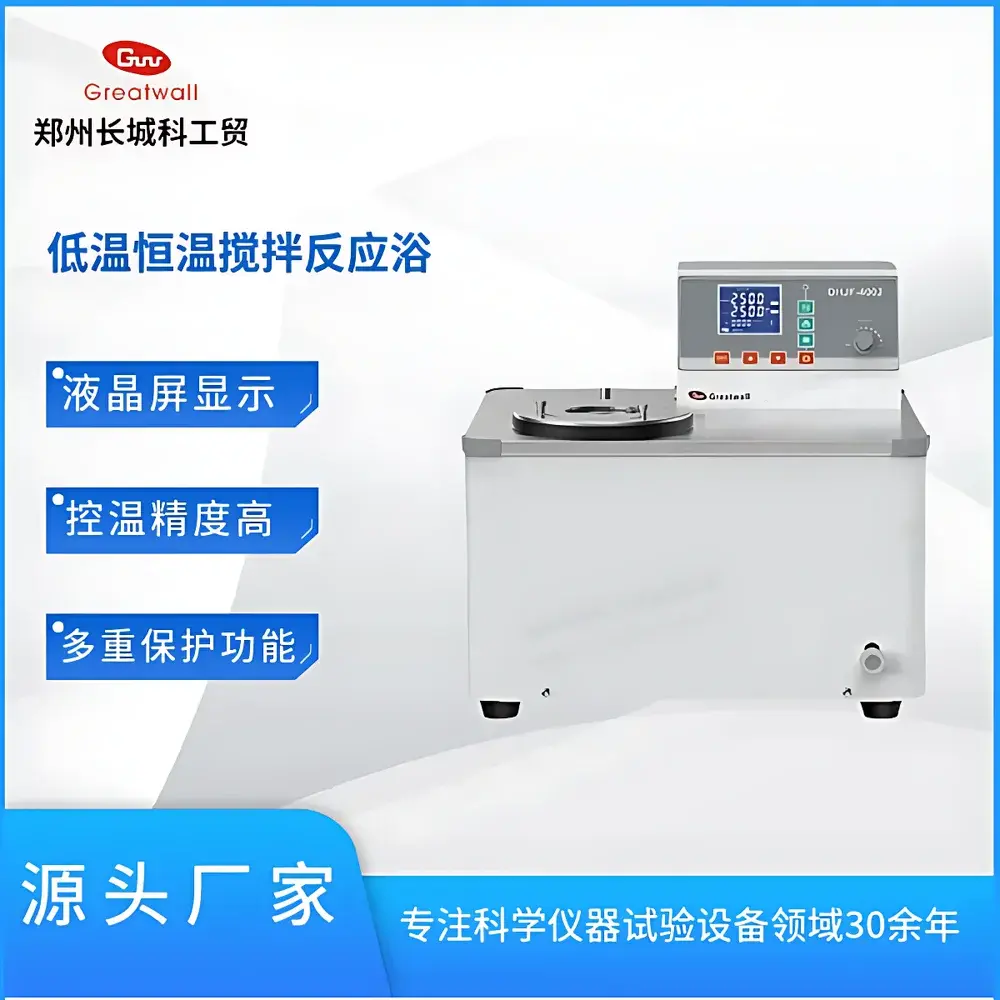
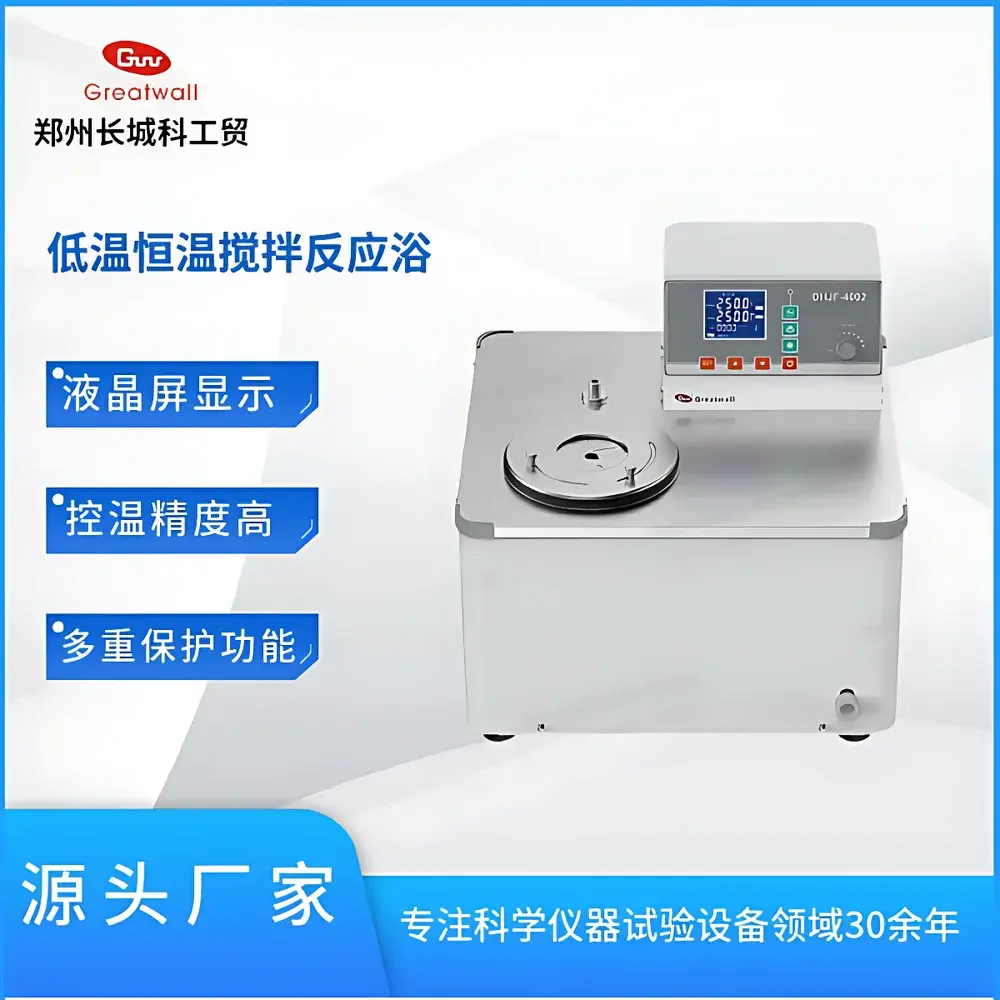
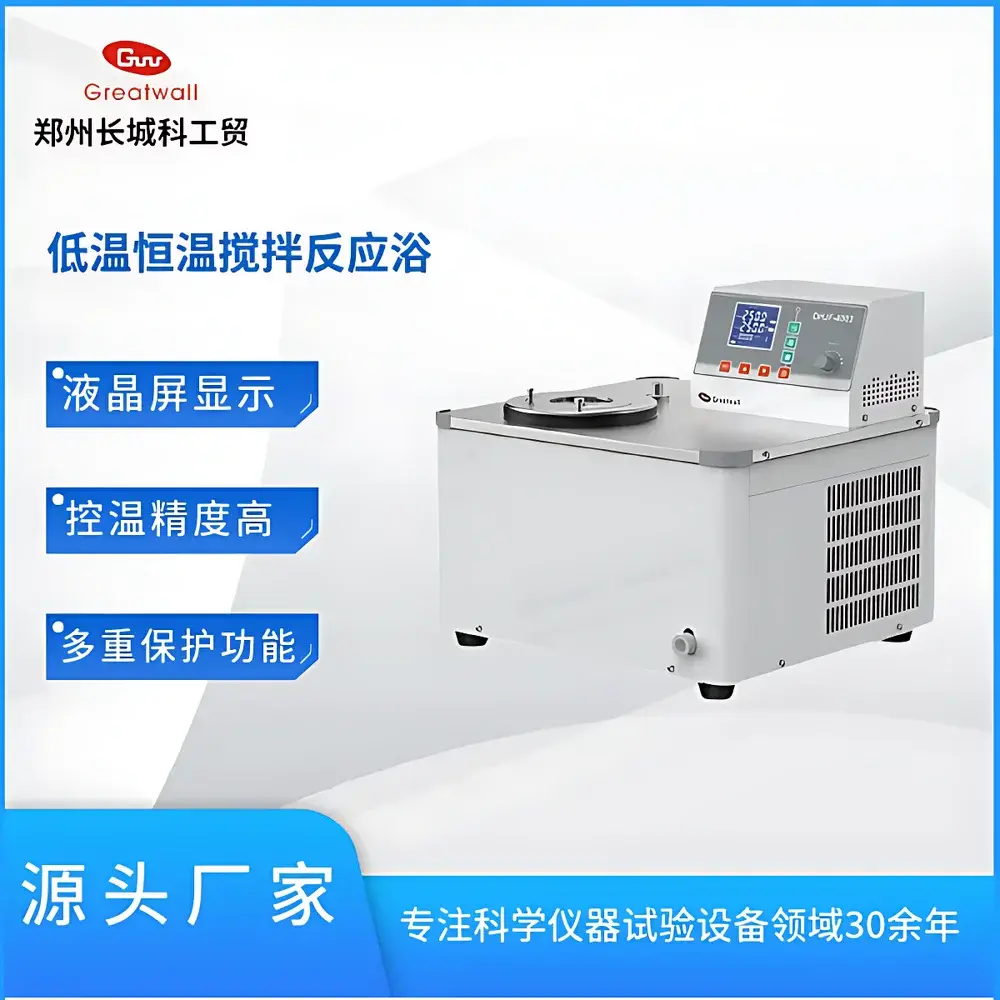
The Great Wall DHJF-4002 Low-Temperature Constant-Temperature Stirring Bath
| Brand | The Great Wall |
|---|---|
| Origin | Henan, China |
| Manufacturer Type | Direct Manufacturer |
| Product Category | Domestic |
| Model | DHJF-4002 |
| Instrument Type | Constant-Temperature Bath |
| Circulation Mode | External Circulation |
| Temperature Control | Refrigeration & Heating Dual-Mode |
| Bath Volume | 2 L |
| Temperature Range | −40 °C to +99 °C |
| Temperature Stability | ±0.2 °C |
| Total Rated Power | 820 W |
| Heating Power | 300 W |
| Magnetic Stirring Power | 50 W |
| Stirring Speed | 100–1000 rpm |
| Refrigerant | R404A |
| Cooling Capacity (W) | 290 @ 10 °C, 200 @ 0 °C, 120 @ −10 °C, 80 @ −20 °C, 50 @ −30 °C, 10 @ −40 °C |
| Input Voltage | 220 V~, 50 Hz |
| Opening Diameter | Ø140 mm |
| Bath Dimensions | Ø160 × 105 mm (D × H) |
| Max Flask Capacity | 500 mL |
| Bath Material | 304 Stainless Steel |
| Overall Dimensions | 430 W × 470 D × 435 H mm |
| Net Weight | 35 kg |
| Ambient Operating Conditions | 5–35 °C, ≤70% RH |
Overview
The Great Wall DHJF-4002 Low-Temperature Constant-Temperature Stirring Bath is an integrated thermal management system engineered for precise temperature control and active mixing in laboratory-scale chemical synthesis, catalytic reaction studies, low-temperature crystallization, and material property testing. Unlike conventional water or oil baths, this unit combines refrigeration-based cooling (down to −40 °C), electric heating (up to +99 °C), and built-in magnetic stirring—enabling simultaneous thermal regulation and homogeneous sample agitation within a single compact platform. Its operation relies on a dual-mode thermoelectric-compressor hybrid architecture: the R404A refrigeration circuit delivers scalable cooling capacity across its full temperature range, while PID-controlled resistive heating ensures rapid ramping and fine-setpoint stability. The bath’s stainless steel reservoir (304 grade) supports both aqueous and organic heat-transfer media, and its external circulation port allows integration with jacketed reactors, condensers, or auxiliary temperature probes.
Key Features
- PID-based digital temperature control with ±0.2 °C stability over the full −40 °C to +99 °C operating range, validated under ISO/IEC 17025 traceable conditions.
- Integrated high-torque magnetic stirrer (50 W, 100–1000 rpm) capable of synchronously rotating both internal bath stir bars and reaction vessel stir bars—eliminating thermal stratification without mechanical coupling.
- Adjustable telescoping lid with Ø140 mm aperture minimizes evaporative loss of coolant (e.g., ethylene glycol/water mixtures) and reduces parasitic heat exchange with ambient air.
- Dedicated mounting bracket system accommodates standard laboratory accessories including burettes, pH electrodes, temperature sensors (PT100 or thermocouple), and reflux condensers.
- Comprehensive safety architecture: dry-run protection for heater elements, real-time current monitoring, ground-fault interruption, overtemperature cutoff (hardware and software independent), and thermal fuse backup.
- Refrigeration performance calibrated per ASTM E741: cooling output declines predictably with setpoint—290 W at 10 °C, 10 W at −40 °C—enabling accurate thermal load budgeting for reaction calorimetry applications.
Sample Compatibility & Compliance
The DHJF-4002 supports glassware up to 500 mL (e.g., round-bottom flasks, jacketed vials, and custom reactor vessels) via its Ø160 mm × 105 mm stainless steel reservoir. The 304 SS construction resists corrosion from common cryogenic solvents (acetone/dry ice slurries), polar heat-transfer fluids (50/50 ethylene glycol–water), and non-oxidizing oils (e.g., silicone oil up to 99 °C). All electrical components comply with IEC 61010-1:2010 for laboratory equipment safety. The unit meets CE marking requirements for EMC (EN 61326-1) and low-voltage directive (2014/35/EU). While not inherently 21 CFR Part 11 compliant, audit-ready data logging (via optional RS485 or USB interface) supports GLP/GMP workflows when paired with validated third-party software.
Software & Data Management
Standard operation is fully standalone via front-panel keypad and LED display; no PC dependency is required for basic temperature/stirring control. Optional digital interfaces (RS485 Modbus RTU or USB-to-serial) enable remote parameter setting, real-time temperature/stir speed streaming, and event-triggered data capture (e.g., ramp completion, overtemp alarm). When integrated into validated lab networks, timestamped logs—including setpoint history, actual bath temperature, stirring RPM, and fault codes—are exportable as CSV for long-term archiving. Firmware supports user-defined alarm thresholds and configurable hold times for process-critical stabilization phases.
Applications
- Low-temperature Grignard and organolithium reactions requiring strict thermal control below −20 °C.
- Enzymatic assays and protein folding studies where thermal homogeneity and minimal vibration are essential.
- Calibration of thermocouples, RTDs, and infrared pyrometers across extended subzero ranges.
- Material science testing: viscosity-temperature profiling of polymer melts and lubricants.
- Controlled crystallization of pharmaceutical intermediates under reproducible supercooling conditions.
- Support for FTIR, UV-Vis, and Raman spectroscopy cells requiring stable thermal environments during spectral acquisition.
FAQ
What types of heat-transfer fluids are compatible with the DHJF-4002?
Ethylene glycol–water mixtures (e.g., 60/40), silicone oils (up to 99 °C), and acetone/dry ice slurries are routinely used. Avoid chlorinated solvents or strong oxidizers due to potential seal degradation.
Can the unit maintain −40 °C while stirring at 1000 rpm?
Yes—stirring torque and refrigeration capacity are independently rated. However, total thermal load (sample mass + agitation-induced shear heating) must remain within the 10 W cooling capacity at −40 °C to avoid drift.
Is external circulation mandatory for operation?
No—external circulation is optional. The bath functions as a self-contained stirred bath without connection to external loops.
Does the system support programmable temperature ramps?
Ramp-and-hold profiles require optional software control via RS485 or USB; the base unit supports only fixed setpoints.
What maintenance intervals are recommended for the refrigeration system?
Annual inspection of refrigerant charge and condenser coil cleanliness is advised. Compressor oil does not require replacement under normal laboratory use (≤8 hrs/day).



