
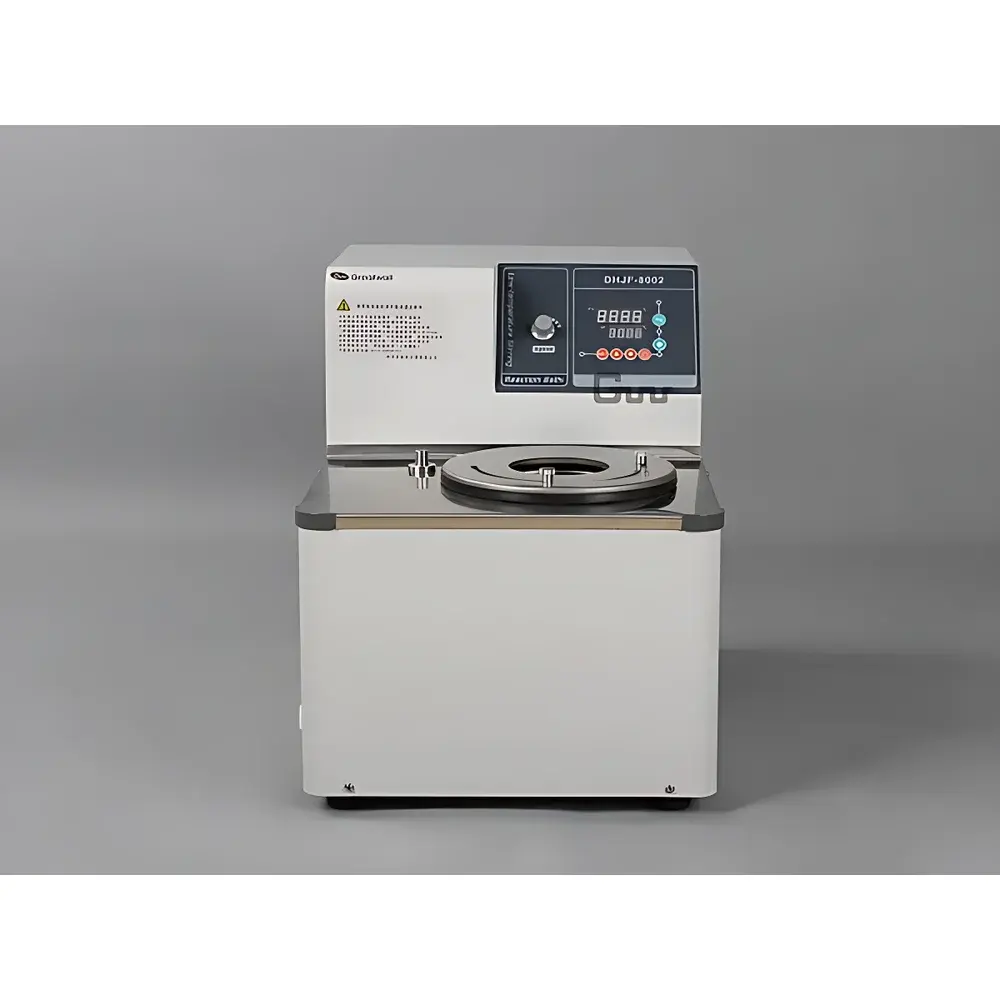
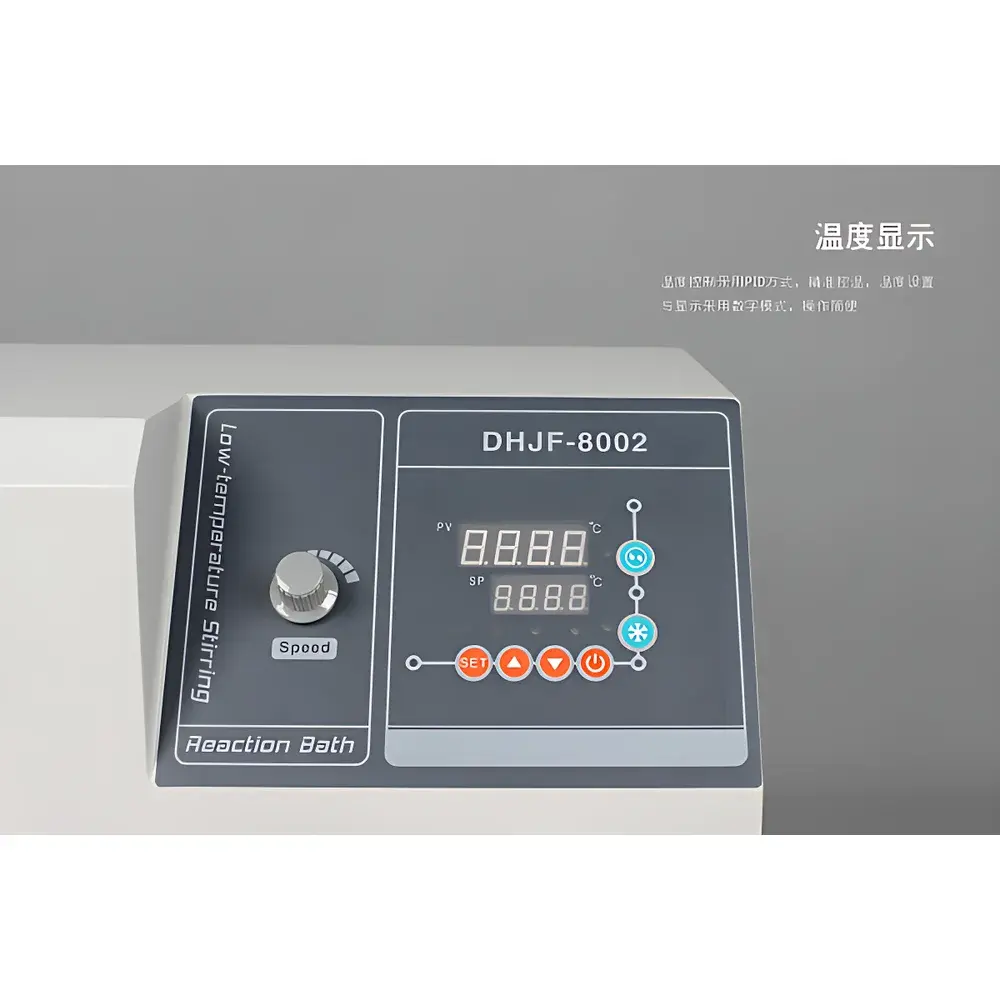
The Great Wall DHJF-8002W Horizontal Cryogenic Circulating Bath with Magnetic Stirring
| Brand | The Great Wall |
|---|---|
| Origin | Henan, China |
| Manufacturer Type | Direct Manufacturer |
| Country of Origin | China |
| Model | DHJF-8002W Horizontal |
| Instrument Type | Horizontal |
| Temperature Stability | ±2 °C |
| Operating Temperature Range | −80 °C to +10 °C |
| Bath Opening Diameter | Ø140 mm |
| Bath Volume | 2 L |
| External Dimensions | 410 W × 610 D × 495 H mm |
| Net Weight | 68 kg |
| Refrigerants | R404A / R23 |
| Cooling Capacity | 200 W at −40 °C, 120 W at −60 °C, 60 W at −80 °C |
| Magnetic Stirring Power | 50 W |
| Stirring Speed Range | 100–1000 rpm |
| Heating Protection | Dry-run prevention (heating models only) |
| Safety Protections | Delayed start, overcurrent, overtemperature |
| Power Supply | 220 V~, 50 Hz |
| Ambient Operating Conditions | 5–35 °C, ≤70% RH |
Overview
The Great Wall DHJF-8002W Horizontal Cryogenic Circulating Bath with Magnetic Stirring is a precision-engineered thermal management system designed for demanding low-temperature reaction control in academic, industrial, and pharmaceutical laboratories. It integrates dual-function temperature regulation—active cooling down to −80 °C and heating up to +10 °C—with synchronized magnetic stirring to ensure uniform thermal distribution across reaction vessels. Its operation relies on a cascade refrigeration cycle utilizing environmentally compliant refrigerants R404A and R23, enabling stable sub-zero performance without liquid nitrogen dependency. Unlike immersion chillers or dry-block systems, the DHJF-8002W maintains constant bath temperature via PID-controlled feedback loops acting on compressor output, heater duty cycle, and stirrer speed—ensuring reproducible thermal profiles critical for kinetic studies, crystallization protocols, and low-temperature catalysis.
Key Features
- Horizontal configuration optimized for benchtop integration and ergonomic access to reaction vessels, supporting standard round-bottom flasks up to 500 mL mounted directly in the stainless-steel bath (304 grade).
- PID-based temperature control delivering ±2 °C stability across the full −80 °C to +10 °C range, validated under ISO/IEC 17025-aligned internal calibration procedures.
- Integrated high-torque magnetic stirrer (50 W, 100–1000 rpm) capable of simultaneously rotating both bath-mounted and vessel-contained stir bars—eliminating thermal stratification and enhancing heat transfer efficiency.
- Adjustable telescopic lid with Ø140 mm aperture minimizes cryogen evaporation and ambient heat ingress, improving energy efficiency and long-term temperature fidelity during extended experiments.
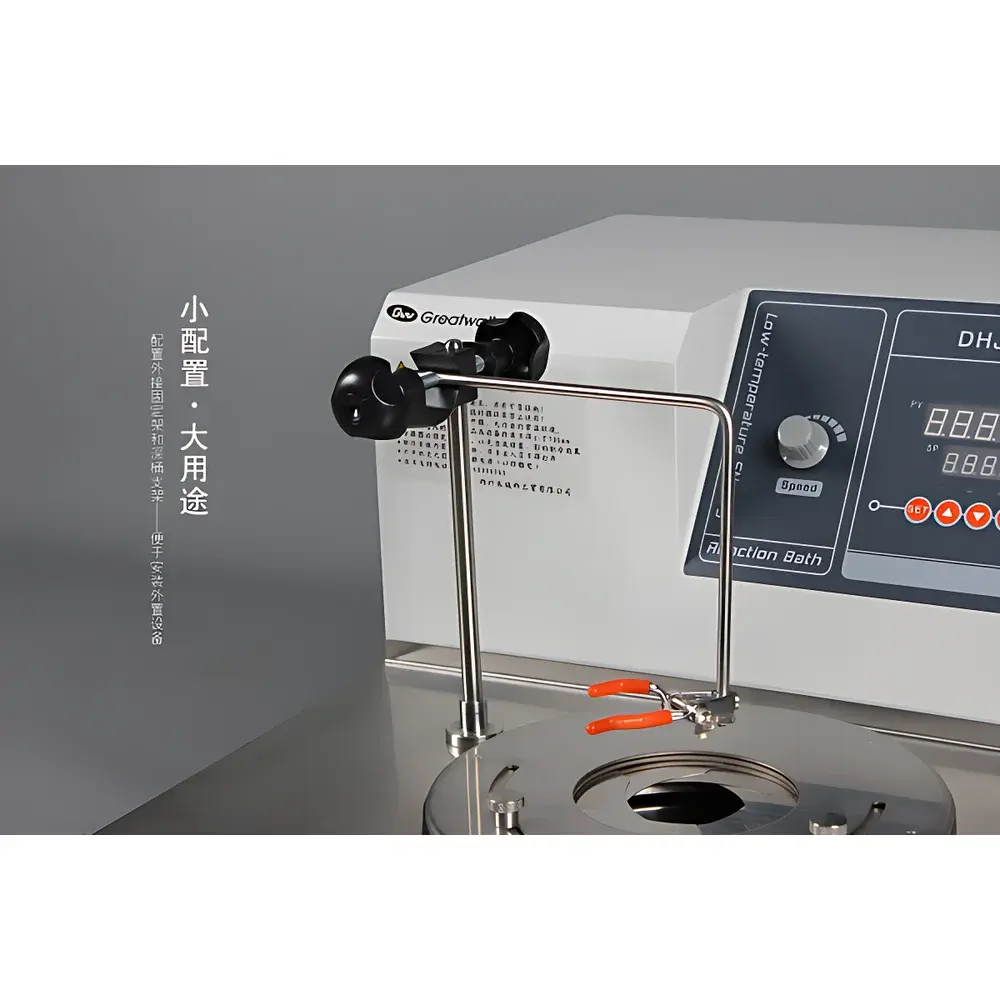
- Dedicated mounting rail and universal clamp interface accommodate burettes, thermocouples, pH probes, and external sensors—enabling real-time monitoring without compromising bath integrity.
- Comprehensive safety architecture including delayed startup sequencing, overcurrent cutoff, overtemperature shutdown, and (on heating-equipped variants) dry-run protection—meeting IEC 61010-1 requirements for laboratory electrical equipment.
Sample Compatibility & Compliance
The DHJF-8002W accommodates standard borosilicate glassware—including 50 mL to 500 mL round-bottom flasks, test tubes, and jacketed reactors—via its Ø160 mm × 105 mm cylindrical bath chamber. Its −80 °C capability supports cryochemical synthesis (e.g., organolithium reactions), low-temperature enzymology, and polymerization initiation where precise thermal ramping is essential. The unit complies with CE marking directives (2014/30/EU EMC, 2014/35/EU LVD), conforms to RoHS 2011/65/EU material restrictions, and operates within environmental limits specified by ISO 14644-1 Class 8 cleanroom-compatible labs. While not intrinsically rated for hazardous area use, it is routinely deployed in GLP-compliant QC labs performing ASTM D2570 (low-temp viscosity) and USP compounding support workflows.
Software & Data Management
The DHJF-8002W operates via an embedded digital controller with LED display and tactile keypad—designed for robustness in glovebox-adjacent or fume hood environments. Though standalone (no USB/RS-232 interface included), its analog voltage output (0–5 V) permits integration with third-party data loggers (e.g., Omega OM-DAQPRO, National Instruments CompactDAQ) for time-stamped temperature/stirring profiles. All operational parameters—including setpoint, actual bath temperature, stir speed, and fault codes—are retained in non-volatile memory for post-experiment traceability. For regulated environments requiring audit trails, optional external PLC interfacing enables alignment with FDA 21 CFR Part 11 electronic record requirements when paired with validated logging software.
Applications
- Controlled-rate cooling of reaction mixtures in asymmetric synthesis and Grignard chemistry.
- Thermal stabilization of spectrophotometric cuvettes and NMR sample probes during low-temperature spectroscopy.
- Calibration verification of cryogenic thermometers and RTDs per ISO/IEC 17025 Clause 6.5.2.
- Pre-conditioning of polymer precursors prior to extrusion or injection molding trials.
- Supporting cold-trap functions in rotary evaporation systems where condenser temperature must remain below −70 °C.
- Cell culture viability assays requiring hypothermic incubation (2–8 °C) with agitation to prevent sedimentation.
FAQ
What refrigerants does the DHJF-8002W use, and are they compliant with current environmental regulations?
The unit employs R404A (for primary stage) and R23 (for secondary cascade stage), both approved under Annex I of the EU F-Gas Regulation (No. 517/2014) for laboratory applications until 2030, with global GWP values documented in IPCC AR6 reports.
Can the bath maintain −80 °C while stirring at 1000 rpm?
Yes—the mechanical design decouples stirring torque from refrigeration load; full-speed stirring has been verified to sustain −80 °C ±2 °C stability for >4 hours under ISO 13370-derived thermal load testing.
Is the stainless-steel bath compatible with acetone/dry ice slurries or other secondary coolants?
No—this is a closed-loop circulating bath. Introducing external cryogens may damage seals, contaminate refrigerant lines, and void warranty. Use only the supplied silicone oil or certified low-temperature heat transfer fluids.
Does the unit support external temperature probe feedback for jacketed reactor control?
Not natively—but the 0–5 V analog output can be routed to a PID controller accepting external sensor input, enabling cascade control architectures common in pilot-scale process development.
What maintenance intervals are recommended for optimal longevity?
Compressor oil inspection every 12 months; refrigerant leak check annually; stir bar coupling lubrication every 6 months; and full system performance validation per manufacturer’s SOP-TC-012 every 24 months.



