
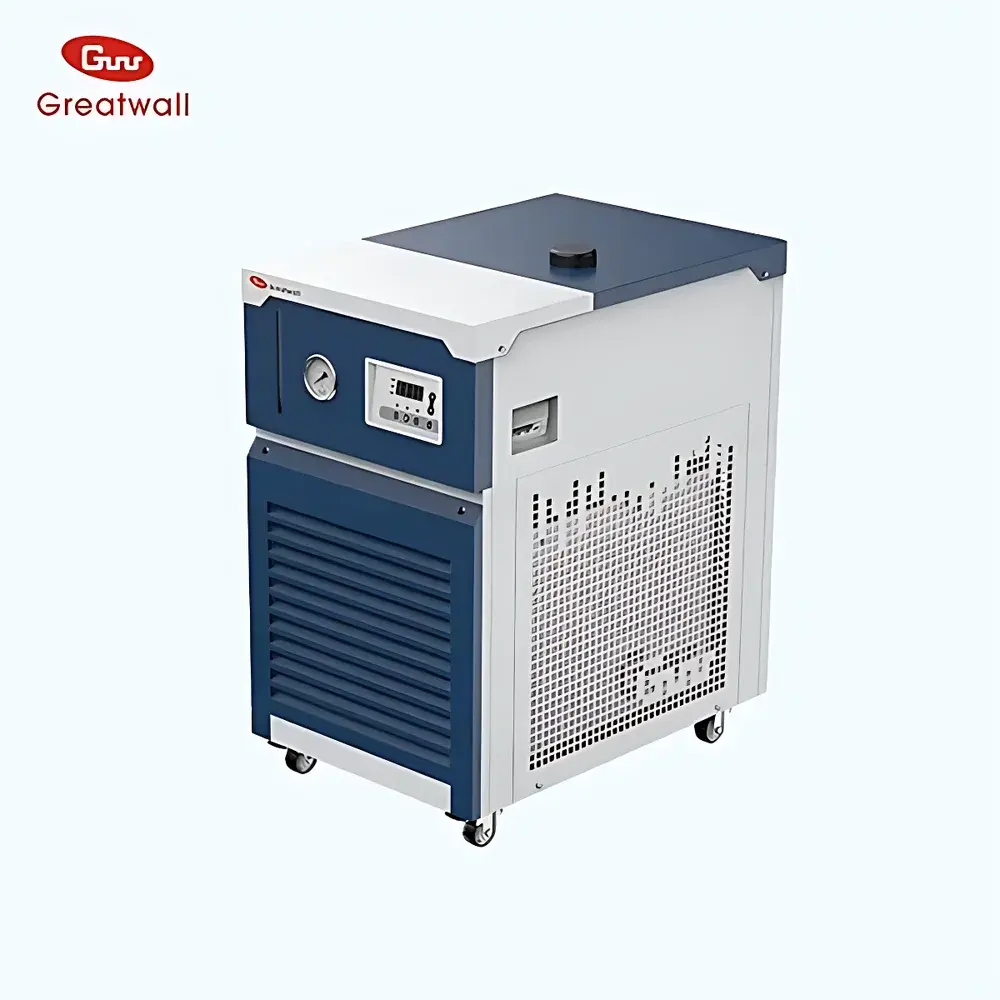
The Great Wall DL10-2000 Circulating Chiller
| Brand | The Great Wall |
|---|---|
| Origin | Henan, China |
| Manufacturer Type | Direct Manufacturer |
| Product Category | Domestic |
| Model | DL10-2000 |
| Instrument Type | Integrated Unit |
| Cooling Method | Air-Cooled |
| Temperature Control Range | −10 to 25 °C |
| Refrigeration Capacity | 2000 W @ 15 °C |
| Temperature Stability | ±2 °C |
| Circulation Pump Pressure | 1 bar |
| Circulation Flow Rate | 30 L/min |
| Reservoir Volume | 17 L |
| Operating Mode | Continuous |
Overview
The Great Wall DL10-2000 Circulating Chiller is an integrated, air-cooled refrigeration system engineered for stable, continuous thermal management in demanding laboratory environments. It operates on the vapor-compression cycle using R134a — a non-ozone-depleting, HFC-based refrigerant compliant with international environmental standards (e.g., Montreal Protocol Annexes and EU F-Gas Regulation). Designed for precision temperature control between −10 °C and +25 °C, the unit delivers 2000 W of cooling capacity at 15 °C ambient reference conditions, making it suitable for sustained heat extraction from high-power analytical instruments and process equipment. Its sealed circulation architecture minimizes evaporation loss and contamination risk, while the 17 L stainless steel (AISI 304) reservoir ensures sufficient thermal mass for load stabilization. The chiller supports external cooling loops via standardized Rc 1/2 internal-thread ports and maintains consistent flow (30 L/min) and pressure (1 bar) across variable backpressure conditions typical of multi-instrument manifolds.
Key Features
- Hermetically sealed, high-efficiency scroll compressor from a globally recognized OEM — optimized for low acoustic emission (<65 dB(A)) and extended service life under continuous operation.
- Adjustable high-pressure vane-type circulation pump (domestic high-performance or optional imported variant), enabling precise flow regulation to match instrument inlet specifications.
- Integrated Pt100 RTD sensor with digital LED display (0.1 °C resolution) and ±2 °C temperature stability over full operating range.
- Multi-layer safety architecture: compressor delay protection, high-pressure cut-off, overload current sensing, and thermal overcurrent interruption — all conforming to IEC 61000-6-2/6-4 EMC and IEC 61010-1 safety requirements.
- Corrosion-resistant 304 stainless steel reservoir with level indicator window and calibrated pressure gauge for real-time loop diagnostics.
- Modular mechanical design: removable left/right side panels facilitate rapid access to condenser coils, pump assembly, and refrigerant service valves without disassembly of structural framing.
- Environmentally certified refrigerant (R134a) with zero ODP and low GWP (1430), aligned with ISO 5149-2:2014 refrigeration system safety guidelines.
Sample Compatibility & Compliance
The DL10-2000 is compatible with aqueous glycol/water mixtures (typically 20–30% ethylene or propylene glycol) as secondary coolant, ensuring freeze protection down to −15 °C without compromising thermal conductivity or pump compatibility. It meets key regulatory expectations for laboratory infrastructure supporting GLP and GMP workflows, including traceable temperature logging capability (via optional analog/digital output interface), audit-ready maintenance records, and compliance with electrical safety standards applicable to Class I, Division 1 laboratory equipment per UL 61010-1 and CSA C22.2 No. 61010-1. While not intrinsically rated for hazardous locations, its sealed refrigerant circuit and grounded chassis minimize ignition risks in standard chemical laboratory settings.
Software & Data Management
The unit includes analog voltage (0–5 V or 0–10 V) and RS-485 Modbus RTU interfaces for integration into centralized building management systems (BMS) or LIMS-controlled lab environments. Optional data-logging modules support time-stamped temperature, pressure, and runtime data export in CSV format — facilitating adherence to FDA 21 CFR Part 11 requirements when paired with validated third-party software platforms. Firmware updates are performed via USB port, with version history and calibration checksums retained in non-volatile memory. All alarm events (e.g., low-level, high-pressure, sensor fault) trigger latching indicators and relay outputs for interlocked shutdown of connected instrumentation.
Applications
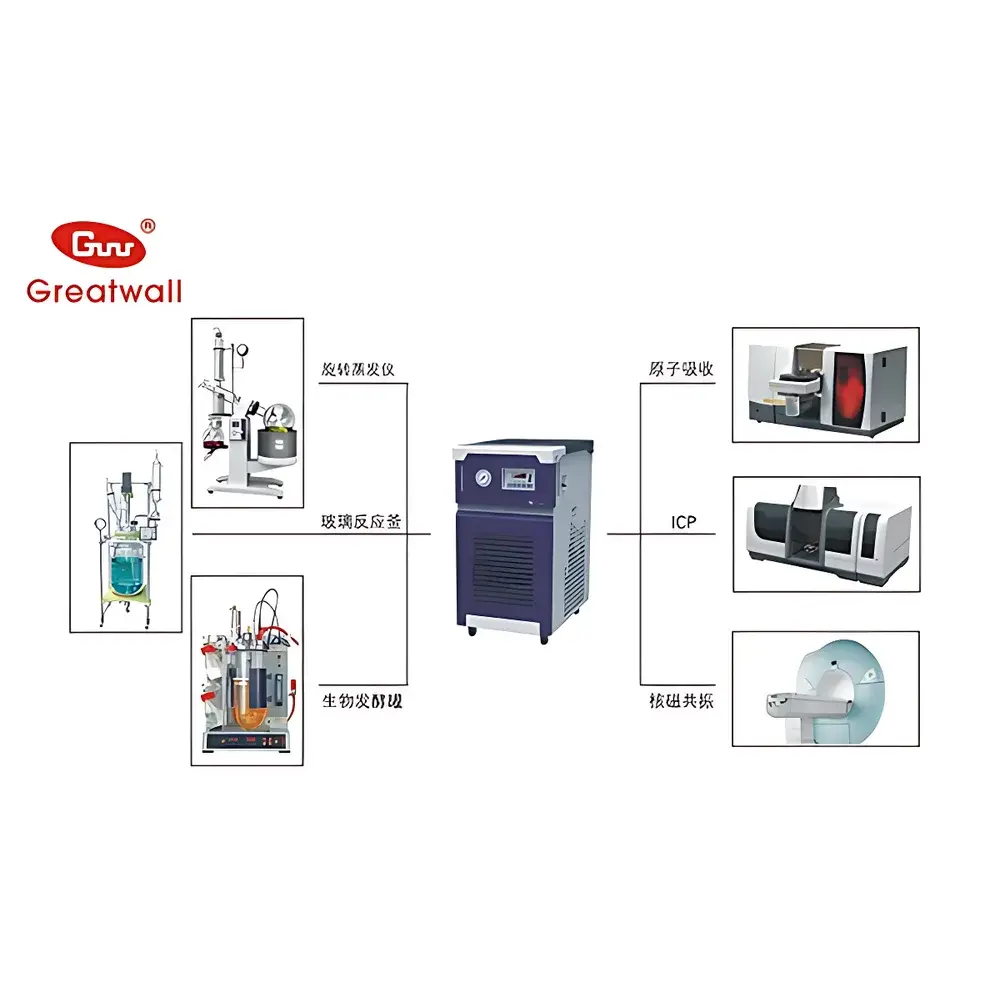
- Analytical Chemistry: Thermal stabilization of ICP-OES, ICP-MS, AAS, and LC-MS source regions; condenser cooling for rotary evaporators and vacuum concentration systems.
- Life Sciences: Temperature control for bioreactors, fermenters, and cryo-microscopy stages; cold trap support for lyophilizers and vacuum desiccators.
- Materials Characterization: Heat dissipation for SEM/TEM column coolers, XRD goniometers, XRF detectors, and magnetron sputtering targets.
- NMR & Laser Systems: Solvent cooling for high-field NMR probe preamplifiers; thermal management of DPSS lasers, Ti:sapphire oscillators, and optical parametric amplifiers.
- Industrial R&D: Process cooling for reaction calorimeters, extruder barrels, and vacuum metallization chambers requiring stable sub-ambient supply temperatures.
FAQ
What is the minimum achievable outlet temperature under no-load conditions?
The chiller achieves −10 °C at the reservoir outlet with no external load and ambient conditions ≤25 °C. Actual delivery temperature depends on flow rate, coolant composition, and system head loss.
Can this unit be used with organic solvents as coolant?
No. Only water-glycol mixtures (ethylene or propylene) are approved. Organic solvents may degrade seals, corrode stainless steel, or compromise refrigerant miscibility.
Is remote monitoring supported out-of-the-box?
Basic analog and Modbus RTU interfaces are standard. Full SCADA integration requires optional firmware configuration and external gateway hardware.
What maintenance intervals are recommended?
Compressor oil inspection every 24 months; condenser coil cleaning quarterly in dusty environments; glycol concentration testing semiannually.
Does the unit comply with electromagnetic compatibility directives?
Yes — certified to IEC 61000-6-2 (immunity) and IEC 61000-6-4 (emissions) for laboratory use, with CE marking valid for EU markets.



