
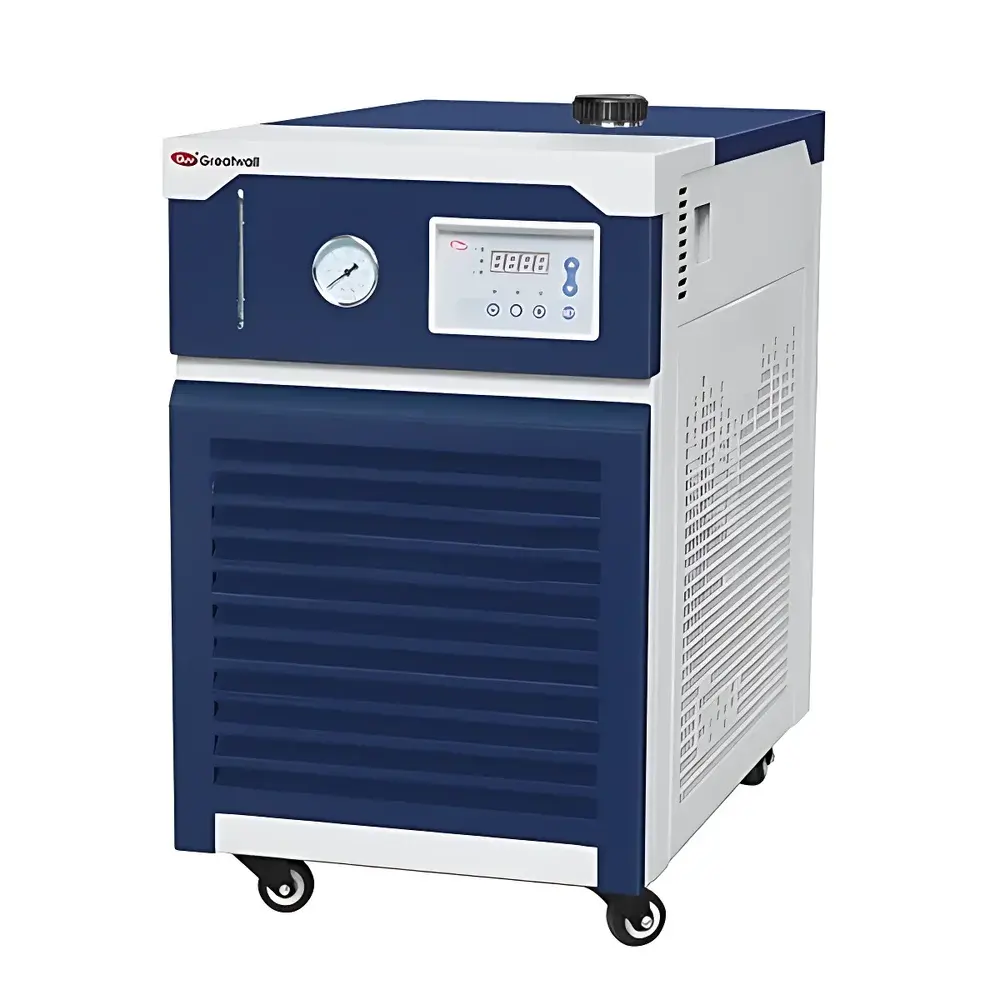
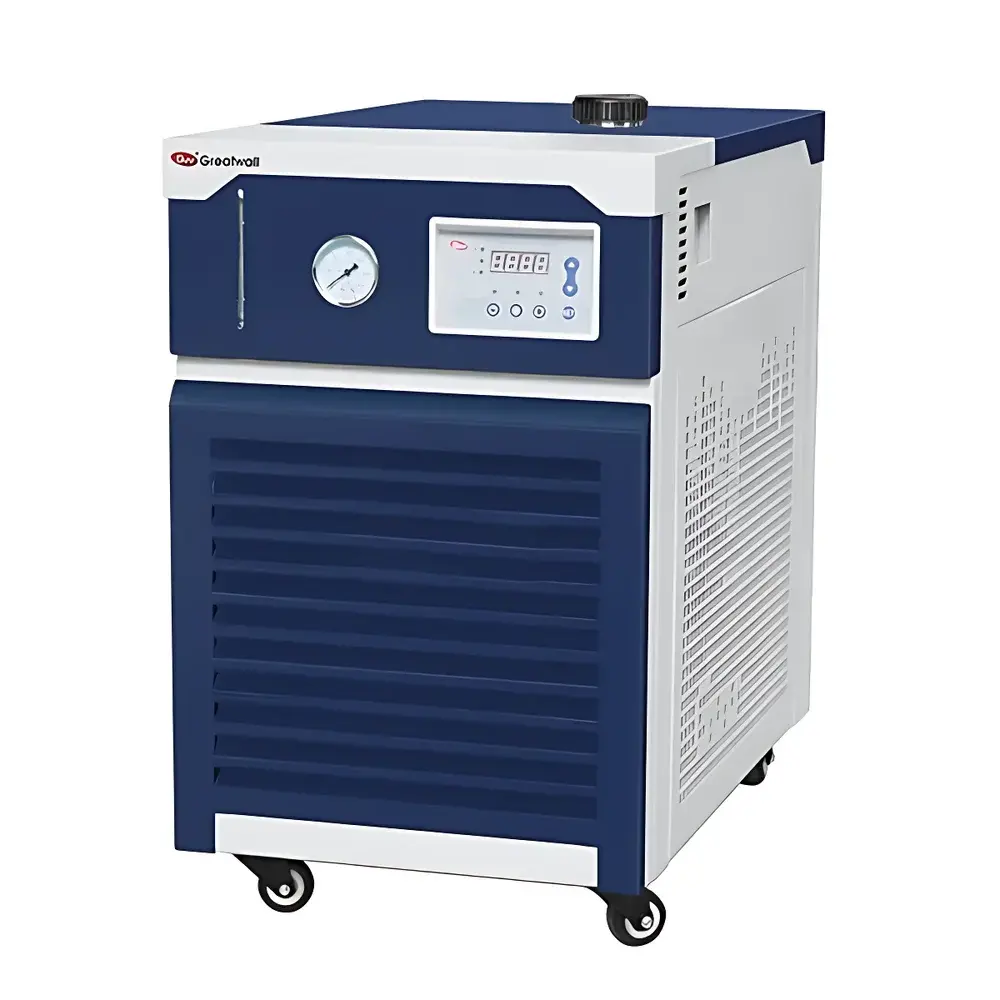
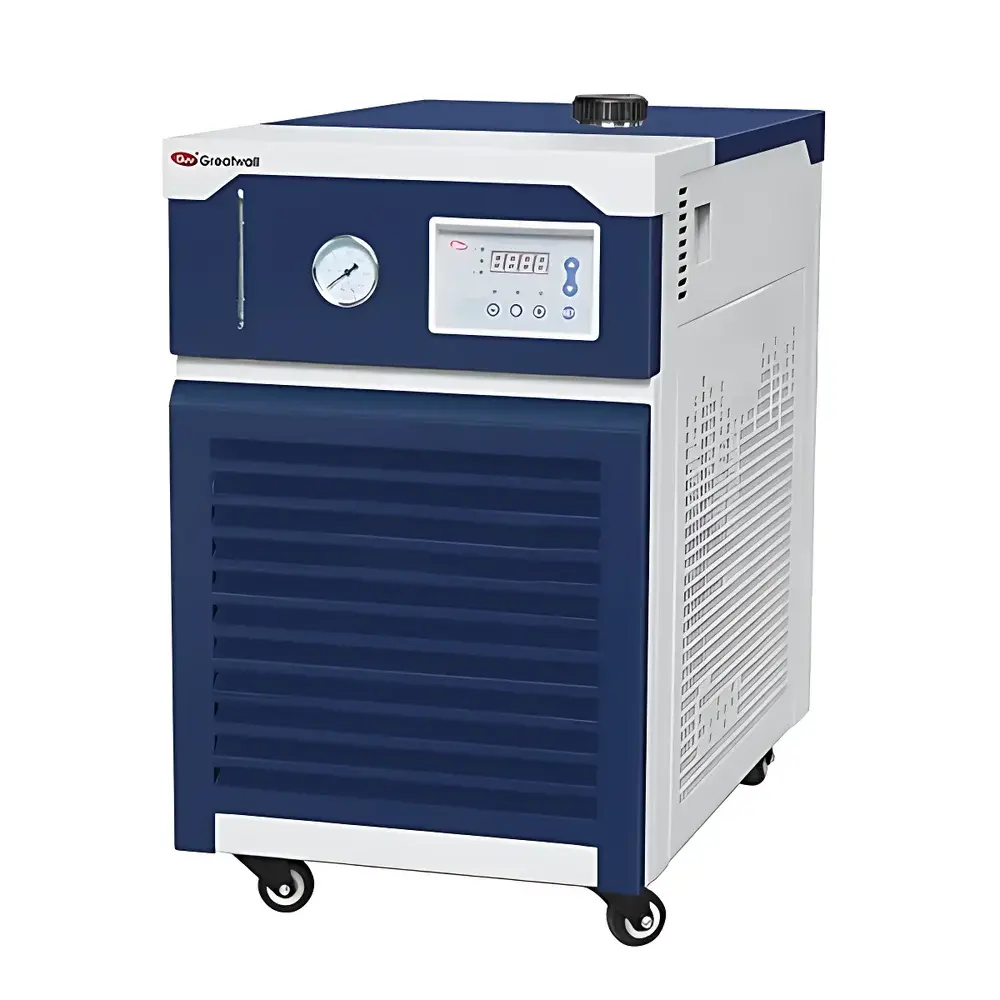
The Great Wall DLSB-10/20 Upgraded Recirculating Chiller
| Brand | The Great Wall |
|---|---|
| Origin | Henan, China |
| Manufacturer Type | Authorized Distributor |
| Origin Category | Domestic (China) |
| Model | DLSB-10/20 |
| Pricing | Upon Request |
| Refrigerant | R410A (CFC-free, eco-friendly) |
| Compressor | Panasonic rotary compressor |
| Condenser | Air-cooled finned-tube with oxygen-free copper spiral tubing |
| Evaporator | 304 stainless steel coil-type, immersed in reservoir |
| Pump | Low-temperature stainless steel shielded pump (AUS304 piping) |
| Reservoir | Sealed tank with level gauge, filtration inlet, and pressure gauge at outlet |
| Controller | LCD-based digital controller, 0.1 °C temperature resolution, CE-compliant |
| Safety Protections | Delay start, overcurrent, overheat, ground fault, high-pressure cut-off |
| Communication | RS485 interface, Modbus RTU protocol for remote monitoring & control |
| Electrical Components | Schneider-certified |
Overview
The Great Wall DLSB-10/20 Upgraded Recirculating Chiller is an engineered thermal management solution designed for precise, stable, and continuous cooling of laboratory equipment requiring low-temperature fluid circulation—particularly rotary evaporators (including one 5 L and three 2 L units), condensers, jacketed reactors, and other heat-exchange-dependent instrumentation. Built upon the proven DLSB platform, this upgraded variant integrates enhanced thermodynamic architecture and improved system-level reliability while maintaining full backward compatibility with existing DLSB-10/20 mounting interfaces and operational protocols. Its core refrigeration cycle employs a vapor-compression principle based on the R410A refrigerant—a chlorine-free, zero-ozone-depletion-potential (ODP = 0) working fluid compliant with international environmental standards including the Montreal Protocol and EU F-Gas Regulation (EU No. 517/2014). The chiller delivers consistent thermal output across ambient conditions up to 35 °C, with operating temperature range typically spanning –10 °C to +30 °C (adjustable in 0.1 °C increments), enabling reproducible solvent condensation and process temperature control essential for GLP- and GMP-aligned laboratories.
Key Features
- High-efficiency refrigeration system featuring a Panasonic rotary compressor—compact in footprint, low-noise (30,000 hours MTBF under continuous duty cycles.
- Air-cooled finned-tube condenser constructed with oxygen-free copper spiral tubing and proprietary tube-to-fin expansion technology, ensuring high heat transfer coefficients (>35 W/m²·K) and long-term fouling resistance.
- Immersed 304 stainless steel coil evaporator housed directly within the sealed reservoir—eliminates risk of mechanical rupture during coolant freezing events and maintains thermal stability even under partial-load or intermittent flow conditions.
- Closed-loop circulation system utilizing AUS304 stainless steel tubing and a hermetically sealed, low-temperature-rated shielded pump—designed to prevent leakage, corrosion, or particulate contamination of heat-transfer fluids (e.g., water/ethylene glycol mixtures).
- Digital LCD controller with CE-marked safety compliance, real-time display of bath temperature, system status indicators (cooling active, pump running, fault alerts), and programmable setpoint retention after power interruption.
- Integrated safety architecture including delayed compressor restart, dual-stage overcurrent protection, thermal cutoff sensors on motor windings and condenser surface, high-pressure switch (cut-off at ≥3.0 MPa), and grounded chassis design per IEC 61000-6-3 EMC requirements.
Sample Compatibility & Compliance
The DLSB-10/20 Upgraded Chiller is validated for use with standard laboratory heat-transfer media—including deionized water, 30–50% aqueous ethylene glycol solutions, and other non-corrosive, low-viscosity fluids compatible with 304 stainless steel and fluorocarbon elastomer seals. It meets mechanical and electrical safety requirements per EN 61010-1:2019 (Safety Requirements for Electrical Equipment for Measurement, Control, and Laboratory Use) and carries CE marking for the European Economic Area. While not inherently 21 CFR Part 11–compliant as a standalone device, its Modbus RTU interface supports integration into validated LIMS or SCADA systems where audit-trail generation, electronic signature enforcement, and data integrity controls are implemented at the supervisory layer. The unit conforms to ISO/IEC 17025:2017 clause 6.4.3 regarding environmental condition monitoring when deployed in accredited testing laboratories.
Software & Data Management
No embedded GUI software is provided; however, the chiller supports industrial-standard serial communication via RS485 physical layer and Modbus RTU protocol (slave ID configurable, baud rate 9600–115200 bps). Compatible registers include input registers for real-time bath temperature (40001), pump status (40002), compressor status (40003), and holding registers for setpoint (40010), remote enable/disable (40011), and alarm reset (40012). This enables seamless integration with third-party lab automation platforms (e.g., LabVIEW, Ignition SCADA, or custom Python-based monitoring dashboards) for centralized thermal log acquisition, trend analysis, and preventive maintenance scheduling. All communication traffic is unencrypted but deterministic—suitable for secure internal networks operating under IT-managed VLAN segmentation.
Applications
- Cooling condenser jackets on rotary evaporation systems to maximize solvent recovery efficiency and minimize bumping during vacuum distillation.
- Temperature stabilization of reaction mixtures in jacketed glass reactors during exothermic synthesis or cryogenic Grignard additions.
- Thermal regulation of HPLC column ovens, detector cells, or autosampler cooling trays where ±0.5 °C stability is required over extended run times.
- Supporting cold-trap operation in vacuum manifold systems used for solvent removal or inert-atmosphere sample handling.
- Providing auxiliary cooling for laser sources, spectrophotometer detectors, or electrophoresis power supplies subject to thermal drift.
FAQ
What is the maximum allowable coolant viscosity for reliable pump operation?
The shielded pump is rated for fluids with dynamic viscosity ≤25 cP at operating temperature; glycol concentrations exceeding 50% by volume are not recommended without prior flow calibration.
Does the unit support external temperature feedback control (e.g., from a reactor jacket sensor)?
No—this model operates in bath-temperature control mode only; it does not accept external PID setpoint modulation via analog or digital input.
Is the reservoir volume sufficient for simultaneous operation with four rotary evaporators?
Yes—the 20 L capacity ensures stable thermal mass and adequate headroom for combined load cycling across one 5 L and three 2 L rotovaps under typical solvent boiling point ranges (35–80 °C).
Can R410A be retrofitted with alternative refrigerants such as R32 or R290?
No—refrigerant substitution voids warranty and violates pressure vessel certification; R410A is specifically matched to compressor displacement, expansion device geometry, and pressure relief valve calibration.
What maintenance intervals are recommended for optimal longevity?
Condenser coil cleaning every 6 months (or more frequently in dusty environments); reservoir fluid replacement and filter inspection annually; compressor oil analysis optional after 10,000 operating hours.



