
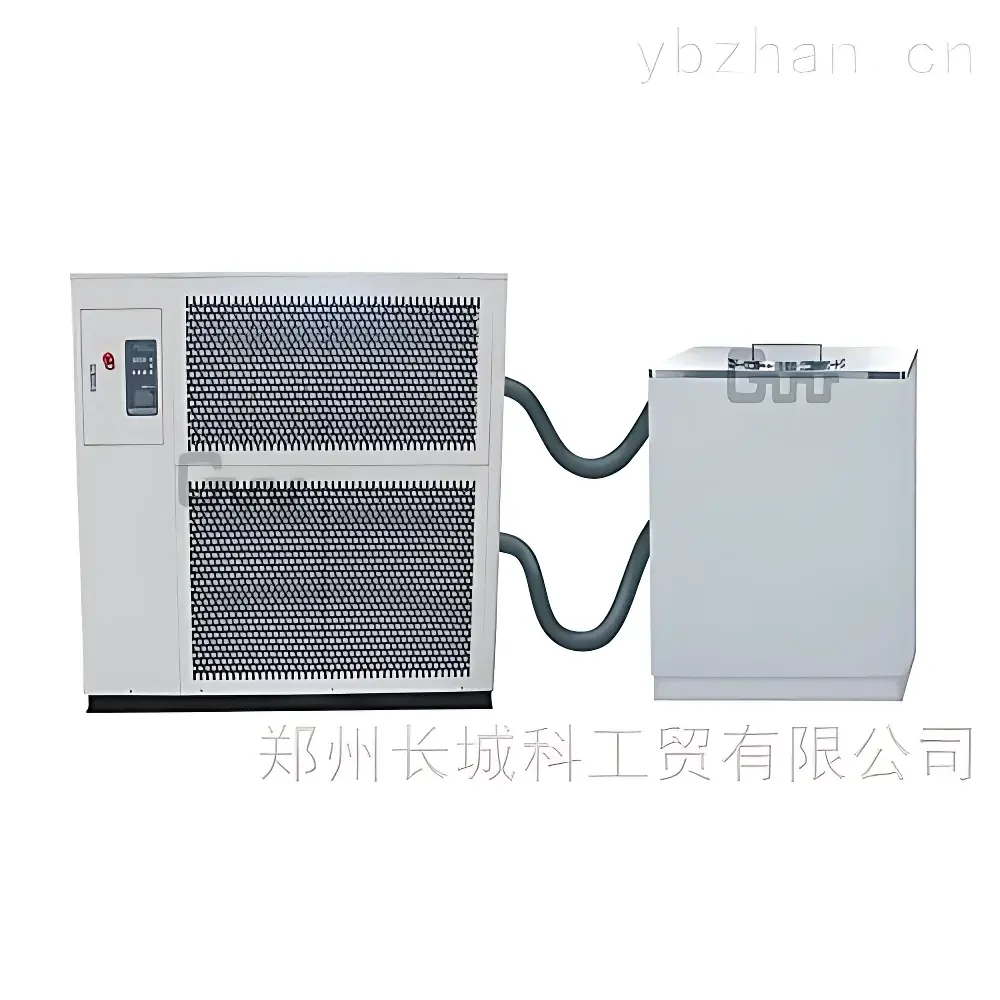
The Great Wall DLSB Pilot-Scale Low-Temperature Circulating Chiller
| Brand | The Great Wall |
|---|---|
| Origin | Henan, China |
| Manufacturer Type | Direct Manufacturer |
| Country of Origin | China |
| Model | DLSB |
| Pricing | Available Upon Request |
Overview
The Great Wall DLSB Pilot-Scale Low-Temperature Circulating Chiller is a mechanically refrigerated, closed-loop liquid circulation system engineered to deliver stable, controllable low-temperature coolant to external process equipment. It operates on vapor-compression refrigeration principles—utilizing a hermetic compressor, condenser, expansion device, and evaporator—to maintain precise bath temperatures across extended operational cycles. Unlike benchtop chillers, the DLSB series is specifically designed for pilot-scale applications where thermal stability, continuous duty cycle performance, and integration flexibility are critical. Its modular architecture separates the refrigeration unit (host) from the insulated reservoir tank, enabling optimized spatial deployment in GMP-compliant laboratories and pilot plants. This configuration supports consistent heat extraction from multiple concurrent processes—including jacketed reactors, rotary evaporators, freeze dryers, and vacuum systems—without thermal cross-talk or pressure instability.
Key Features
- Modular split-system design: Independent refrigeration host and insulated reservoir tank facilitate flexible installation, simplified coolant filling, and reduced footprint in constrained production environments.
- High-efficiency thermal insulation: Reservoir tank constructed with multi-layer polyurethane foam (≥80 mm thickness) minimizes ambient heat ingress, reducing energy consumption by up to 35% compared to non-insulated alternatives under continuous operation at –20 °C.
- Dual-stage safety architecture: Integrated high-pressure cut-off switch (set point: 2.8 MPa) prevents compressor overpressure failure; leakage current protection (≤30 mA) complies with IEC 61000-4-5 surge immunity standards.
- Intelligent compressor management: Built-in 3-minute anti-short-cycle delay prevents mechanical stress during power interruption or rapid restart scenarios—extending compressor service life beyond 20,000 operating hours.
- Configurable cooling interface: Standard air-cooled condenser; optional water-cooled condenser kit available for high-ambient-temperature facilities (>35 °C) or noise-sensitive cleanroom zones.
- Scalable refrigeration capacity: Base DLSB platform supports field-upgradable compressor modules (R404A or R507A refrigerant variants) to meet increased heat load demands from multi-reactor setups or larger-volume evaporation systems.
Sample Compatibility & Compliance
The DLSB chiller is compatible with standard industrial coolant fluids—including 30% ethylene glycol/water, 40% propylene glycol/water, and silicone oil formulations—enabling operation down to –30 °C depending on fluid selection and flow rate. Its stainless steel (304) reservoir and fluorocarbon-sealed circulation pump ensure chemical resistance against common organic solvents (e.g., acetone, THF, dichloromethane) and mild aqueous reagents. The system conforms to GB/T 10826.1–2018 (Chinese national standard for circulating chillers), and its electrical safety design meets IEC 61010-1:2010 requirements for laboratory equipment. While not certified to UL/CSA or CE for direct EU/US market placement, it is routinely deployed in ISO 9001-certified pharmaceutical pilot lines for API synthesis and lyophilization support—fully traceable via factory calibration certificates (NIST-traceable PT100 sensor, ±0.2 °C accuracy at 25 °C).
Software & Data Management
The DLSB operates via an embedded PID controller with dual-sensor feedback (reservoir inlet/outlet temperature monitoring) and adjustable setpoint ramping (0.1–5.0 °C/min). Optional RS485 Modbus RTU interface enables integration into SCADA or DCS platforms for centralized temperature logging, alarm forwarding, and audit trail generation. When paired with third-party data acquisition software (e.g., LabVIEW or Ignition), the chiller supports 21 CFR Part 11–compliant electronic records—including user login tracking, parameter change history, and timestamped event logs—required for GLP/GMP validation protocols. No proprietary cloud platform is included; all firmware updates are delivered via secure USB flash drive with SHA-256 checksum verification.
Applications
- Pharmaceutical pilot manufacturing: Maintaining jacket temperature control (–10 °C to +5 °C) during crystallization, hydrogenation, and low-temperature acylation reactions in 20–100 L glass-lined reactors.
- Chemical process development: Coupling with rotary evaporators (up to 50 L volume) for solvent recovery under reduced pressure at controlled condenser temperatures (–15 °C to –5 °C).
- Biotechnology: Providing cold source for centrifuge cooling jackets and chromatography column ovens during purification of thermolabile proteins and monoclonal antibodies.
- Materials science: Supporting cryogenic grinding, polymerization quenching, and thin-film deposition systems requiring stable sub-zero thermal sinks.
- Quality control labs: Enabling ASTM D2570 (low-temperature viscosity testing) and ISO 3104 (petroleum product kinematic viscosity) compliant bath conditions.
FAQ
What is the lowest achievable temperature with the DLSB chiller using standard coolant?
With 30% ethylene glycol/water mixture and nominal flow rate (15 L/min), the system achieves –25 °C at the reservoir outlet under continuous load. Lower temperatures require alternative heat transfer fluids and may impact long-term seal integrity.
Can the DLSB be integrated into an existing plant HVAC or central chilled water system?
Yes—via optional water-cooled condenser retrofit. Integration requires isolation valves, differential pressure monitoring, and compatibility verification with facility-grade deionized water specifications (conductivity <5 µS/cm).
Is remote monitoring supported out-of-the-box?
No native Ethernet or Wi-Fi capability exists. Remote access requires external Modbus-to-Ethernet gateway hardware and custom SCADA configuration.
Does the system include validation documentation for GMP use?
Factory-installed calibration certificates and IQ/OQ templates are provided. Full PQ execution must be performed on-site per user-defined process parameters and acceptance criteria.
What maintenance intervals are recommended for uninterrupted pilot-scale operation?
Compressor oil inspection every 6 months; refrigerant leak check annually; reservoir cleaning and coolant replacement every 12 months or after 2,000 operational hours—whichever occurs first.



