
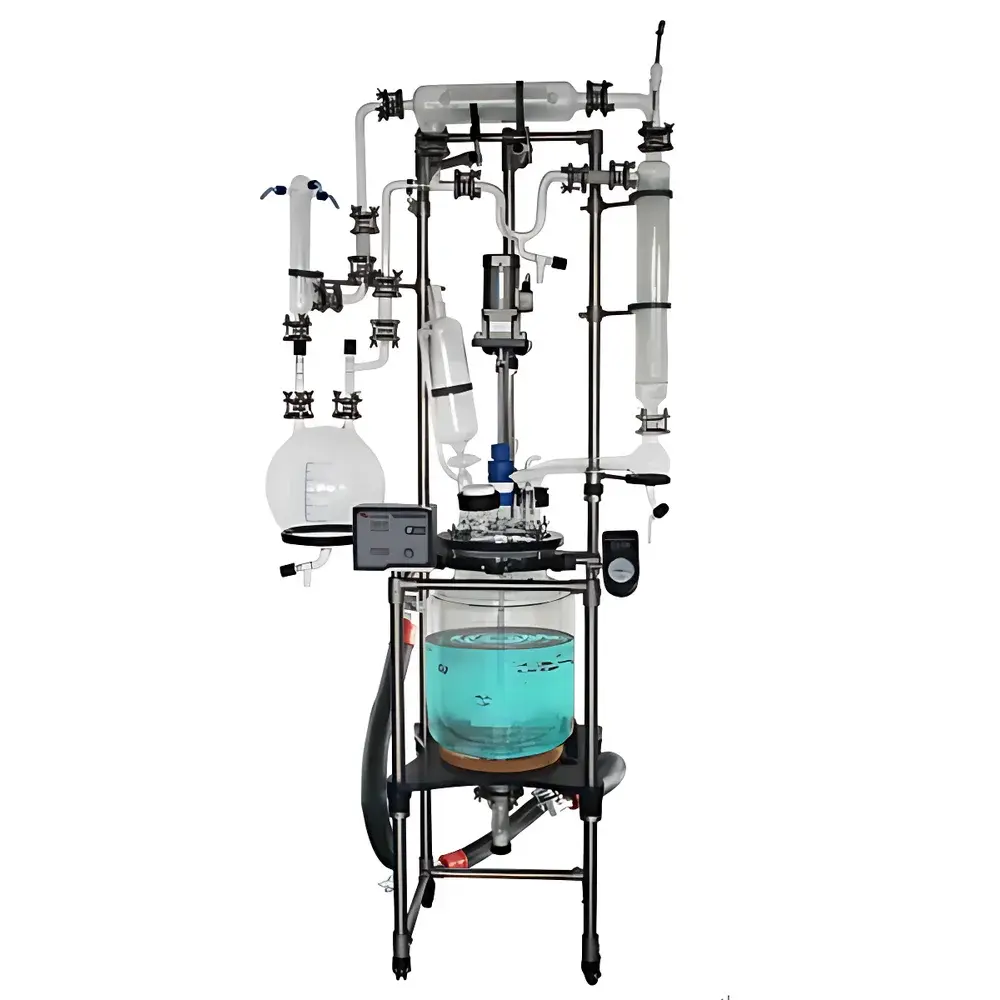
The Great Wall GR-10T Borosilicate Glass Fractional Distillation Reactor
| Brand | The Great Wall |
|---|---|
| Origin | Henan, China |
| Manufacturer Type | Direct Manufacturer |
| Origin Category | Domestic |
| Model | GR-10T |
| Price Range | USD 7,000–14,000 (FOB) |
| Vessel Capacity | 10 L |
| Instrument Material | Borosilicate Glass 3.3 |
| Operating Pressure Range | −0.1 to 0 MPa (gauge) |
| Vacuum Level | −0.098 MPa (absolute) |
| Jacket Volume | ~3.0 L |
| Condenser Heat Transfer Area | 0.234 m² |
| Constant-Pressure Dropping Funnel | 1000 mL |
| Distillation Column Dimensions | Ø85 × 715 mm |
| Packing | Glass Raschig Rings |
| Number of Ports on Reactor Head | 6 |
| Temperature Range | −80 °C to +200 °C |
| Max Allowable ΔT (Jacket vs. Vessel) | ≤80 °C |
| Jacket Max Pressure | +0.03 MPa |
| Stirring Motor Power | 90 W |
| Speed Control | Frequency Inverter |
| Speed Range | 50–500 rpm |
| Temperature Sensor | Pt100 (SUS304 sheath + PTFE jacket) |
| Temp Display Accuracy | ±0.1 °C |
| Seals & Valves | PTFE |
| Bottom Discharge Valve Height | 320 mm |
| Agitator Type | Paddle-type |
| Blade Material | PTFE-coated SUS304 shaft & blades |
| Frame Material | SUS304 stainless steel |
| Mobility | Locking Casters |
| Power Supply | 220–240 V~, 50/60 Hz |
| Ambient Operating Conditions | 5–35 °C, ≤70% RH |
| Overall Dimensions (W×D×H) | ~1080 × 650 × 2380 mm |
Overview
The Great Wall GR-10T Borosilicate Glass Fractional Distillation Reactor is a fully integrated, bench-scale distillation and reaction system engineered for precise temperature-controlled separation, solvent recovery, and small-batch synthesis under reduced pressure. Designed around the principles of vapor–liquid equilibrium and fractional condensation, the unit combines high thermal stability with chemical inertness—enabling operation across an exceptionally wide temperature range (−80 °C to +200 °C) and vacuum conditions down to −0.098 MPa (absolute). Its core architecture adheres to standard laboratory reactor design conventions: a double-jacketed borosilicate glass 3.3 vessel provides uniform heating/cooling while maintaining optical clarity for real-time process observation; a horizontal condenser with 0.234 m² effective heat transfer area ensures high-efficiency reflux control; and a modular port configuration (six standardized NS29/32 or NS24/29 ground-glass joints) supports flexible integration of feed lines, thermocouple ports, inert gas inlets, and vacuum manifolds. All wetted components—including the distillation column (Ø85 × 715 mm), packed with chemically inert glass Raschig rings—are fabricated from ASTM E438 Type I, Class A borosilicate glass 3.3, certified for low thermal expansion (3.3 × 10⁻⁶/K), high hydrolytic resistance (ISO 719 HGB 1), and compliance with DIN ISO 1042 volumetric tolerance standards.
Key Features
- Borosilicate glass 3.3 construction throughout all process-wetted parts—resistant to thermal shock, alkalis, and most organic solvents per ISO 720 and ISO 719 testing protocols
- Horizontal condenser with extended surface area (0.234 m²) and optimized coolant flow path for stable reflux ratio control and minimal hold-up volume
- PTFE-sealed, corrosion-resistant bottom discharge valve with zero-liquid-retention geometry—designed to prevent cross-contamination during batch transfer
- SUS304 structural frame with locking casters for stable positioning and safe reconfiguration within fume hoods or ventilated enclosures
- Frequency-inverter-driven 90 W three-phase agitator delivering smooth, low-vibration stirring from 50 to 500 rpm, with digital speed readout and torque-consistent performance across viscosity ranges
- Pt100 temperature sensor housed in SUS304 sheath with outer PTFE insulation—providing ±0.1 °C display resolution and long-term drift stability per IEC 60751 Class B specifications
- Double-jacketed reactor body (10 L working volume, ~3.0 L jacket capacity) rated for ≤+0.03 MPa jacket pressure and compatible with circulating chillers, oil baths, or steam sources
- Stress-relieved fluid connections via stainless steel insulated flexible hoses at jacket inlet/outlet ports—eliminating mechanical strain on ground-glass joints
Sample Compatibility & Compliance
The GR-10T is suitable for processing non-explosive, non-polymerizing liquid mixtures with boiling point differentials ≥15 °C—commonly applied to purification of fine chemical intermediates, pharmaceutical actives (APIs), natural product extracts, and specialty solvents. It complies with general laboratory safety requirements per EN 61010-1:2019 (electrical safety) and is compatible with GLP-compliant workflows when paired with validated data logging systems. While not intrinsically rated for ATEX or IECEx hazardous-area use, its all-glass fluid path and absence of internal electrical components minimize ignition risk in controlled environments. All glass joints conform to ISO 3585 dimensional tolerances, ensuring interchangeability with standard labware from major international suppliers (e.g., Chemglass, Ace Glass, Kimble). The system meets material traceability requirements for ISO 9001-certified manufacturing facilities and supports documentation of calibration records for temperature, pressure, and rotational speed per FDA 21 CFR Part 11–ready software configurations.
Software & Data Management
The GR-10T operates as a standalone analog-digital hybrid system: critical parameters (stirring speed, bath temperature, and internal vessel temperature) are displayed locally via integrated digital indicators. For full data acquisition and regulatory compliance, it is designed to interface with third-party PID controllers or SCADA platforms via 4–20 mA or 0–10 V analog outputs (optional module). When integrated with validated laboratory information management systems (LIMS) or electronic lab notebooks (ELN), temperature and agitation logs can be time-stamped, user-authenticated, and archived with audit trails—meeting ALCOA+ (Attributable, Legible, Contemporaneous, Original, Accurate, Complete, Consistent, Enduring, Available) data integrity criteria. No proprietary firmware or closed-source software is embedded; all control logic remains transparent and vendor-neutral.
Applications
- Fractional distillation of heat-sensitive organic compounds (e.g., terpenes, esters, lactones) under controlled vacuum to suppress decomposition
- Multi-step synthesis requiring sequential addition, reflux, and in-situ solvent removal—such as Fischer esterification, amidation, or Grignard reactions
- Removal of low-boiling solvents (e.g., diethyl ether, dichloromethane, pentane) from reaction mixtures prior to crystallization or chromatography
- Recovery and recycling of high-purity solvents (e.g., THF, acetonitrile, toluene) in QC/QA laboratories operating under ISO/IEC 17025 accreditation
- Method development for continuous-flow distillation processes, using the GR-10T as a scalable reference platform for pilot-stage optimization
- Educational demonstration of Raoult’s law, relative volatility, and theoretical plate efficiency in university-level chemical engineering labs
FAQ
Is the GR-10T suitable for corrosive halogenated solvents such as chloroform or carbon tetrachloride?
Yes—the borosilicate glass 3.3 body, PTFE seals, and SUS304 frame provide broad compatibility with halogenated organics; however, prolonged exposure to hot, concentrated hydrogen halides or free halogens is not recommended.
Can the system be upgraded to support automated fraction collection?
Yes—via external integration with programmable fraction collectors (e.g., Gilson FC204, Buchi F-200) using TTL or relay-triggered signals synchronized to temperature or time-based thresholds.
What vacuum pump is recommended for achieving −0.098 MPa absolute pressure?
A two-stage oil-lubricated rotary vane pump (e.g., KNF NRP series or Edwards RV8) with cold trap is advised; dry scroll pumps may achieve the target vacuum but require careful moisture management for long-term reliability.
Does the GR-10T include CE or UL certification?
The base unit carries CE marking per Machinery Directive 2006/42/EC and EMC Directive 2014/30/EU; UL listing is available upon request for specific regional deployments subject to factory inspection and test validation.
How often should the PTFE stirrer shaft coating be inspected for wear?
Visual inspection is recommended after every 200 operational hours or following any abrasive slurry processing; replacement intervals depend on duty cycle and media abrasivity, typically ranging from 6 to 18 months under standard organic synthesis conditions.
Related Products



