
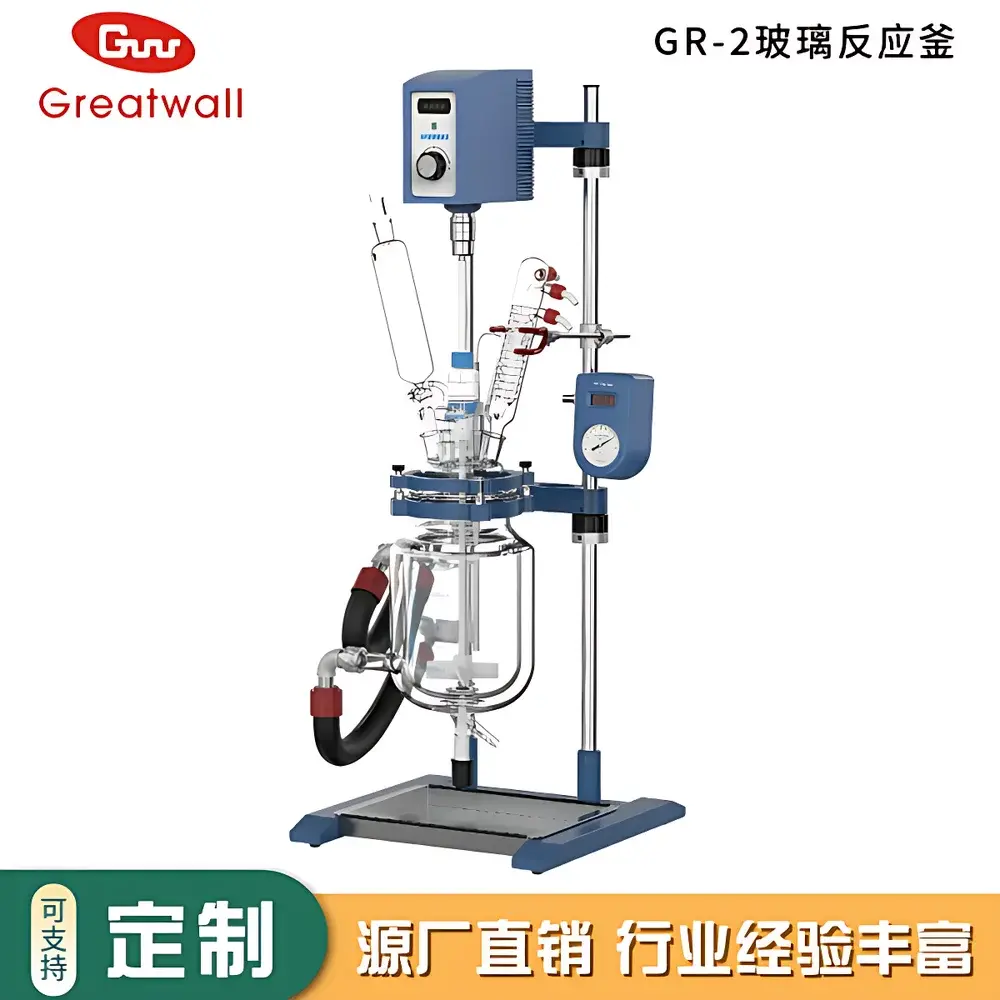
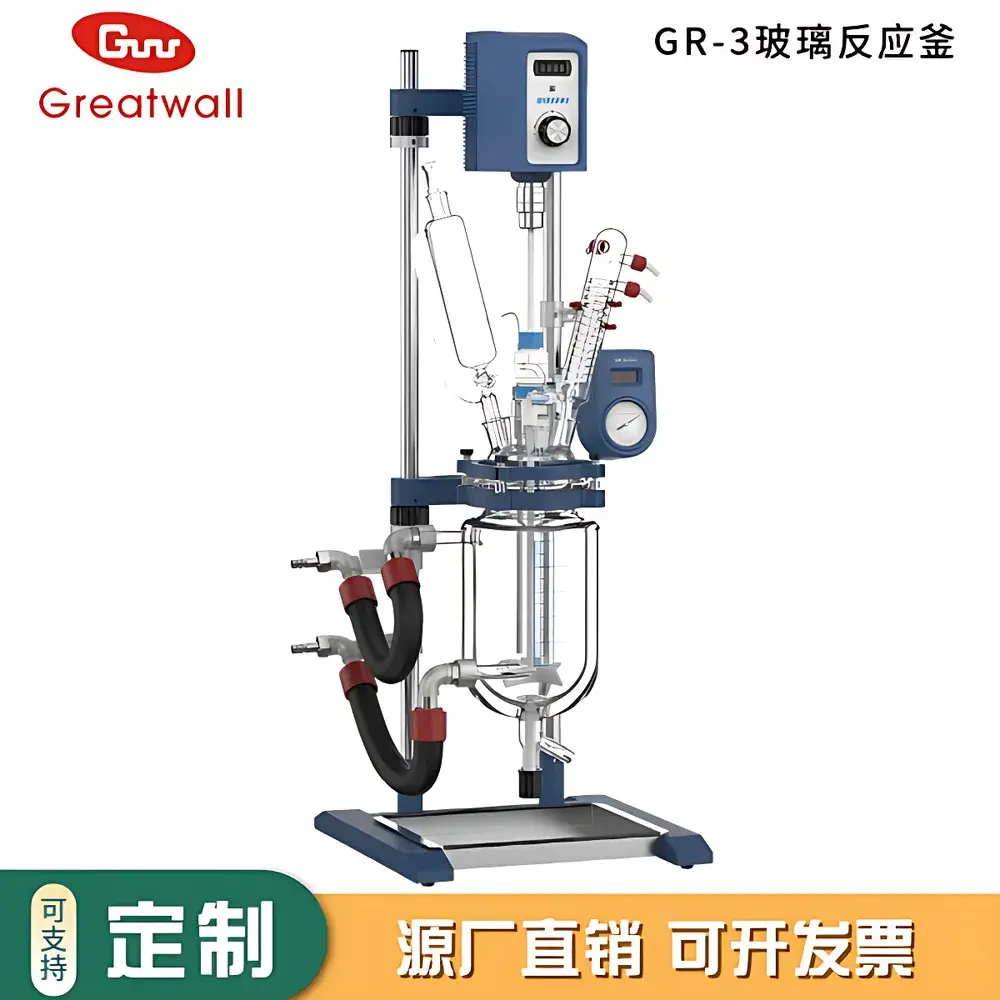
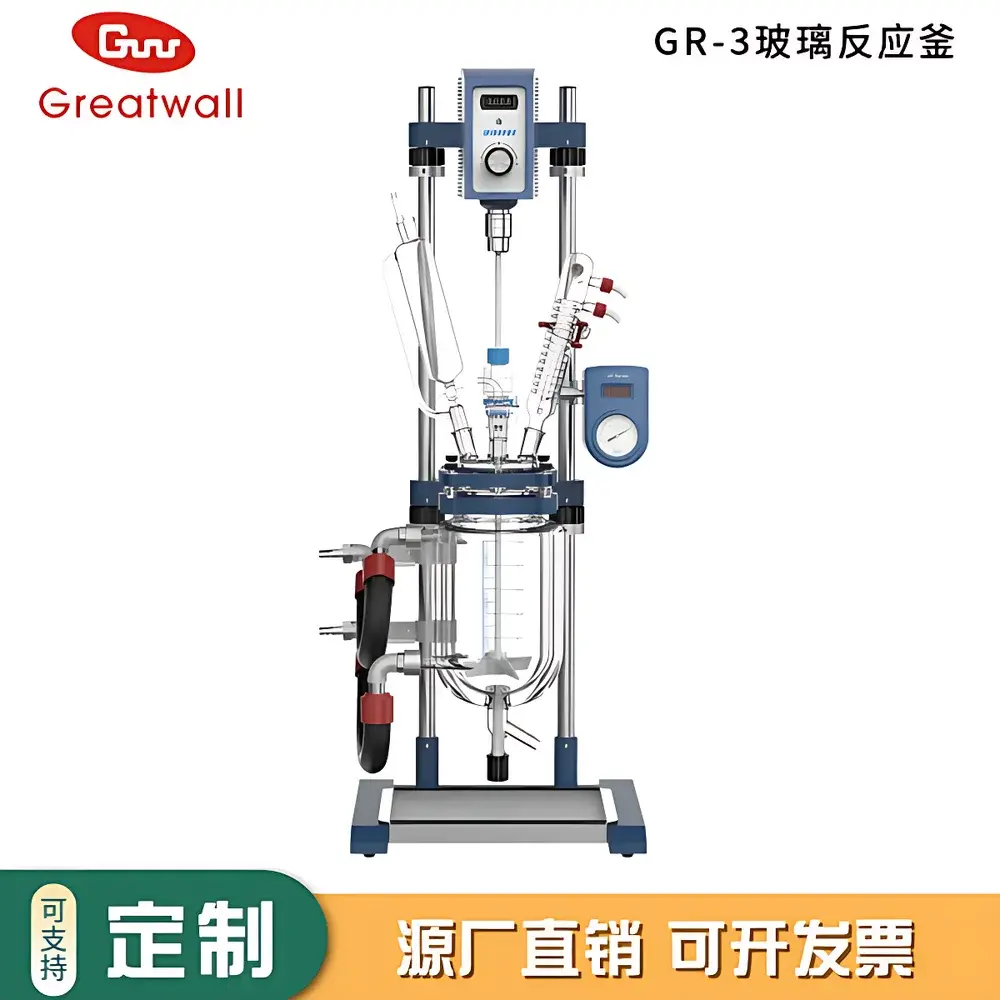
The Great Wall GR-2 Benchtop Double-Jacketed Glass Reactor
| Brand | The Great Wall |
|---|---|
| Origin | Henan, China |
| Manufacturer Type | Direct Manufacturer |
| Country of Origin | China |
| Model | GR-2 |
| Instrument Category | Jacketed Reactor |
| Volume Capacity | 2 L |
| Vessel Material | Borosilicate Glass 3.3 |
| Operating Temperature Range | −80 °C to +200 °C |
| Operating Pressure Range | −0.1 MPa to 0 MPa (gauge) |
| Jacket Connection | Stainless Steel Insulated Flexible Hoses |
| Discharge Configuration | Top-Mounted Tilt-Drain |
| Frame Material | 06Cr19Ni10 Stainless Steel + Carbon Structural Steel with Epoxy Powder Coating + Anodized Aluminum |
| Stirring Shaft | 06Cr19Ni10 Stainless Steel Core with PTFE Cladding |
| Impeller Material | PTFE |
| Sealing System | Proprietary Mechanical Seal Assembly |
| Vessel Geometry | Dual-Wall (Inner/Outer Glass), Vertical Cylindrical with Conical Bottom |
Overview
The Great Wall GR-2 Benchtop Double-Jacketed Glass Reactor is an engineered solution for controlled chemical synthesis, solvent reflux, crystallization, and small-scale process development in academic laboratories, pharmaceutical R&D centers, and fine chemical pilot facilities. Its core design follows the principle of jacketed thermal management: the annular space between the inner and outer borosilicate glass walls enables precise temperature control via circulating heat transfer fluids—such as silicone oil, ethylene glycol–water mixtures, or dry ice–acetone slurry—allowing stable operation across a wide thermal envelope from −80 °C to +200 °C. Unlike single-wall reactors, the double-jacket architecture eliminates direct thermal shock to reaction contents while enabling simultaneous heating and cooling without system reconfiguration. The reactor operates under low-pressure conditions (−0.1 MPa to ambient), making it suitable for vacuum-assisted distillation, reduced-pressure drying, and inert-atmosphere reactions when coupled with standard glassware adapters and gas inlet valves.
Key Features
- Borosilicate glass 3.3 construction for both inner vessel and jacket—compliant with DIN ISO 3585 standards—ensuring high hydrolytic resistance, low thermal expansion (3.3 × 10⁻⁶ K⁻¹), and compatibility with aggressive reagents including concentrated acids, alkalis, and halogenated solvents.
- Integrated top-mounted tilt-drain mechanism with PTFE-sealed valve assembly, permitting complete, residue-free discharge without disassembly or manual tilting of the entire unit.
- Proprietary mechanical stirring seal system designed for extended service life under continuous operation; accommodates variable-speed DC motors (typically 0–250 rpm) with torque compensation up to 1.5 N·m.
- Stirring assembly comprising a 06Cr19Ni10 (AISI 304 equivalent) shaft fully clad in molded PTFE and a monolithic PTFE impeller—eliminating metal exposure to reaction media and preventing catalytic side reactions or ion leaching.
- Modular frame architecture combining stainless steel load-bearing structure, powder-coated carbon steel support elements, and anodized aluminum mounting plates—optimized for stability, corrosion resistance, and ease of wipe-down cleaning per GLP laboratory hygiene protocols.
- Jacket fluid ports fitted with reinforced stainless steel flexible hoses featuring EPDM liners and swivel fittings—minimizing mechanical stress transmission during thermal cycling and eliminating risk of glass fracture at port junctions.
Sample Compatibility & Compliance
The GR-2 is compatible with organic solvents (e.g., THF, DMF, dichloromethane), aqueous electrolytes, polymerization precursors, and air/moisture-sensitive reagents when used under nitrogen or argon purge. Its all-glass wetted path meets USP Class VI biocompatibility requirements for nonclinical research applications. While not certified to ASME BPVC Section VIII or PED 2014/68/EU, the reactor adheres to common lab-scale safety conventions outlined in ASTM E2500-18 (Guide for Specification, Design, and Verification of Pharmaceutical and Biopharmaceutical Manufacturing Systems) and ISO 14644-1 (cleanroom classification support). Pressure containment is limited to −0.1 MPa (full vacuum) to atmospheric; users must implement external pressure relief or vacuum breakers when interfacing with pumps or condensers.
Software & Data Management
The GR-2 is a standalone analog-controlled instrument and does not incorporate embedded microprocessors or digital interfaces. Temperature regulation requires external circulators (e.g., Huber CC-K series or JULABO F25 HL) equipped with PID controllers and Pt100 sensor inputs. For audit-trail compliance in regulated environments, integration with validated data loggers (e.g., Omega OM-DAQPRO-5300) connected to circulator analog outputs (0–10 V or 4–20 mA) supports 21 CFR Part 11–compliant recordkeeping when paired with electronic lab notebook (ELN) systems. All glass components are marked with batch-specific etched identifiers for traceability during equipment qualification (IQ/OQ/PQ).
Applications
- Batch synthesis of APIs and intermediates under controlled thermal profiles and inert atmosphere.
- Enantioselective catalysis requiring strict exclusion of metal contaminants.
- Solvent recovery via rotary evaporation-compatible reflux setups.
- Polymerization kinetics studies using inline FTIR probe ports (optional accessory).
- Crystallization screening across supersaturation gradients with programmable cooling ramps.
- Photochemical reactions when combined with UV-transparent quartz jackets (custom configuration).
FAQ
What is the maximum allowable working temperature for the GR-2?
The inner vessel is rated for continuous operation up to +200 °C; however, sustained use above +150 °C requires verification of circulator fluid thermal stability and gasket material compatibility.
Can the GR-2 be used under positive pressure?
No—it is designed exclusively for vacuum-to-atmospheric pressure operation. Positive pressure application voids warranty and compromises structural integrity.
Is the stirring system suitable for highly viscous media?
Yes, when paired with high-torque drive units (≥2 N·m) and anchor or helical ribbon impellers (available as accessories); standard PTFE paddle impellers are optimized for viscosities below 5,000 mPa·s.
How is calibration performed for temperature accuracy?
Calibration is conducted externally via the circulator’s integrated Pt100 sensor; the reactor itself does not contain embedded sensors and relies on fluid-loop equilibrium for thermal uniformity.
Are replacement glass parts available with serialized traceability?
Yes—each glass component carries a laser-etched serial number linked to manufacturing lot records, supporting equipment lifecycle documentation per ISO/IEC 17025 requirements.



