
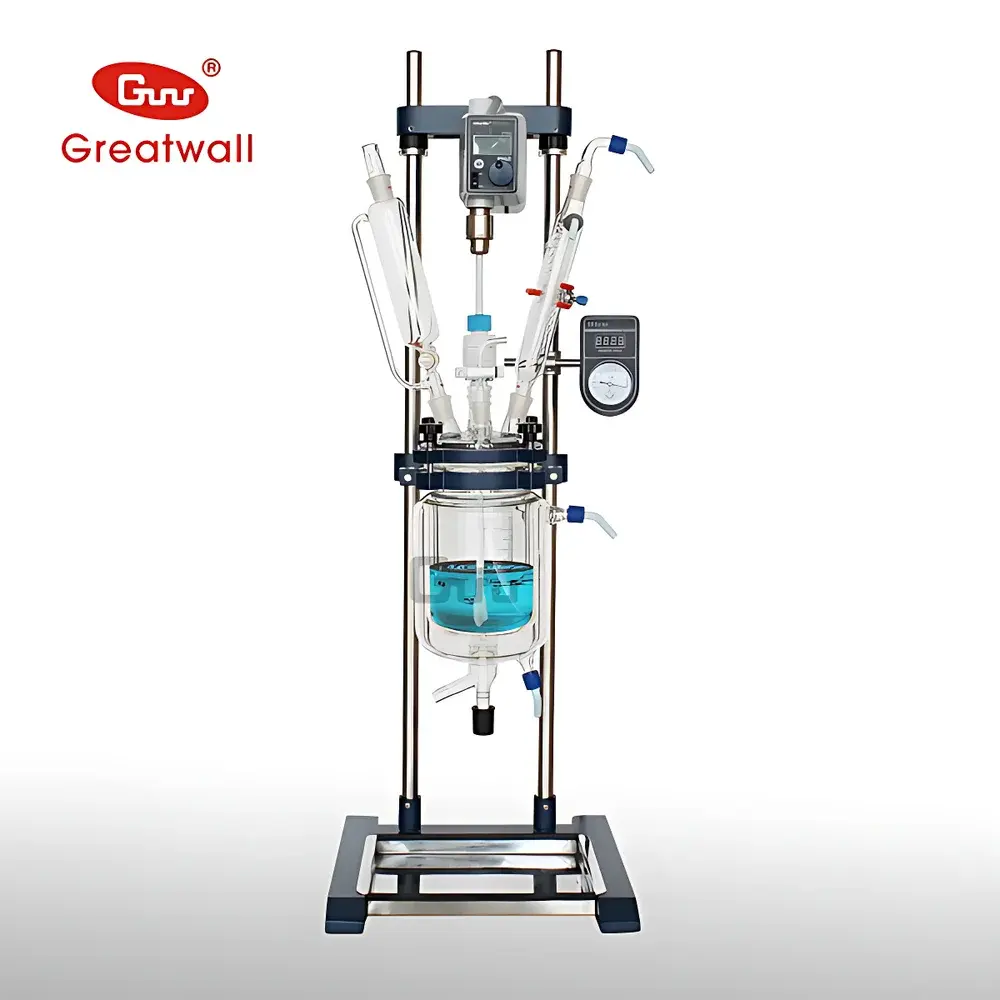
The Great Wall GR-2 Dual-Jacketed Variable-Speed Glass Reactor
| Brand | The Great Wall |
|---|---|
| Origin | Henan, China |
| Manufacturer Type | Direct Manufacturer |
| Country of Origin | China |
| Model | GR-2 |
| Instrument Category | Glass Reactor |
| Usable Volume | Micro-scale |
| Construction Material | Borosilicate Glass 3.3 |
| Operating Pressure Range | −0.1 MPa to 0 MPa (gauge) |
| Jacketed Capacity | 1 L |
| Temperature Range | −80 °C to +200 °C |
| Stirring Drive | Top-mounted, angled discharge configuration |
| Stirrer Shaft Material | 06Cr19Ni10 stainless steel with PTFE cladding |
| Impeller Material | PTFE |
| Sealing System | Proprietary magnetic-coupled mechanical seal |
| Frame Material | Hybrid construction — 06Cr19Ni10 stainless steel, carbon structural steel with epoxy powder coating, and anodized aluminum components |
| Jacket Inlet/Outlet | Stainless steel insulated flexible hoses |
Overview
The Great Wall GR-2 Dual-Jacketed Variable-Speed Glass Reactor is an engineered laboratory-scale reaction system designed for controlled synthesis, crystallization, polymerization, and solvent-sensitive chemical transformations under precisely regulated thermal and mechanical conditions. Its core architecture follows the Couette flow principle in stirred-tank reactor design, enabling reproducible mass and heat transfer characteristics across a wide operating envelope. The reactor vessel and jacket are fabricated entirely from ASTM F795-compliant borosilicate glass 3.3—ensuring exceptional thermal shock resistance (ΔT ≥ 150 °C), hydrolytic stability (ISO 719 Class HGB 1), and optical clarity for real-time visual monitoring of reaction progress, phase separation, or precipitate formation. With a nominal working volume of 1 L and a vacuum-rated pressure range from −0.1 MPa (full vacuum) to atmospheric (0 MPa gauge), the GR-2 supports both reflux and reduced-pressure distillation protocols without compromising structural integrity.
Key Features
- Borosilicate glass 3.3 construction compliant with DIN ISO 3585 standards for chemical resistance and thermal stability
- Dual-jacket design enabling simultaneous heating (via circulating oil bath) and cooling (via chilled glycol or dry ice–acetone) with independent temperature control zones
- Top-mounted, magnetically coupled stirring drive with variable speed control (0–600 rpm typical range) and torque-sensing feedback for consistent shear profile delivery
- PTFE-coated 06Cr19Ni10 (AISI 304 equivalent) stirrer shaft and fully PTFE impeller—eliminating metal contamination risks in catalytic or organometallic reactions
- Angled bottom discharge port with PTFE-sealed valve—facilitating complete, residue-free sample recovery without disassembly
- Stress-relieved jacket inlet/outlet connections using stainless steel braided, insulated flexible hoses—preventing thermal-induced microfractures at glass–metal interfaces
- Hybrid support frame combining corrosion-resistant 06Cr19Ni10, powder-coated carbon steel, and anodized aluminum—optimized for long-term lab environment durability and ease of decontamination
Sample Compatibility & Compliance
The GR-2 is compatible with a broad spectrum of organic solvents (e.g., THF, DMF, DCM, toluene), aqueous acidic/basic media (pH 0–14), and reactive intermediates including Grignard reagents and lithium aluminum hydride suspensions—provided operating temperatures remain within the −80 °C to +200 °C envelope. All wetted surfaces are non-leaching and inert per USP and ISO 10993-12 biocompatibility screening guidelines. The reactor meets CE marking requirements for laboratory equipment (2014/30/EU EMC Directive and 2014/35/EU Low Voltage Directive) and conforms to IEC 61010-1:2010 safety standards for electrical equipment used in laboratory environments. Its vacuum-rated design supports ASTM E2910-19 procedures for residual solvent analysis and ISO 11222:2020 methods for reaction calorimetry calibration.
Software & Data Management
While the GR-2 operates as a standalone analog-controlled unit, it integrates seamlessly with third-party digital control systems via 0–10 VDC analog input/output ports for jacket temperature setpoint modulation and stirrer speed synchronization. Optional RS485 Modbus RTU interface modules enable connection to LabVIEW, DeltaV, or Siemens Desigo CCMS platforms for centralized logging of temperature, pressure, and agitation parameters. All operational data—including timestamps, setpoints, and manual override events—are traceable for GLP/GMP-aligned workflows. The system supports 21 CFR Part 11-compliant electronic audit trails when paired with validated SCADA software, fulfilling documentation requirements for pharmaceutical process development and regulatory submissions.
Applications
- Small-batch fine chemical synthesis under inert atmosphere (N₂/Ar purged via standard NS29/24 joint)
- Kinetic studies requiring precise thermal ramping (e.g., Arrhenius parameter determination)
- Controlled precipitation of nanoparticles and metal–organic frameworks (MOFs)
- Multi-step tandem reactions with in situ quenching and intermediate isolation
- Development of green chemistry protocols using low-boiling solvents under vacuum-assisted removal
- Educational demonstrations of reaction engineering principles (e.g., residence time distribution, heat balance modeling)
FAQ
What is the maximum allowable vacuum level for continuous operation?
The GR-2 is rated for sustained operation at −0.1 MPa (absolute ~0.013 bar), verified per ISO 10271 leak testing protocols.
Can the reactor be used with aggressive fluorinated solvents such as HFIP or TFEE?
Yes—borosilicate glass 3.3 exhibits negligible corrosion rates (<0.1 mg/dm²/day) in fluorinated alcohols and ethers at ≤100 °C, as confirmed by DIN 12111 accelerated immersion testing.
Is the stirring system suitable for highly viscous reaction mixtures?
The proprietary magnetic coupling delivers up to 1.2 N·m stall torque; for viscosities exceeding 50,000 mPa·s, a dual-anchor impeller configuration is recommended and available as an accessory.
Does the GR-2 comply with explosion-proof requirements for solvent-based reactions?
The base unit is not intrinsically safe; however, it may be installed within Class I, Division 2 hazardous locations when paired with certified external explosion-proof motor controllers and grounding kits per NEC Article 500.
What maintenance intervals are recommended for the mechanical seal assembly?
Under normal use (≤8 hrs/day, ambient humidity <60% RH), the PTFE–ceramic face seal requires inspection every 500 operational hours and replacement every 2,000 hours or after exposure to solid particulates.



