
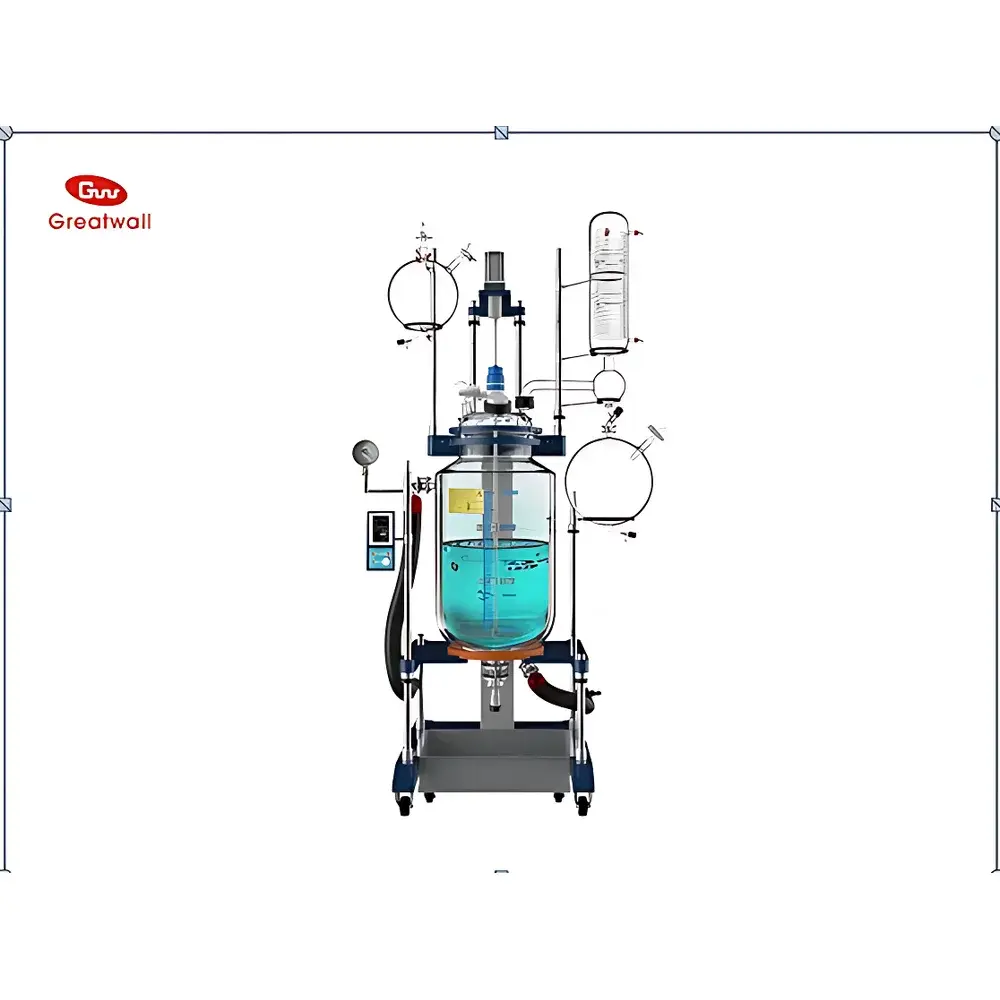
The Great Wall GRF-80CE Dual-Jacketed Glass Reactor
| Brand | The Great Wall |
|---|---|
| Origin | Henan, China |
| Manufacturer Type | Direct Manufacturer |
| Origin Category | Domestic |
| Model | GRF-80CE |
| Price Range | USD 2,800–7,000 (FOB) |
| Usable Volume | 80 L (Medium-Scale) |
| Construction Material | Borosilicate Glass 3.3 |
| Operating Pressure | Low-Pressure (Vacuum to Atmospheric) |
| Jacket Capacity | ~25 L |
| Condenser Heat Transfer Area | ~0.954 m² |
| Feed Bottle Capacity | 10 L |
| Receiver Bottle Capacity | 20 L |
| Internal Pressure Rating | –0.1 to 0.0 MPa |
| Jacket Pressure Rating | ≤0.03 MPa |
| Temperature Range | –80 °C to +200 °C |
| Stirring Motor | DC Brushless, 370 W |
| Speed Range | 20–500 rpm |
| Speed Accuracy | ±1 rpm (display), ±0.7% (≤300 rpm), ±1% (>300 rpm) |
| Max Torque | 5.4 N·m |
| Power Supply | 100–240 V AC, 50/60 Hz |
| Vacuum Level | –0.098 MPa (absolute) |
| Frame Material | Q235 steel (powder-coated) + 6061-F aluminum (powder-coated) + SUS304 structural elements |
| Drip Tray Material | SUS316L |
| Stirrer Shaft & Blades | SUS304 core with PTFE cladding |
| Sealing | Proprietary mechanical seal assembly |
| Temperature Sensor | PT100 (PTFE-sheathed) |
| Interface | RS485 standard on control box |
| Dimensions (W×D×H) | ~1250 × 1000 × 2400 mm |
| Ambient Operating Conditions | 5–35 °C, ≤70% RH |
| Max ΔT (Jacket vs. Reactor Wall) | ≤80 °C |
Overview
The Great Wall GRF-80CE Dual-Jacketed Glass Reactor is an engineered platform for controlled, scalable chemical synthesis and process development under vacuum, inert atmosphere, or reflux conditions. Designed around the principles of thermal management, mechanical stability, and chemical inertness, it integrates a double-walled borosilicate glass 3.3 vessel with independently regulated heating/cooling jacket circulation and precision-stirred reaction dynamics. Its operational envelope—spanning –80 °C to +200 °C and –0.1 MPa to ambient pressure—enables cryogenic lithiation, high-temperature esterification, solvent-free condensations, and vacuum distillation workflows common in fine chemical, pharmaceutical intermediate, and academic synthetic laboratories. The reactor’s all-glass wetted path ensures zero metal leaching, while its modular port configuration supports inline pH monitoring, gas sparging, automated dosing, and fractional condensation setups per ASTM E2875 and ISO 17025-compliant method development protocols.
Key Features
- Borosilicate glass 3.3 construction throughout all process-contact components—including reactor body, condenser, feed/receiver vessels, and ground-glass joints—guarantees exceptional thermal shock resistance (ΔT ≤ 80 °C), hydrolytic stability, and optical clarity for real-time reaction observation.
- DC brushless stirring motor (370 W) delivers continuous torque output up to 5.4 N·m across a fully adjustable 20–500 rpm range, with digital speed display resolution of ±1 rpm and closed-loop speed stability of ±0.7% below 300 rpm.
- Seven standardized ports on the reactor head include: one 60# flange for stirrer shaft, one 35# flange for PT100 temperature probe, one 50# spherical joint for condenser coupling, two 34# standard taper joints for liquid addition, one 40# taper joint for feed bottle connection, and one 95# flange for solid charging—enabling full system integration without custom adaptors.
- Stainless steel (SUS316L) drip tray captures incidental spills and prevents floor contamination; non-drip bottom discharge valve eliminates residual holdup and facilitates quantitative transfer of viscous or crystalline products.
- Frame architecture combines powder-coated Q235 structural steel, anodized 6061-F aluminum panels, and SUS304 load-bearing elements—delivering rigidity, corrosion resistance, and ease of decontamination in GLP-aligned lab environments.
- RS485 serial interface on the control console enables bidirectional communication with external PLCs, SCADA systems, or LIMS platforms for audit-trail-capable data logging aligned with FDA 21 CFR Part 11 requirements.
Sample Compatibility & Compliance
The GRF-80CE accommodates heterogeneous, multiphase, and highly exothermic reactions involving organic solvents (e.g., THF, DMF, toluene), corrosive reagents (e.g., HCl(g), SOCl₂, AlCl₃ slurries), and moisture-sensitive organometallics. Its low-pressure rating (–0.1 MPa) supports solvent removal under reduced boiling points, while the jacket’s 0.03 MPa pressure limit permits steam or pressurized thermal oil circulation. All glass-to-metal seals utilize proprietary dual-lip mechanical seals with PTFE-faced stationary rings, validated for >5,000 hours of continuous operation under cyclic thermal loading. The system conforms to IEC 61010-1 (Safety Requirements for Electrical Equipment for Measurement, Control, and Laboratory Use) and meets CE marking requirements for laboratory apparatus. Documentation includes material traceability certificates for SUS316L and borosilicate glass 3.3, supporting ISO 9001 quality system audits.
Software & Data Management
While the GRF-80CE operates via standalone digital control panel (LED-based, with real-time display of rpm, torque, temperature, and elapsed time), its embedded RS485 interface allows seamless integration with third-party data acquisition software such as LabVIEW, MATLAB, or custom Python-based DAQ scripts. Users may configure automated ramp-hold profiles, trigger external pumps or valves via Modbus RTU commands, and archive timestamped datasets—including torque transients during crystallization onset or viscosity inflection points during polymerization—for retrospective analysis. All parameter logs are exportable in CSV format; when paired with compliant time-server synchronization and role-based user access, the configuration satisfies ALCOA+ (Attributable, Legible, Contemporaneous, Original, Accurate, Complete, Consistent, Enduring, Available) data integrity criteria required in GMP-regulated R&D labs.
Applications
- Synthesis of active pharmaceutical ingredients (APIs) requiring strict temperature ramp control and inert-atmosphere handling (e.g., Grignard additions, hydrogenations).
- Process optimization studies for batch crystallization, including supersaturation profiling and nucleation kinetics measurement.
- Vacuum-assisted removal of low-boiling solvents from reaction mixtures prior to work-up or chromatographic purification.
- Multi-step tandem reactions where intermediate isolation is avoided—enabled by sequential reagent addition through dedicated taper joints and inline condensation.
- Teaching laboratories conducting undergraduate organic chemistry experiments involving reflux, distillation, and gas evolution monitoring.
- Material science applications including sol-gel synthesis, nanoparticle precipitation, and precursor decomposition under controlled thermal gradients.
FAQ
What is the maximum allowable temperature differential between the jacket fluid and reactor contents?
The design limits the absolute temperature difference to ≤80 °C to prevent thermal stress-induced fracture of the borosilicate glass 3.3 vessel.
Can the GRF-80CE be operated under positive pressure?
No—it is rated exclusively for vacuum to atmospheric pressure (–0.1 to 0.0 MPa) in the reaction chamber; positive pressure operation is not permitted per safety certification.
Is the PT100 temperature sensor calibrated and traceable to NIST standards?
The supplied PT100 sensor is factory-calibrated; users may perform field verification using certified dry-block calibrators—full calibration documentation is available upon request.
What maintenance intervals are recommended for the mechanical seal and stirring bearing?
Under normal usage (≤8 hrs/day, non-abrasive media), inspect the seal assembly every 6 months and replace the bearing every 24 months—or sooner if axial play exceeds 0.15 mm.
Does the system support remote start/stop and parameter adjustment via Ethernet or Wi-Fi?
The base configuration includes only RS485; Ethernet or Wi-Fi connectivity requires optional gateway hardware and firmware upgrade, sold separately.



