
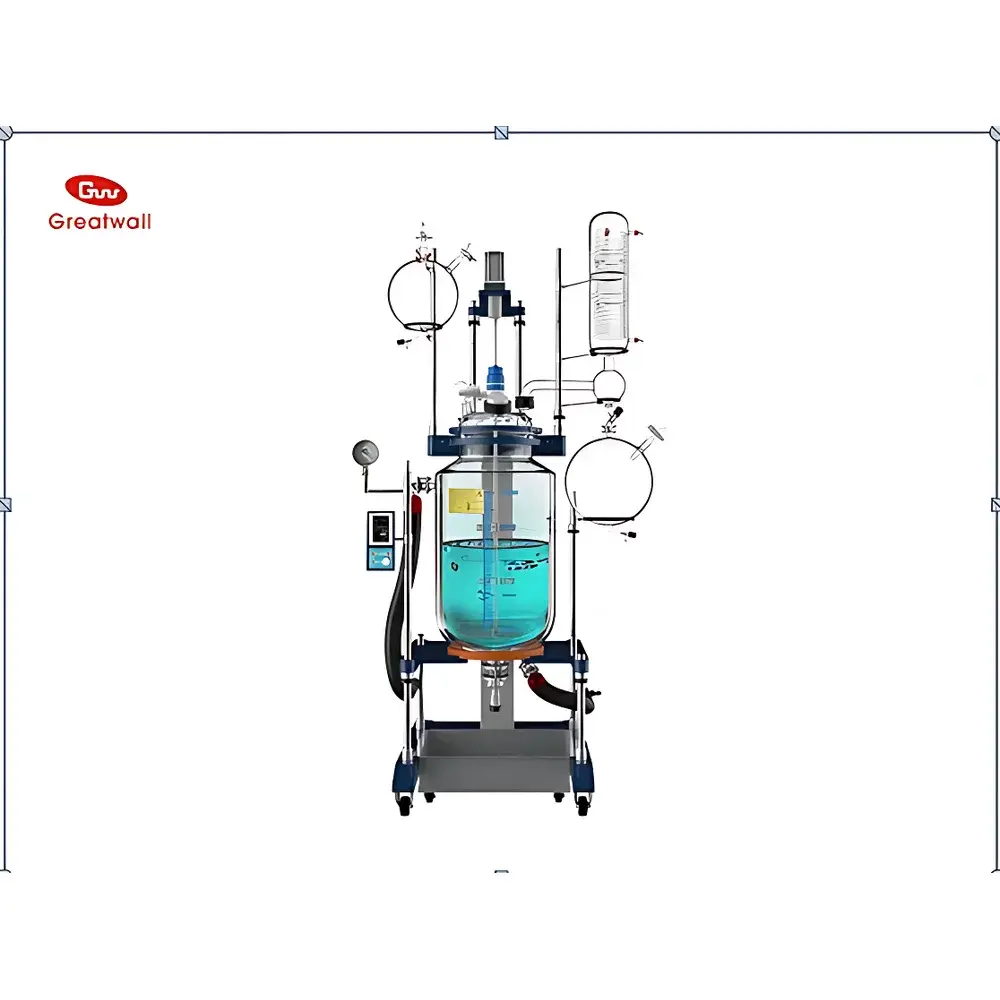
The Great Wall GRF-80CE Dual-Layer Lifting Glass Reactor
| Brand | The Great Wall |
|---|---|
| Origin | Henan, China |
| Manufacturer Type | Manufacturer |
| Origin Category | Domestic |
| Model | GRF-80CE |
| Price Range | USD 2,800–7,000 (FOB) |
| Usable Volume | Medium-Scale (80 L) |
| Construction Material | Borosilicate Glass 3.3 |
| Operating Pressure | Low Vacuum to Atmospheric (−0.1 MPa to 0 MPa) |
| Vacuum Level | −0.098 MPa |
| Jacket Volume | ~25 L |
| Condenser Heat Transfer Area | ~0.954 m² |
| Feed Bottle Capacity | 10 L |
| Receiver Bottle Capacity | 20 L |
| Stirring Motor Power | 370 W |
| Speed Range | 20–500 rpm |
| Speed Accuracy | ±1 rpm (display), ±0.7% (≤300 rpm), ±1% (>300 rpm) |
| Max Torque | 5.4 N·m |
| Temperature Range | −80 °C to +200 °C |
| Frame Material | Q235 steel (powder-coated) + 6061-F aluminum (powder-coated) + SUS304 stainless steel |
| Drip Tray Material | SUS316L |
| Stirring Shaft & Blades | SUS304 core with PTFE cladding |
| Sealing | Proprietary mechanical seal assembly |
| Temperature Sensor | PT100 (PTFE-sheathed) |
| Electrical Input | 100–240 V AC, 50/60 Hz |
| Dimensions (W×D×H) | ~1250 × 1000 × 2400 mm |
| Net Weight | ~280 kg |
Overview
The Great Wall GRF-80CE Dual-Layer Lifting Glass Reactor is an engineered laboratory-scale synthesis platform designed for controlled chemical reactions under variable temperature and pressure conditions. Built upon the principles of jacketed thermal management and vacuum-compatible glass process engineering, it enables precise heat transfer via dual-layer circulation (inner reactor wall + outer jacket), while maintaining full visual access to reaction progress through borosilicate glass 3.3 components. Its operational envelope spans −80 °C to +200 °C and −0.1 MPa to atmospheric pressure, making it suitable for low-temperature condensation, high-boiling-point distillations, reflux syntheses, and solvent-sensitive crystallization protocols. The lifting mechanism allows vertical adjustment of the upper assembly—facilitating safe, tool-free access to the reactor interior during charging, sampling, or cleaning without disassembly.
Key Features
- Borosilicate glass 3.3 construction throughout all wetted parts—including reactor body, condenser, feed/receiver bottles, and all standard-taper ground-glass joints—ensures exceptional thermal shock resistance (ΔT ≤ 80 °C), chemical inertness against strong acids/bases, and optical clarity for real-time reaction monitoring.
- Dual-layer lifting design permits smooth vertical displacement of the top assembly (including condenser, reflux head, and feed ports) to accommodate large-volume solid charging or internal instrumentation insertion without breaking vacuum or dismantling connections.
- Integrated DC brushless stirring motor delivers continuous speed control from 20 to 500 rpm, with digital torque feedback (up to 5.4 N·m) and ±1 rpm display resolution. Speed stability meets ISO 8573-1 Class 4 requirements for lab-grade reproducibility.
- Seven standardized port configurations on the reactor lid include: one 60# flange (stirrer shaft), one 35# flange (PT100 temperature probe), one 50# spherical joint (condenser interface), two 34# standard taper joints (liquid addition), one 40# taper (feed bottle connection), and one 95# flange (solid charge port)—enabling modular integration with distillation trains, gas inlets, or pH probes.
- Stainless steel (SUS316L) drip tray captures incidental spills and prevents floor contamination; all structural framing combines powder-coated Q235 carbon steel and 6061-F aluminum for corrosion resistance and ease of decontamination.
- PTFE-sheathed PT100 sensor and PTFE-coated stainless steel (SUS304) stirring shaft ensure long-term reliability in aggressive media, while the proprietary mechanical seal assembly minimizes maintenance frequency and maintains vacuum integrity down to −0.098 MPa.
Sample Compatibility & Compliance
The GRF-80CE supports a broad range of organic, inorganic, and organometallic reaction systems—including Grignard formations, hydrogenations (with external H₂ supply), esterifications, polymerizations, and multi-step cascade reactions. Its −0.1 MPa operating limit complies with ASTM E2877-22 guidelines for low-pressure reactor safety classification. All glass components conform to DIN ISO 3585 specifications for borosilicate glass 3.3. The system’s electrical architecture adheres to IEC 61010-1:2010 (Safety Requirements for Electrical Equipment for Measurement, Control, and Laboratory Use), including overcurrent protection and reinforced insulation. Optional validation packages support IQ/OQ documentation per GLP and GMP environments, with traceable calibration records for temperature (±0.3 °C) and pressure (±0.002 MPa).
Software & Data Management
The integrated control panel features an LED interface displaying real-time values for temperature, speed, torque, and elapsed time. RS485 serial communication (Modbus RTU protocol) enables bidirectional data exchange with external SCADA or LIMS platforms. When paired with optional PC-based software (e.g., LabView-compatible drivers or The Great Wall’s proprietary ReactorControl Suite), users can log timestamped datasets, configure multi-stage temperature/speed ramps, set alarm thresholds (e.g., torque overload > 5.0 N·m), and generate CSV-formatted audit trails compliant with FDA 21 CFR Part 11 requirements—including electronic signatures, user access levels, and immutable change history.
Applications
- Process development of active pharmaceutical ingredients (APIs) under controlled exothermic conditions, with jacketed cooling capacity supporting reaction enthalpy management up to 15 kW/m³.
- Solvent-free or low-solvent green chemistry workflows, including mechanochemical-assisted reactions enabled by the robust stirring torque and wide temperature window.
- Distillation and fractional separation of thermally labile compounds using the 0.954 m² condenser surface area and adjustable reflux ratio via the dual condenser orientation.
- Material synthesis for battery electrolytes and metal-organic frameworks (MOFs), where oxygen/moisture exclusion is achieved via repeated nitrogen purging cycles and sustained vacuum hold-down (< −0.095 MPa for ≥ 12 h).
- Educational demonstration of reaction kinetics, phase equilibria, and mass transfer phenomena in university teaching labs—supported by transparent geometry and standardized joint interfaces compatible with third-party sensors.
FAQ
What is the maximum allowable temperature differential between the reactor interior and jacket?
The design limits the ΔT across the glass wall to ≤ 80 °C to prevent thermal stress fracture—e.g., if the jacket circulates −40 °C coolant, the internal reaction temperature must remain ≥ −40 °C.
Can the GRF-80CE be used for hydrogenation reactions?
Yes—when equipped with a certified H₂-compatible gas inlet valve, pressure-rated sealing gaskets, and explosion-proof accessories (optional), it supports catalytic hydrogenations at ≤ 0.1 MPa gauge pressure.
Is the system compatible with automated process control systems?
Yes—the RS485 interface supports Modbus RTU commands for remote start/stop, setpoint adjustment, and real-time parameter polling; custom OPC UA gateways are available upon request.
How is vacuum integrity verified during commissioning?
A standard leak test procedure (per ISO 10272:2020) is included in the manual: evacuate to −0.098 MPa, isolate, and monitor pressure rise ≤ 0.001 MPa/h over 30 minutes.
What maintenance intervals are recommended for the mechanical seal and motor?
Under continuous operation, inspect the seal every 500 hours; replace bearings and PTFE wear components every 2,000 hours or per visual wear assessment—no lubrication required for the brushless motor.



