
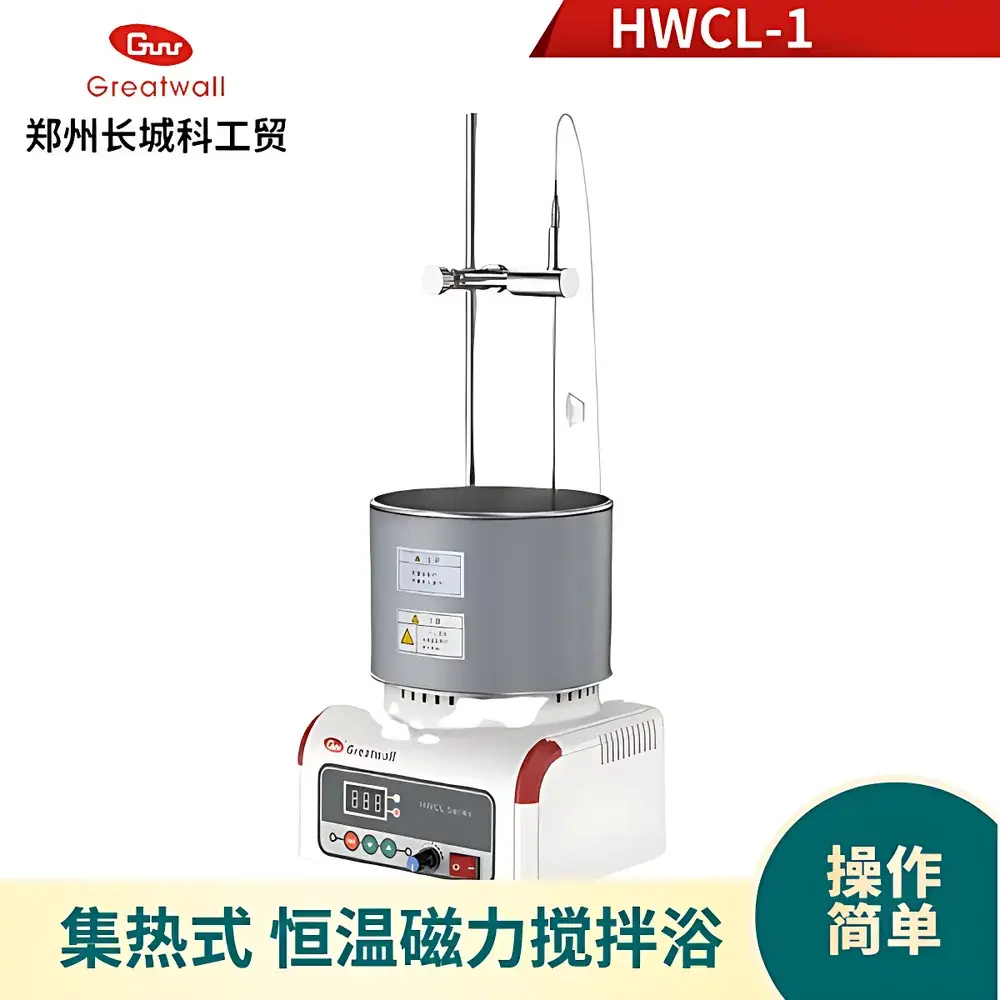
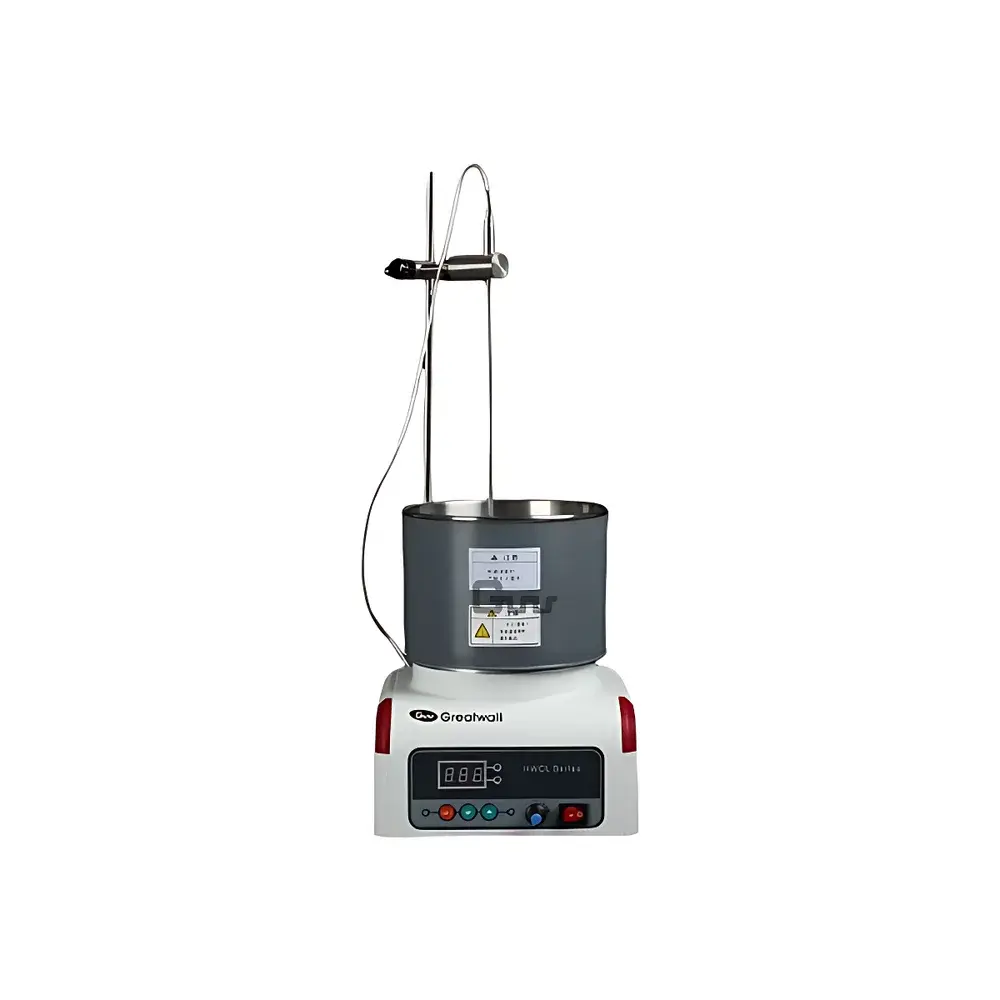
The Great Wall HWCL-1 Integrated Heating Magnetic Stirring Bath
| Brand | The Great Wall |
|---|---|
| Origin | Henan, China |
| Manufacturer Type | Direct Manufacturer |
| Instrument Type | Magnetic Stirrer |
| Max Vessel Capacity | 500 mL |
| Speed Range | 0–2000 rpm |
| Temperature Range | RT+5°C to 200°C (oil bath) / RT+5°C to 95°C (water bath) |
| Temp Stability | ±1°C |
| Heating Power | 300 W |
| Bath Dimensions | Ø145 × 104 mm |
| Bath Volume | 1.5 L |
| Overall Dimensions | 190 W × 200 D × 490 H mm |
| Net Weight | 4 kg |
| Power Supply | 110 V~, 60 Hz or 220–240 V~, 50/60 Hz |
| Protection Features | Overcurrent, Ground Fault, Overtemperature |
| Drive Motor | Brushless DC |
| Magnet Type | High-Temperature Permanent Magnet |
| Control Method | PID Temperature Control |
| Input & Display | Keypad + LED |
Overview
The Great Wall HWCL-1 Integrated Heating Magnetic Stirring Bath is an engineered laboratory platform designed for precise thermal control and homogeneous mixing in open-bath configurations. Unlike conventional hotplates or standalone stirrers, the HWCL-1 integrates a thermostatically regulated heating bath with a synchronized magnetic stirring mechanism—enabling simultaneous temperature maintenance and mechanical agitation of reaction vessels immersed in heat-transfer media (e.g., water, silicone oil, or ethylene glycol). Its operational principle relies on conductive and convective heat transfer through the bath fluid, coupled with rotational torque transmission via high-strength permanent magnets embedded beneath the bath plate. This architecture ensures uniform thermal distribution across the vessel base and sidewalls, minimizing axial and radial thermal gradients that commonly compromise reaction reproducibility in synthesis, dissolution testing, or kinetic studies.
Key Features
- Integrated dual-function design: simultaneous precise temperature regulation and magnetic stirring within a single compact unit.
- Brushless DC motor drive ensures low-noise operation, extended service life, and consistent torque delivery across the full 0–2000 rpm speed range.
- High-temperature resistant permanent magnet assembly maintains stable magnetic coupling up to 200°C without demagnetization—critical for prolonged oil-bath applications.
- PID-based digital temperature control delivers ±1°C stability across both water (RT+5°C to 95°C) and oil (RT+5°C to 200°C) operating modes.
- Intuitive front-panel interface with keypad input and LED display enables rapid parameter entry and real-time monitoring of setpoint and actual temperature.
- Robust safety architecture includes overcurrent protection, ground-fault detection, and independent overtemperature cutoff—compliant with IEC 61010-1 requirements for laboratory electrical equipment.
- 1.5 L cylindrical stainless-steel bath (Ø145 × 104 mm) accommodates standard 500 mL round-bottom flasks or beakers with full fluid immersion for optimal thermal contact.
Sample Compatibility & Compliance
The HWCL-1 supports glassware commonly used in synthetic chemistry and analytical sample preparation—including borosilicate round-bottom flasks, flat-bottom beakers, and jacketed reactors—provided external dimensions fit within the bath’s 145 mm diameter footprint. Its open-bath configuration allows direct visual access and easy insertion/removal of vessels without mechanical constraints. While not certified for hazardous area use (e.g., ATEX or IECEx), the unit meets general-purpose laboratory safety standards under IEC 61010-1 and conforms to electromagnetic compatibility (EMC) requirements per IEC 61326-1. It is suitable for environments operating under GLP-compliant workflows where instrument calibration records, temperature verification logs, and operator intervention timestamps are maintained manually or via external data loggers.
Software & Data Management
The HWCL-1 operates as a stand-alone analog-digital hybrid system with no embedded firmware or network connectivity. All operational parameters—including set temperature, actual bath temperature, and stir speed—are displayed locally via LED indicators; no remote monitoring or data export capability is provided. Users requiring audit-trail functionality (e.g., FDA 21 CFR Part 11 compliance) must integrate the unit with external calibrated thermocouple probes and third-party data acquisition systems. For routine QC/QA documentation, laboratories typically record setpoints, observed stability deviations, and duration of operation in bound logbooks or validated electronic lab notebooks (ELNs), referencing the unit’s serial number and calibration certificate (recommended annually per ISO/IEC 17025 guidelines).
Applications
- Synthesis and reflux reactions requiring controlled heating and continuous agitation (e.g., esterification, condensation, or Grignard preparations).
- Dissolution testing of pharmaceutical dosage forms per USP , particularly when combined with automated sampling manifolds.
- Calibration of temperature-sensitive sensors using traceable reference baths.
- Viscosity measurements of thermally responsive fluids where bath temperature must remain stable during rotational shear application.
- Preparation of homogeneous polymer solutions, nanoparticle dispersions, or catalyst slurries prior to filtration or characterization.
- Standardized heating protocols in environmental testing labs (e.g., ASTM D92 for flash point determination using Cleveland Open Cup apparatus).
FAQ
What types of bath fluids are compatible with the HWCL-1?
Water, silicone oil (up to 200°C), and ethylene glycol/water mixtures are routinely used. Avoid halogenated solvents or low-flash-point hydrocarbons due to fire risk and material compatibility concerns.
Can the HWCL-1 accommodate a 1 L flask?
No—the maximum recommended vessel volume is 500 mL to ensure full immersion and thermal uniformity within the 1.5 L bath capacity.
Is external temperature calibration required?
Yes. While the built-in sensor provides operational feedback, periodic verification against a NIST-traceable reference thermometer is essential for applications demanding metrological rigor.
Does the unit support programmable ramp-soak temperature profiles?
No—it features only manual setpoint control with static PID tuning; multi-step thermal programming requires external controllers.
What maintenance is recommended for long-term reliability?
Regular cleaning of the bath chamber to prevent residue buildup, inspection of the stir bar coupling alignment, and annual verification of thermal and rotational performance by an accredited service provider.



