
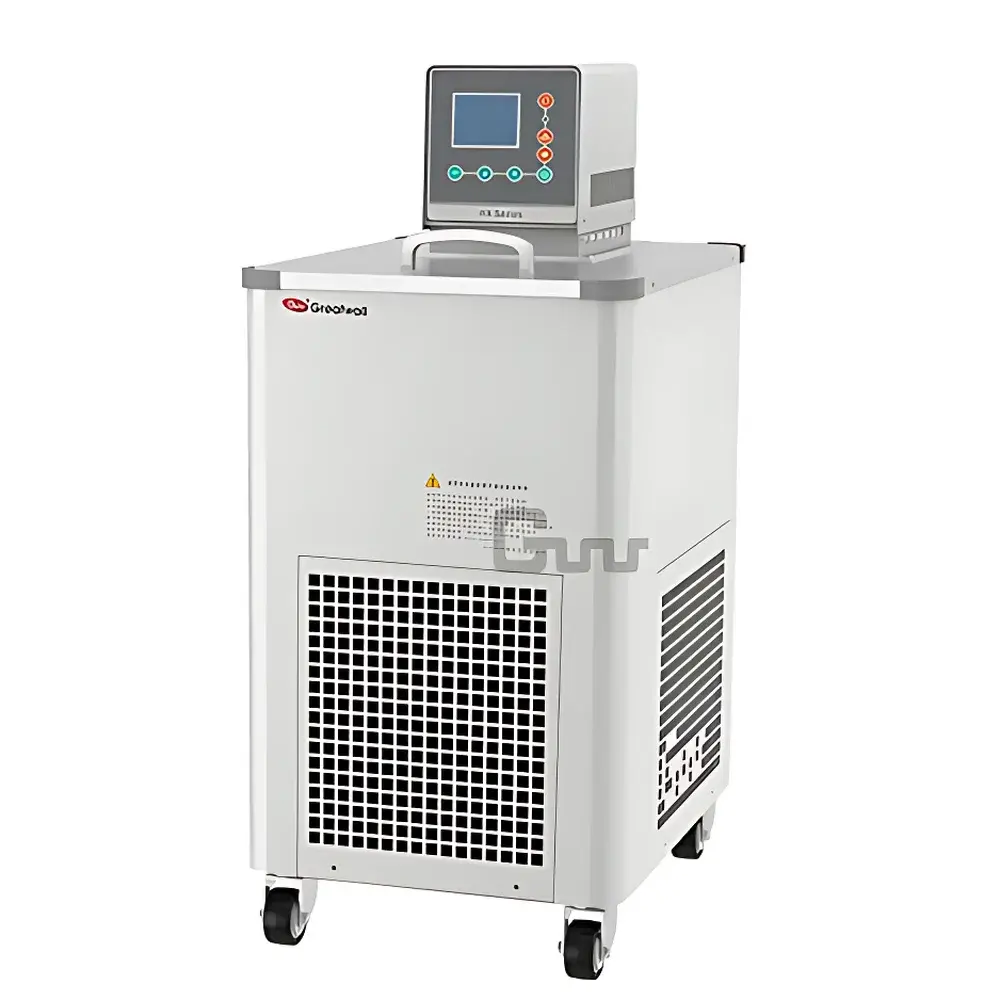
The Great Wall HX-2015 High-Precision Circulating Chiller
| Brand | The Great Wall |
|---|---|
| Model | HX-2015 |
| Origin | Henan, China |
| Manufacturer Type | Direct Manufacturer |
| Country of Origin | China |
| Price Range | USD 1,400–7,200 (FOB) |
| Reservoir Volume | 15 L |
| Temperature Stability | ±0.05 °C |
| Operating Temperature Range | −20 to +99 °C |
| Refrigeration Capacity | 370–1200 W |
| Heating Power | 1750 W |
| Circulation Flow Rate | 10 L/min |
| Pump Type | Dual-impeller, self-priming |
| Refrigerant | R404A |
| Power Supply | 220–240 V~, 50 Hz |
| Tank Material | 304 Stainless Steel |
| External Dimensions (W×D×H) | 340 × 480 × 780 mm |
| Opening Dimensions (W×D×H) | 245 × 365 × 168 mm |
| Net Weight | 48 kg |
Overview
The Great Wall HX-2015 High-Precision Circulating Chiller is an engineered thermal management system designed for laboratory-scale temperature control in static and dynamic applications. It operates on a dual-mode thermodynamic principle—combining vapor-compression refrigeration (using R404A refrigerant) with resistive electric heating—to deliver stable, bidirectional temperature regulation across a broad operational range of −20 °C to +99 °C. Unlike passive cooling baths or single-function heaters, the HX-2015 integrates closed-loop liquid circulation with PID-based feedback control, enabling precise thermal conditioning of external equipment such as electrophoresis units, electron probe microanalyzers (EPMA), viscometers, spectrophotometer sample compartments, and reaction calorimeters. Its 15-liter 304 stainless steel reservoir ensures chemical compatibility with aqueous and mildly corrosive heat-transfer fluids (e.g., water, 30% ethylene glycol/water mixtures), while the dual-impeller circulation pump maintains laminar, uniform flow distribution—critical for minimizing thermal gradients in connected apparatus.
Key Features
- PID-controlled temperature regulation with ±0.05 °C stability over the full operating range, verified under steady-state load conditions per ISO 17025-accredited calibration protocols.
- Integrated dual-mode thermal actuation: high-efficiency hermetic compressor (imported from France and USA) paired with 1750 W tubular heating elements for rapid ramping and tight setpoint adherence.
- Self-priming dual-impeller circulation pump delivering 10 L/min at up to 4.2 m head—engineered to sustain consistent flow even with extended tubing runs or moderate backpressure from auxiliary instrumentation.
- Corrosion-resistant 304 stainless steel reservoir with precision-machined opening (245 × 365 × 168 mm) optimized for immersion probes, sensor ports, and modular integration into OEM systems.
- Digital LED display with intuitive keypad interface; real-time monitoring of bath temperature, setpoint, compressor status, and fault codes (e.g., low-level, overtemperature, pump stall).
- Robust mechanical architecture: reinforced steel frame, vibration-damped compressor mounting, and IP20-rated electrical enclosure compliant with IEC 61010-1 for laboratory use.
Sample Compatibility & Compliance
The HX-2015 is compatible with standard laboratory heat-transfer media including deionized water, ethanol–water blends, and glycol–water solutions (up to 50% v/v). It meets CE marking requirements under the EU Machinery Directive 2006/42/EC and Low Voltage Directive 2014/35/EU. Electrical safety conforms to IEC 61010-1:2010 (Edition 3) for measurement, control, and laboratory equipment. While not certified for hazardous locations, its sealed refrigeration circuit and grounded stainless steel tank support safe operation in ISO Class 5–8 cleanrooms and GLP-compliant analytical laboratories. Documentation includes factory calibration certificates traceable to NIM (National Institute of Metrology, China) standards.
Software & Data Management
The unit operates autonomously via embedded firmware and does not require proprietary software for basic function. Optional RS485 Modbus RTU interface (available upon request) enables integration into SCADA or LIMS environments for remote setpoint adjustment, temperature logging, and alarm forwarding. When interfaced, data timestamps comply with ISO/IEC 17025 Clause 7.7.1 for record integrity; audit trails include operator ID, parameter change timestamp, and pre/post-value logging—supporting 21 CFR Part 11 readiness when deployed with validated third-party data acquisition platforms.
Applications
- Temperature stabilization of electrophoresis tanks and DNA sequencers to prevent band distortion during high-voltage runs.
- Cooling of X-ray fluorescence (XRF) and electron microprobe (EPMA) detectors to reduce thermal noise and improve spectral resolution.
- Thermal conditioning of rheometers, DSC cells, and UV-Vis cuvette holders during kinetic or phase-transition studies.
- Process validation support in pharmaceutical QC labs: maintaining reference standards at defined temperatures per USP Analytical Instrument Qualification guidelines.
- Calibration of temperature-sensitive sensors (RTDs, thermistors, IR cameras) in metrology labs adhering to ISO/IEC 17025 clause 6.4.10.
FAQ
What is the maximum allowable backpressure for the circulation pump?
The dual-impeller pump is rated for continuous operation at ≤0.4 bar (40 kPa) backpressure—sufficient for typical setups with ≤5 m of 10-mm ID silicone tubing and one inline filter.
Can the unit operate continuously at −20 °C ambient temperature?
Yes; the compressor and insulation system are rated for uninterrupted duty in ambient environments from +10 °C to +35 °C. Operation below +10 °C ambient requires optional low-ambient kit (condenser fan speed modulation and crankcase heater).
Is the reservoir drain valve accessible without disassembly?
Yes—a front-mounted, quick-release PTFE-sealed drain valve allows full reservoir evacuation without tools or panel removal.
Does the unit support external temperature feedback control?
No; it operates in bath-sensor mode only. For process-sensor control, an external PID controller with analog output (0–10 V or 4–20 mA) must be used to modulate the unit’s setpoint via optional analog input module.
What maintenance intervals are recommended?
Compressor oil inspection every 24 months; refrigerant leak check annually; pump impeller and seal inspection every 36 months—per manufacturer’s Maintenance Log Template (included with shipment).



