
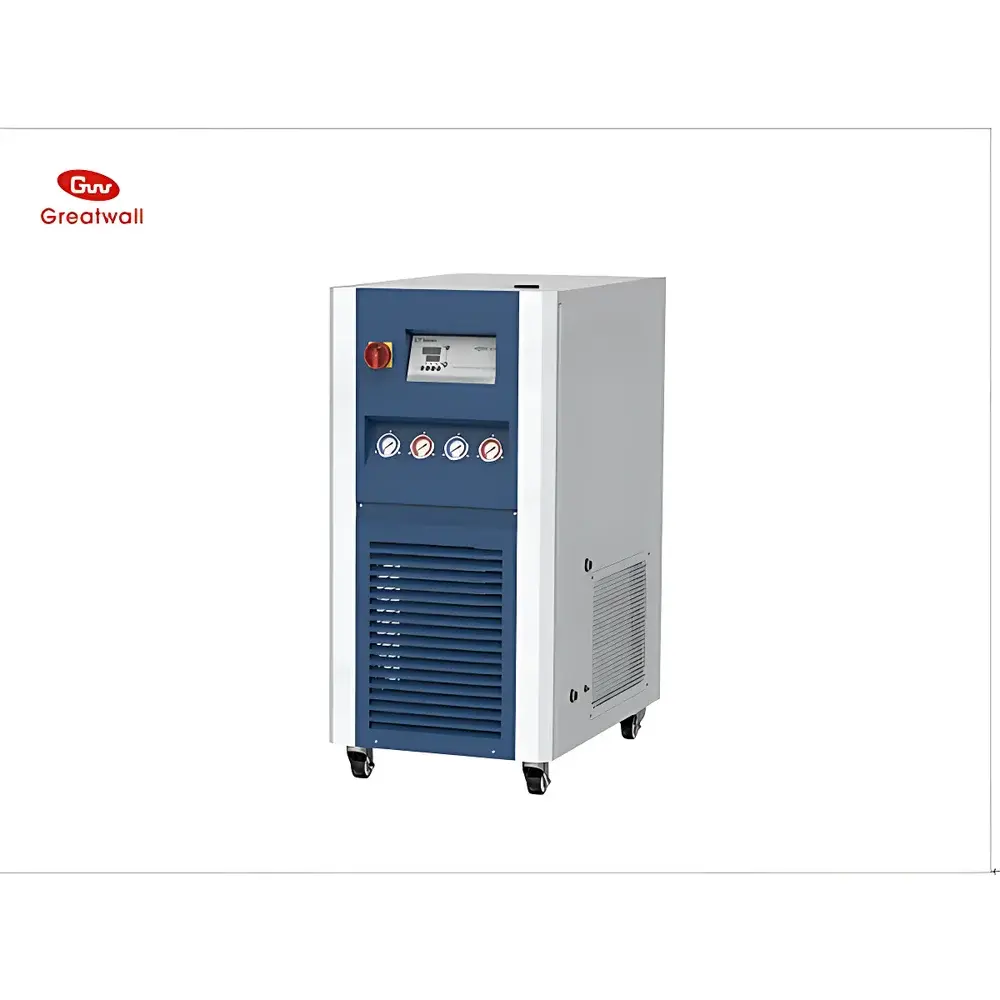
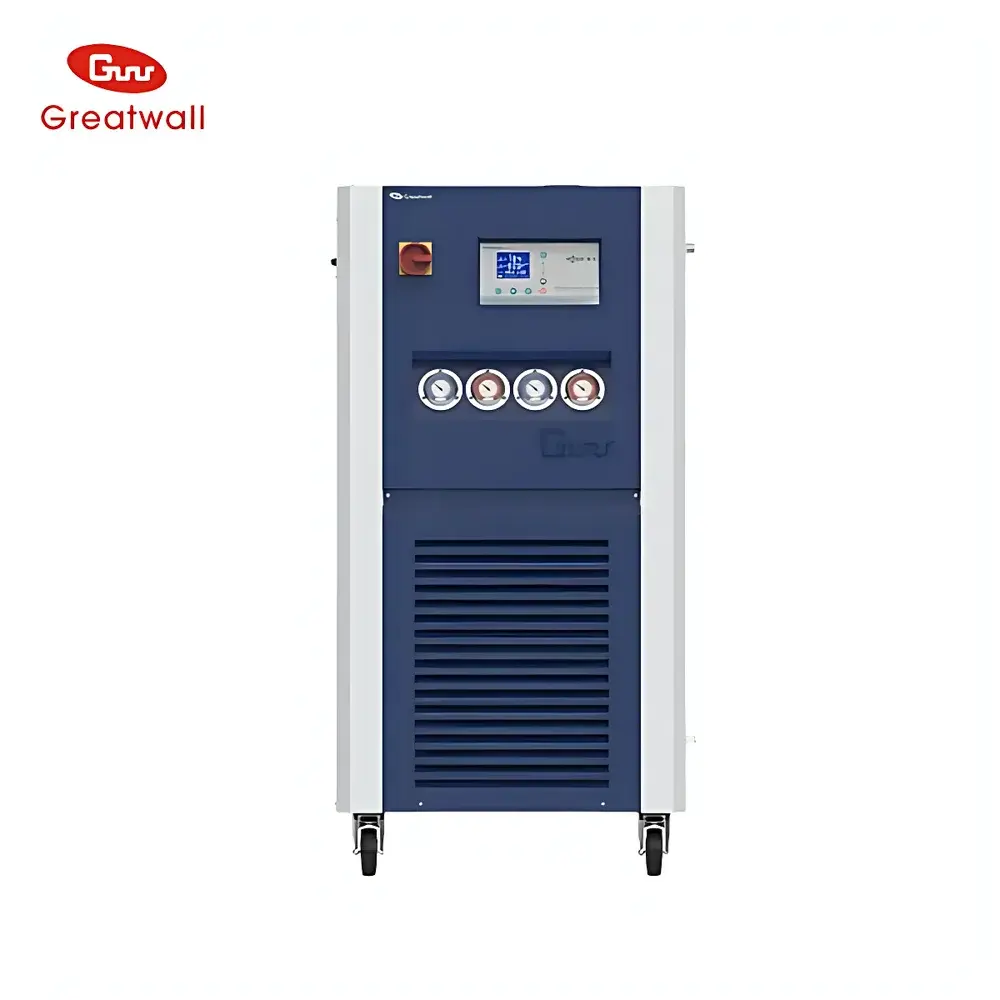
The Great Wall LT-100-80 Ultra-Low Temperature Circulating Chiller
| Brand | The Great Wall |
|---|---|
| Origin | Henan, China |
| Manufacturer Type | Direct Manufacturer |
| Product Category | Domestic |
| Model | LT-100-80 Ultra-Low Temperature Circulating Chiller |
| Instrument Type | Integrated Unit |
| Cooling Method | Air-Cooled |
| Temperature Control Range | −80 °C to −40 °C |
| Refrigeration Capacity | 2.5–10 kW |
| Temperature Stability | ±2 °C |
| Circulating Pump Pressure | 1 bar |
| Circulating Pump Flow Rate | 30 L/min |
Overview
The Great Wall LT-100-80 Ultra-Low Temperature Circulating Chiller is an integrated, air-cooled thermal management system engineered for precise and stable external cooling in demanding laboratory and pilot-scale applications. It operates on a closed-loop refrigeration cycle using a multi-stage cascade compression system—typically employing R23/R508B or equivalent low-global-warming-potential (GWP) refrigerants—to achieve sustained operation down to −80 °C. Unlike single-stage chillers limited to −40 °C, the LT-100-80 utilizes dual or triple compressor stages with intermediate heat exchange to overcome thermodynamic constraints at ultra-low temperatures. Its primary function is to supply a continuous, temperature-regulated coolant stream (e.g., ethanol/water or silicone oil mixtures) to external process equipment—including jacketed reactors, calorimeters, spectroscopic cryostats, and material testing chambers—enabling controlled exothermic reaction quenching, low-temperature polymerization, cryogenic characterization, and thermal cycling validation.
Key Features
- Closed-loop circulation architecture minimizes fluid evaporation and hygroscopic degradation—critical when using low-viscosity organic heat transfer fluids below −60 °C;
- Comprehensive safety architecture: high-pressure cut-off switches, phase-sequence monitoring, compressor thermal overload protection, delayed restart logic (≥3 min), and overcurrent circuit interruption;
- Intelligent liquid-level management system with overflow detection and automatic drain activation to prevent pump cavitation or seal damage from overfilling;
- Stainless steel reservoir and fluid pathways ensure chemical compatibility with common cryogenic heat transfer media and resist embrittlement at sub-zero temperatures;
- Integrated PID-based temperature controller with real-time setpoint ramping, hold functionality, and manual/auto mode switching for process flexibility;
- Front-panel digital display with dual-channel readout (setpoint/actual temperature) and status indicators for refrigeration stage engagement, pump operation, and fault conditions.
Sample Compatibility & Compliance
The LT-100-80 is designed for use with non-corrosive, low-freezing-point heat transfer fluids—including 30/70% ethanol/water, ethylene glycol/water blends, and methyl silicone oils (e.g., DC-200 series). It is not rated for direct contact with aggressive solvents (e.g., chlorinated hydrocarbons, strong acids/bases) or flammable fluids exceeding flash point thresholds defined in IEC 61000-6-4. While not certified to UL 61010-1 or CE Machinery Directive out-of-the-box, its electrical design conforms to GB 4793.1–2019 (equivalent to IEC 61010-1:2010) for laboratory equipment safety. For GxP environments, optional audit-trail-enabled controllers and 21 CFR Part 11-compliant software modules are available upon request to support GLP/GMP documentation requirements.
Software & Data Management
The standard unit features local control only; however, an optional RS485 Modbus RTU interface enables integration into centralized SCADA or LabVantage systems for remote monitoring of temperature, pump status, and alarm states. Third-party data acquisition platforms (e.g., LabVIEW, MATLAB, or DeltaV) can poll real-time values at configurable intervals (1–30 s). When equipped with the optional Ethernet module, the chiller supports SNMP traps and HTTP-based status queries—facilitating automated log generation and deviation alerts aligned with ISO/IEC 17025 clause 7.7 (monitoring of environmental conditions).
Applications
- Temperature control of glass- or stainless-steel jacketed reactors during low-T hydrogenation, Grignard synthesis, or lithiation reactions;
- Cryogenic conditioning of polymer samples prior to DMA, DSC, or tensile testing per ASTM D638 and ISO 527;
- Thermal stabilization of FTIR, Raman, or UV-Vis spectrometers requiring detector or sample-stage cooling;
- Simulating extreme ambient conditions in accelerated aging studies (e.g., ICH Q1A stability protocols);
- Supporting superconductivity research setups where magnet or sensor cooling demands stable sub-−70 °C operation.
FAQ
What heat transfer fluids are compatible with the LT-100-80 at −80 °C?
Ethanol/water (30/70 v/v), methanol/water (40/60), and low-viscosity silicone oils (e.g., Dow Corning DC-200, viscosity ≤50 cSt at −80 °C) are validated. Avoid glycerol-based fluids due to excessive viscosity below −40 °C.
Can this chiller maintain −80 °C while delivering 30 L/min flow?
Yes—but sustained full-flow operation at the lowest temperature requires adequate heat rejection capacity. Ambient temperature must remain ≤25 °C, and airflow around condenser coils must be unobstructed. At −80 °C, maximum usable refrigeration capacity is ~2.5 kW; higher loads require reduced setpoints or flow modulation.
Is the reservoir volume adjustable or user-serviceable?
The reservoir is fixed at 25 L and sealed for pressure integrity. Fluid top-up and replacement are performed via the dedicated fill port with integrated level sensor; no internal tank disassembly is required.
Does the unit include insulation for external tubing?
No—external line insulation (e.g., Armaflex or elastomeric foam rated to −100 °C) must be applied by the end user to minimize parasitic heat gain and condensation, especially in humid environments.
What maintenance intervals are recommended?
Compressor oil and filter-drier replacement every 24 months or 4,000 operating hours; annual inspection of refrigerant charge integrity and electrical contact resistance; quarterly verification of pump seal integrity and fluid pH (for aqueous mixes).



