
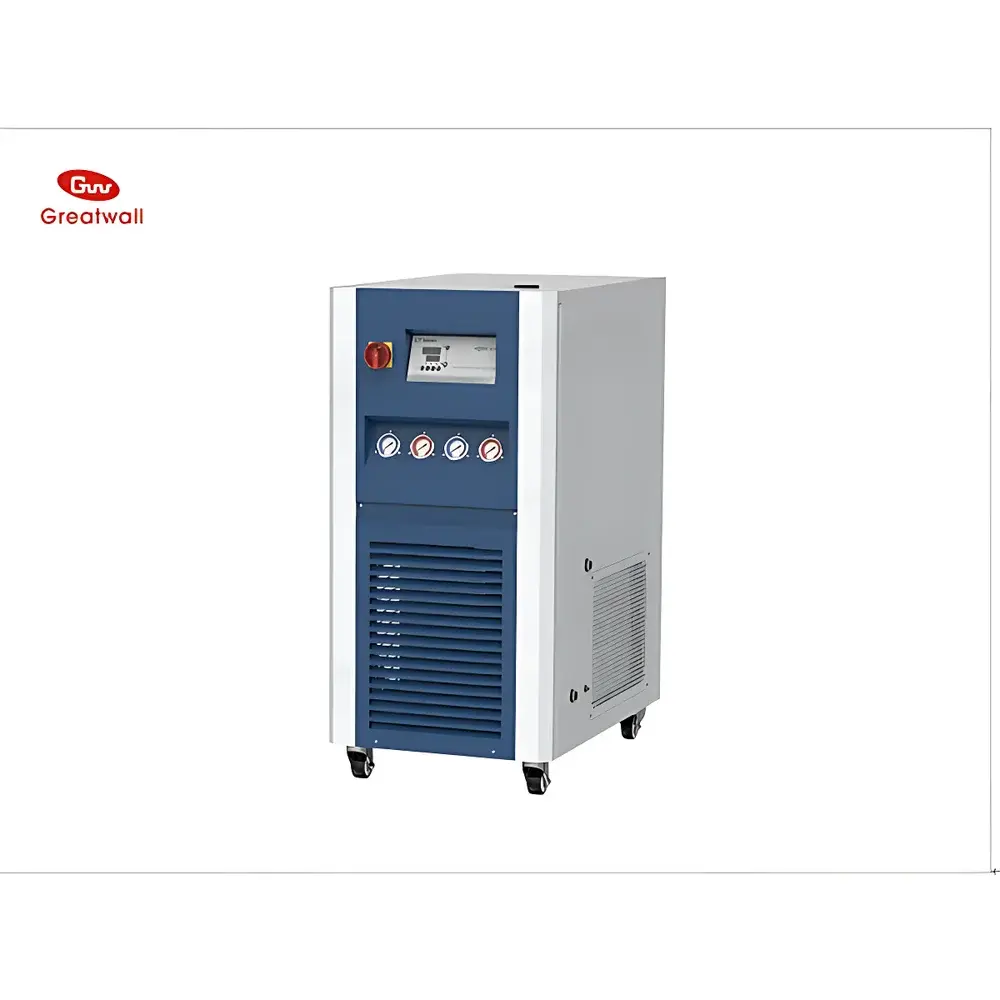
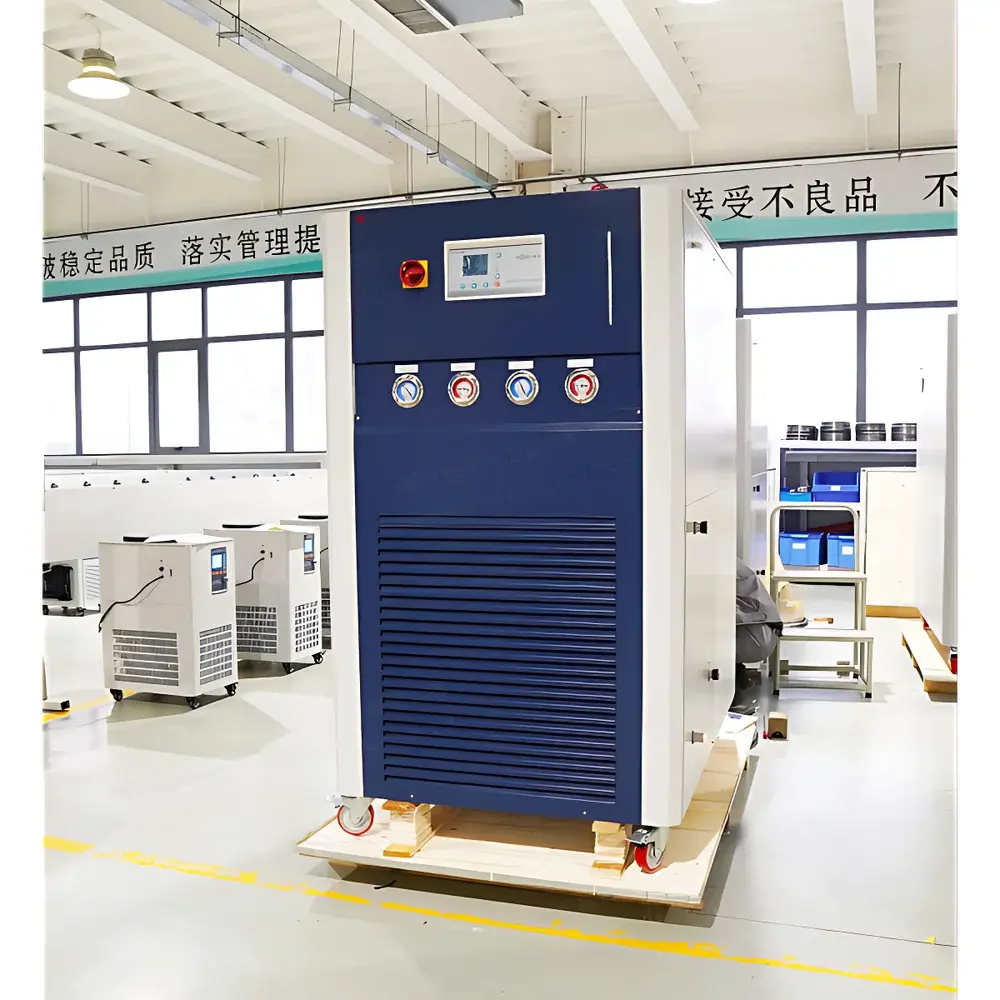
The Great Wall LT-50-80 Cryogenic Circulating Chiller
| Brand | The Great Wall |
|---|---|
| Origin | Henan, China |
| Manufacturer Type | Direct Manufacturer |
| Equipment Type | Vertical |
| Temperature Stability | ±2 °C |
| External Dimensions (W×D×H) | 710 mm × 1230 mm × 1380 mm |
| Minimum Operating Temperature | −80 °C |
| System Configuration | Closed-loop Circulation |
| Safety Protections | High-pressure cut-off, leakage current protection, compressor time-delay start, thermal overload protection, overcurrent protection, phase-sequence monitoring |
| Liquid Overfill Protection | Automatic discharge mechanism |
Overview
The Great Wall LT-50-80 Cryogenic Circulating Chiller is an engineered closed-loop refrigeration system designed to deliver stable, precisely regulated sub-ambient cooling for laboratory and pilot-scale process applications. Utilizing a cascade two-stage compression refrigeration cycle with environmentally compliant low-GWP refrigerants (R23/R13 or equivalent), the unit achieves sustained operational capability at temperatures down to −80 °C—enabling controlled cryogenic environments essential for exothermic reaction management, low-temperature material characterization, and thermal stress testing. Its vertical architecture optimizes floor space utilization while maintaining structural rigidity for long-term vibration-free operation. Unlike open-bath chillers, the LT-50-80 employs a fully sealed circulation path, minimizing exposure of heat-transfer fluid (e.g., ethanol/water or specialized silicone-based fluids) to ambient humidity and oxygen—thereby preserving fluid integrity, viscosity stability, and thermal conductivity over extended service intervals.
Key Features
- Cascade Refrigeration Architecture: Dual-compressor system with independent high- and low-stage circuits ensures reliable deep-cooling performance without mechanical freezing of internal components or evaporator fouling.
- Integrated Safety Monitoring: Real-time hardware-level protections include refrigerant high-pressure shutdown, phase-sequence verification for three-phase power input, compressor thermal overload sensing, timed startup delay to prevent voltage surge damage, and ground-fault leakage detection compliant with IEC 61000-4-5 immunity standards.
- Intelligent Fluid Management: Built-in level sensor array triggers automatic overflow discharge when thermal fluid volume exceeds calibrated thresholds—preventing pump cavitation, seal extrusion, and pressure transients during fill operations.
- Vibration-Damped Mounting: Compressors and condenser fans are isolated using elastomeric mounts to suppress structure-borne noise and mechanical transmission into connected reactors or analytical instruments.
- Corrosion-Resistant Fluid Path: All wetted surfaces—including reservoir, pump head, and heat exchanger—utilize 316 stainless steel or electropolished passivated alloys compatible with common organic solvents and low-temperature brines.
Sample Compatibility & Compliance
The LT-50-80 is routinely deployed in GMP-aligned pharmaceutical development labs for jacketed reactor temperature control during cryogenic Grignard or lithiation reactions, and in polymer R&D facilities for dynamic mechanical analysis (DMA) sample conditioning per ASTM D7028. Its closed-loop design eliminates atmospheric moisture ingress—critical for hygroscopic reagents or water-sensitive catalysts. The system meets CE marking requirements under the Machinery Directive 2006/42/EC and Low Voltage Directive 2014/35/EU. Electrical safety certification includes EN 61010-1:2019 for laboratory equipment. While not intrinsically rated for Class I Division 1 hazardous locations, optional ATEX-compliant variants (LT-50-80-ATEX) are available upon request for solvent-handling environments.
Software & Data Management
The chiller operates via an embedded industrial-grade controller with a 5.7-inch TFT LCD HMI interface supporting multi-language UI (English, German, Japanese). Temperature setpoint, ramp rate, hold duration, and alarm thresholds are programmable through intuitive menu navigation. Optional RS485 Modbus RTU or Ethernet TCP/IP communication enables integration into centralized SCADA or LIMS platforms. Audit trail functionality records all parameter changes, alarm events, and maintenance alerts with timestamp and operator ID—supporting GLP/GMP documentation requirements under 21 CFR Part 11 when paired with validated electronic signature workflows. Data export is supported via USB mass storage in CSV format for traceability and trend analysis.
Applications
- Temperature control of jacketed glass or stainless-steel reactors (1–100 L capacity) during low-T synthesis, crystallization, or hydrogenation.
- Thermal preconditioning of composite materials prior to tensile, impact, or fracture toughness testing per ISO 6603 or ASTM D5041.
- Cooling support for high-field NMR probe pre-cooling systems requiring stable −70 °C to −80 °C thermal sinks.
- Environmental simulation chambers where precise thermal cycling between −80 °C and +25 °C must be replicated with ≤±2 °C uniformity across test volume.
- Calibration laboratories maintaining reference standards for cryogenic thermocouples (Type T, E) and PRTs per ISO/IEC 17025.
FAQ
What is the lowest achievable bath temperature with standard heat-transfer fluid?
The LT-50-80 maintains a stable setpoint of −80 °C using certified low-viscosity ethanol/water mixtures (e.g., 30/70 v/v) or synthetic silicone oils rated for −100 °C service. Actual minimum temperature depends on ambient conditions, flow rate, and connected heat load.
Can this chiller be integrated with third-party reactor control systems?
Yes—via Modbus RTU (RS485) or Ethernet TCP/IP, enabling bidirectional communication for remote setpoint adjustment, status polling, and fault logging within distributed control environments.
Is the unit suitable for continuous 24/7 operation in a production environment?
Designed for uninterrupted duty cycles, the LT-50-80 incorporates redundant thermal monitoring, compressor oil-level sensors, and predictive maintenance alerts—validated for >10,000 hours MTBF under ISO 13374 condition monitoring guidelines.
Does it comply with FDA 21 CFR Part 11 for electronic records?
When configured with validated software modules and external electronic signature infrastructure, audit trails meet Part 11 requirements for data integrity, retention, and operator accountability.
What maintenance intervals are recommended?
Compressor oil and filter replacement every 6,000 operating hours; annual calibration of PT100 temperature sensors against NIST-traceable references; biannual inspection of refrigerant charge integrity via manifold gauge set and leak detection.



