
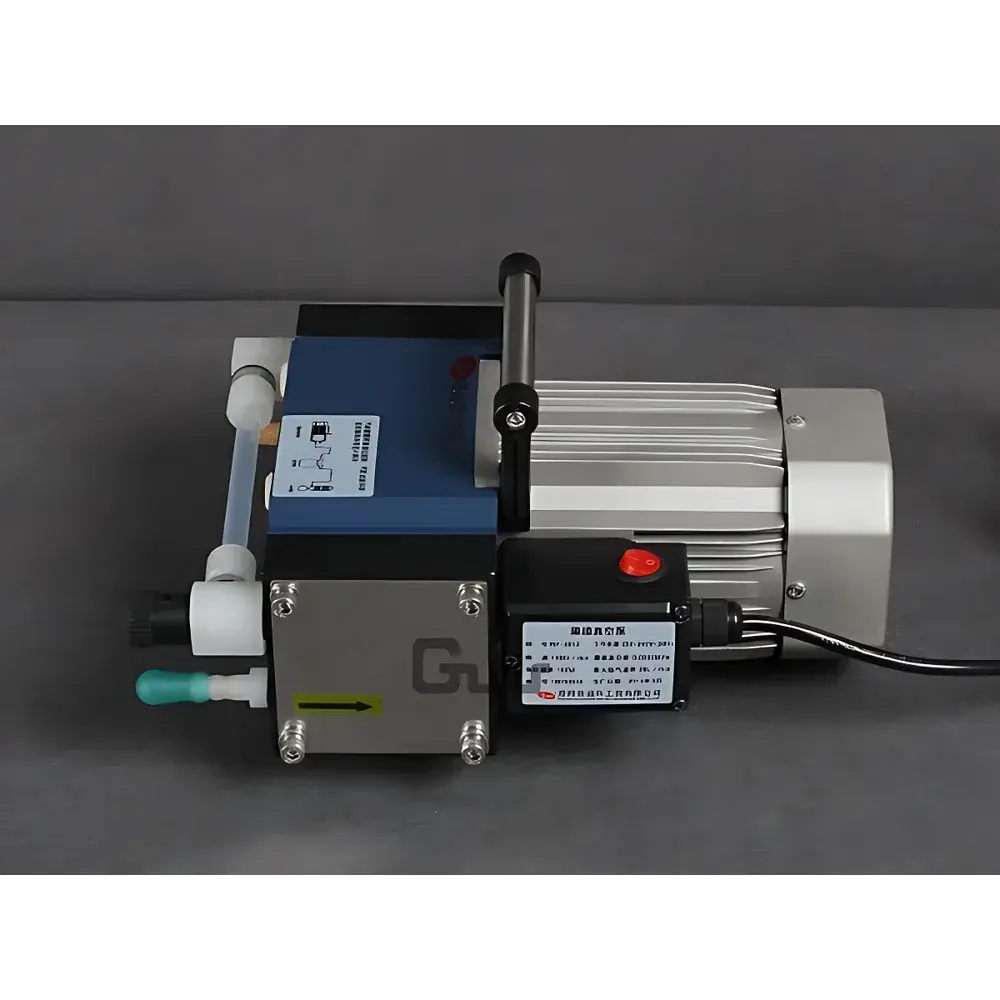
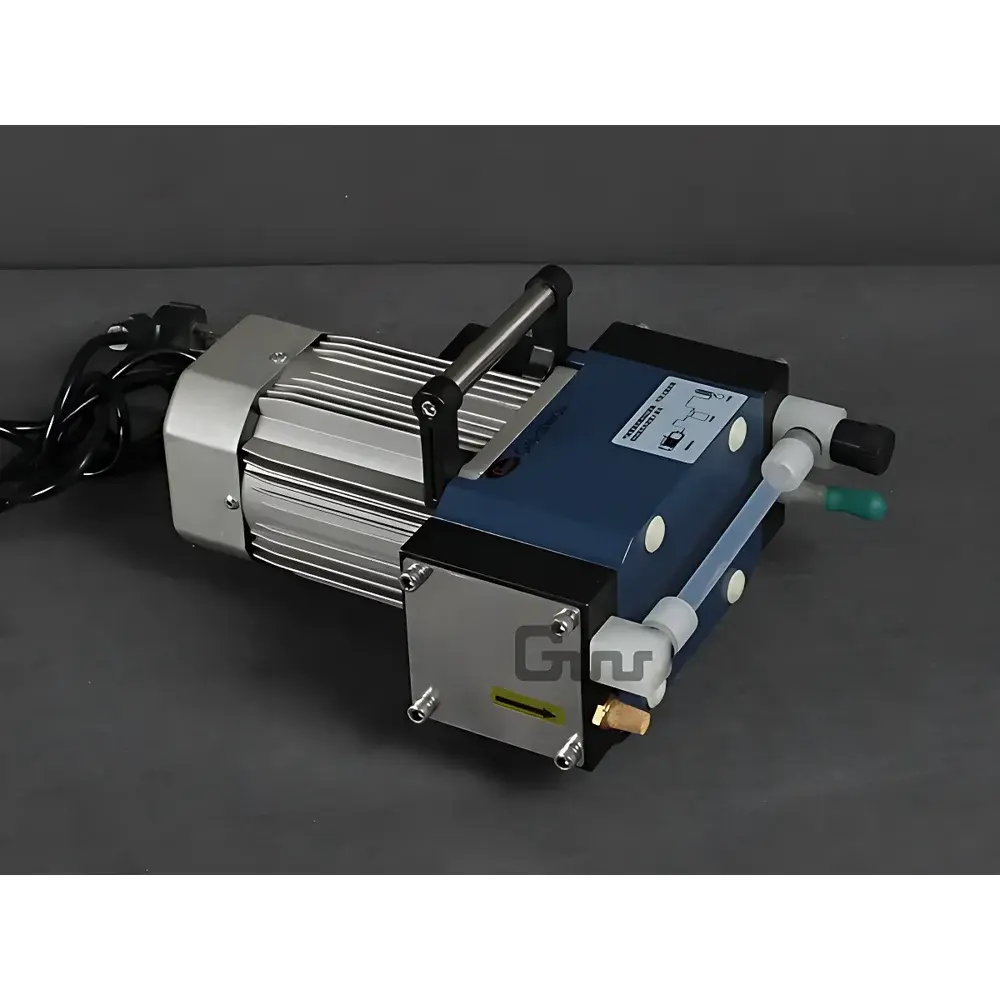
The Great Wall MP-201Z Oil-Free Diaphragm Vacuum Pump
| Brand | The Great Wall |
|---|---|
| Origin | Henan, China |
| Manufacturer Type | Direct Manufacturer |
| Country of Origin | China |
| Model | MP-201Z |
| Pump Type | Diaphragm Vacuum Pump |
| Lubrication | Oil-Free |
| Ultimate Vacuum | 2 kPa (8 mbar) |
| Pumping Speed | 25 L/min |
| Motor Power | 180 W |
| Input Voltage/Frequency | 220–240 V~, 50 Hz |
| Motor Speed | 1300 rpm |
| Inlet Port Diameter | Ø6 mm |
| Dimensions (W×D×H) | 300 × 230 × 170 mm |
| Net Weight | 10 kg |
Overview
The Great Wall MP-201Z is an oil-free diaphragm vacuum pump engineered for reliable, contamination-free operation in analytical, preparative, and quality control laboratories. It operates on positive displacement principle via a PTFE-coated elastomeric diaphragm driven by an eccentric cam mechanism—eliminating the need for lubricating oil and preventing hydrocarbon backstreaming or sample contamination. Designed for continuous duty under moderate vacuum loads, the MP-201Z delivers stable suction performance across a wide range of low-to-medium vacuum applications, including rotary evaporation, vacuum filtration, solvent removal, freeze-drying support, and inert atmosphere purging. Its sealed motor enclosure and chemically resistant wetted materials (including EPDM valves and PTFE diaphragm) ensure compatibility with mildly corrosive vapors and reactive gases, making it suitable for use with organic solvents, dilute acids and bases, and moisture-sensitive samples.
Key Features
- Oil-free operation ensures zero risk of oil vapor contamination—critical for GC sample introduction, mass spectrometry auxiliary pumping, and pharmaceutical process validation.
- PTFE-reinforced diaphragm and EPDM valve assembly provide enhanced chemical resistance against common laboratory solvents (e.g., acetone, ethanol, ethyl acetate) and weak inorganic reagents.
- Thermally protected 180 W induction motor enables sustained operation at ambient temperatures up to 40 °C without derating; integrated thermal cutoff prevents coil overheating during extended duty cycles.
- Compact footprint (300 × 230 × 170 mm) and lightweight design (10 kg) facilitate benchtop integration, mobile cart mounting, or placement inside fume hoods or gloveboxes.
- Standard Ø6 mm barbed inlet port accepts reinforced PVC or silicone tubing (ID 4–6 mm); optional vacuum gauge port (M4 thread) available for analog or digital pressure monitoring.
- No maintenance required beyond periodic diaphragm inspection—typical service life exceeds 5,000 operating hours under nominal load conditions.
Sample Compatibility & Compliance
The MP-201Z is validated for use with non-explosive, non-particulate-laden gas streams. It complies with IEC 61000-6-3 (EMC emission standards) and IEC 61000-6-2 (immunity requirements) for laboratory environments. While not rated for ATEX or IECEx Zone 1/2 hazardous area use, its spark-free motor design and absence of oil reservoirs reduce ignition risk when handling Class I flammable vapors below their LEL—provided proper ventilation and vapor concentration monitoring are maintained per OSHA 1910.120 and local safety protocols. The pump meets ISO 8573-1:2010 Class 4 purity requirements for compressed air/vacuum systems, ensuring particulate and oil aerosol levels remain within acceptable limits for GLP-compliant sample preparation workflows.
Software & Data Management
As a standalone mechanical vacuum source, the MP-201Z does not incorporate embedded firmware, digital interfaces, or data logging capabilities. It is intended for manual, analog operation—consistent with regulatory expectations for Class I vacuum support equipment under FDA 21 CFR Part 11 Annex 11 and EU GMP Annex 11, where simplicity and auditability supersede automation. For laboratories requiring traceable vacuum control, the MP-201Z may be paired with external digital vacuum controllers (e.g., MKS 925, Agilent VAC-100) equipped with RS-485 or analog 0–10 V output, enabling integration into LabVantage, Empower, or DeltaV-based process supervision systems with full electronic record retention and user access controls.
Applications
- Rotary evaporation of heat-sensitive compounds (e.g., natural product isolates, polymer precursors) requiring stable 2–10 kPa vacuum levels.
- Gravity or pressure-assisted vacuum filtration of crystalline precipitates from aqueous or alcoholic media.
- Pre-concentration of environmental water samples prior to GC-MS analysis—avoiding hydrocarbon interference from oil-lubricated pumps.
- Desiccator evacuation for hygroscopic standard storage (e.g., USP reference standards, NIST SRMs).
- Support vacuum for cold traps in fractional distillation setups or Schlenk line manifolds.
- Low-vacuum degassing of adhesives, coatings, or composite resins in materials R&D labs.
FAQ
Can the MP-201Z be used with aggressive acids such as concentrated HCl or HNO₃?
No. While the PTFE diaphragm and EPDM valves resist mild acidity, prolonged exposure to fuming or hot concentrated mineral acids will degrade elastomers and compromise seal integrity. Use only with diluted (<10 % v/v), room-temperature acid vapors.
Is this pump suitable for high-vacuum applications like electron microscopy or vacuum metallurgy?
No. With an ultimate vacuum of 2 kPa (8 mbar), the MP-201Z is optimized for rough vacuum duties. It cannot achieve the 10⁻³ Pa range required for high-vacuum instrumentation.
Does the MP-201Z require a cooling water supply or exhaust condenser?
No. It is air-cooled and generates negligible heat load during normal operation. No external cooling or vapor trapping is necessary unless condensable solvents are continuously pumped at high rates.
What is the recommended replacement interval for the diaphragm?
Under typical lab usage (≤4 hrs/day, non-corrosive loads), diaphragm replacement is advised every 18–24 months or after 3,000–5,000 operating hours—whichever occurs first—as verified by reduced pumping speed or audible valve chatter.
Can multiple MP-201Z units be manifolded to increase total flow capacity?
Yes, provided inlet and outlet manifolds are sized to minimize pressure drop (<10 % of system vacuum loss), and all units operate on the same electrical circuit with adequate overcurrent protection. Parallel configuration does not improve ultimate vacuum but increases volumetric throughput linearly.
Related Products



