
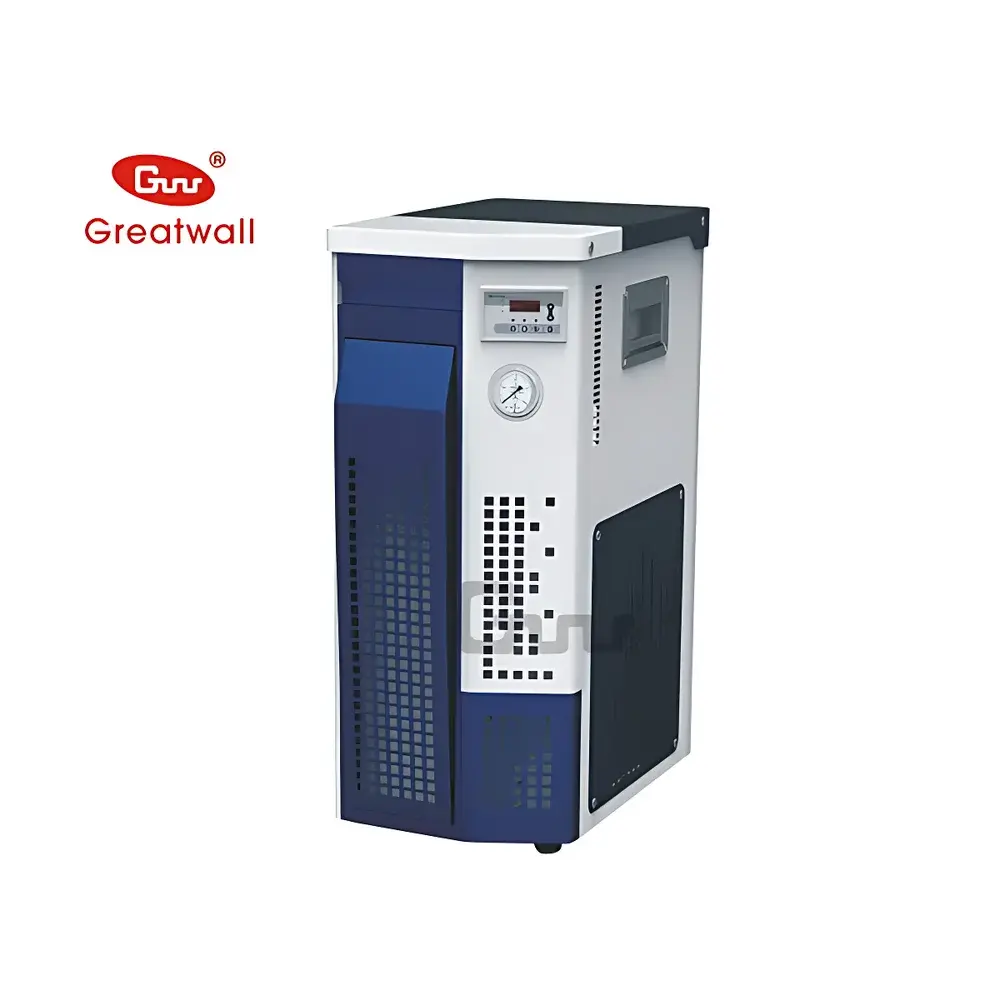
The Great Wall RJHS-2020 Low-Temperature Solvent Recovery System
| Brand | The Great Wall |
|---|---|
| Origin | Henan, China |
| Manufacturer Type | Original Equipment Manufacturer (OEM) |
| Country of Manufacture | China |
| Model | RJHS-2020 |
| Pricing | Available Upon Request |
Overview
The Great Wall RJHS-2020 Low-Temperature Solvent Recovery System is an industrial-grade condensation-based solvent recovery unit engineered for the efficient, energy-conscious reclamation of volatile organic compounds (VOCs) from process exhaust streams. Operating on the principle of cryogenic condensation—where vapor-phase solvents are cooled below their dew points to induce phase transition into liquid—the RJHS-2020 enables closed-loop solvent reuse without chemical alteration or degradation of molecular integrity. Unlike thermal oxidation or carbon adsorption methods, this system preserves solvent purity and composition, making it suitable for applications requiring high-fidelity recovered solvents—such as pharmaceutical active ingredient synthesis, precision coating formulation, and analytical reference standard preparation. Its design emphasizes operational safety, minimal maintenance, and compatibility with continuous or batch-mode operation in regulated manufacturing environments.
Key Features
- Cryogenic condensation core with multi-stage refrigeration circuit capable of achieving condensing temperatures down to –40 °C, optimized for high-boiling-point solvents including ketones, ethers, and aromatic hydrocarbons.
- Stainless steel 304 construction throughout wetted parts ensures corrosion resistance against aggressive solvents such as chlorinated hydrocarbons, alcohols, and sulfur-containing compounds.
- Integrated explosion-proof electrical components (certified to Class I, Division 2, Group D per NEC/CEC standards) for safe deployment in hazardous locations.
- Modular heat exchanger design facilitates cleaning, inspection, and replacement without full system shutdown—reducing downtime during routine GLP/GMP-compliant maintenance.
- Real-time temperature and pressure monitoring at inlet, condenser outlet, and recovered liquid reservoir via calibrated PT100 sensors and digital display interface.
- Low-noise scroll-type compressors and insulated refrigerant lines minimize ambient thermal load and acoustic emissions in laboratory or production floor settings.
Sample Compatibility & Compliance
The RJHS-2020 is validated for recovery of a broad spectrum of organic solvents, including but not limited to: n-hexane, toluene, xylene, acetone, methyl ethyl ketone (MEK), tetrahydrofuran (THF), ethanol, isopropanol, acetonitrile, dimethylformamide (DMF), and low-concentration amine or mercaptan vapors. It meets structural and performance requirements aligned with ISO 14001 environmental management systems and supports compliance with OSHA 29 CFR 1910.1200 (Hazard Communication) and EPA Method 25A for VOC emission control verification. While not inherently certified to ATEX or IECEx, its mechanical architecture allows for third-party certification to Zone 1/21 classification upon customer-specified configuration.
Software & Data Management
The RJHS-2020 operates via an embedded programmable logic controller (PLC) with local HMI touchscreen interface. All operational parameters—including condenser temperature setpoint, inlet flow rate (via optional mass flow sensor integration), refrigerant pressure, and accumulated recovered volume—are logged at user-defined intervals (1–60 minutes). Data export is supported via USB flash drive in CSV format for traceability and audit readiness. The system supports optional RS-485 Modbus RTU communication for integration into centralized SCADA or MES platforms, enabling automated batch records and alignment with FDA 21 CFR Part 11 requirements when paired with validated electronic signature modules and audit trail firmware.
Applications
- Pharmaceutical manufacturing: Recovery of solvents used in API crystallization, extraction, and chromatographic purification—supporting solvent reuse within ICH Q5C stability protocols.
- Coatings & inks: Reclamation of toluene, xylene, and ester blends from spray booths and mixing rooms to maintain consistent viscosity and VOC content in reformulated batches.
- Electronics cleaning: On-site recovery of isopropyl alcohol (IPA) and terpenes from precision component degreasing lines, reducing procurement frequency and waste disposal costs.
- Polymer processing: Capture and return of THF and DMF from polyacrylonitrile (PAN) fiber spinning exhaust, minimizing raw material loss and stack emissions reporting burden.
- Research laboratories: Small-scale solvent recycling in synthetic chemistry workflows where solvent grade consistency directly impacts reaction yield and reproducibility.
FAQ
What types of solvents can the RJHS-2020 recover effectively?
It is optimized for solvents with boiling points between 35 °C and 200 °C and vapor pressures above 1 kPa at 20 °C—including aliphatic and aromatic hydrocarbons, oxygenated solvents (alcohols, ketones, ethers), and select nitrogen- and sulfur-containing organics.
Does the system require external cooling water or chilled glycol supply?
No—it is fully self-contained with integrated air-cooled refrigeration; no ancillary utility connections beyond standard 3-phase 380 V AC power are required.
Can the RJHS-2020 be integrated into an existing fume hood or ducted exhaust system?
Yes—standardized 150 mm and 200 mm flanged inlet ports allow direct connection to ductwork; static pressure drop across the unit is ≤ 350 Pa at rated airflow (500–1200 m³/h, model-dependent).
Is validation documentation (DQ/IQ/OQ) available?
Factory-issued DQ templates and IQ/OQ protocols compliant with ISO 9001 and GAMP5 guidelines are provided upon order; site-specific execution requires qualified third-party validation support.



