
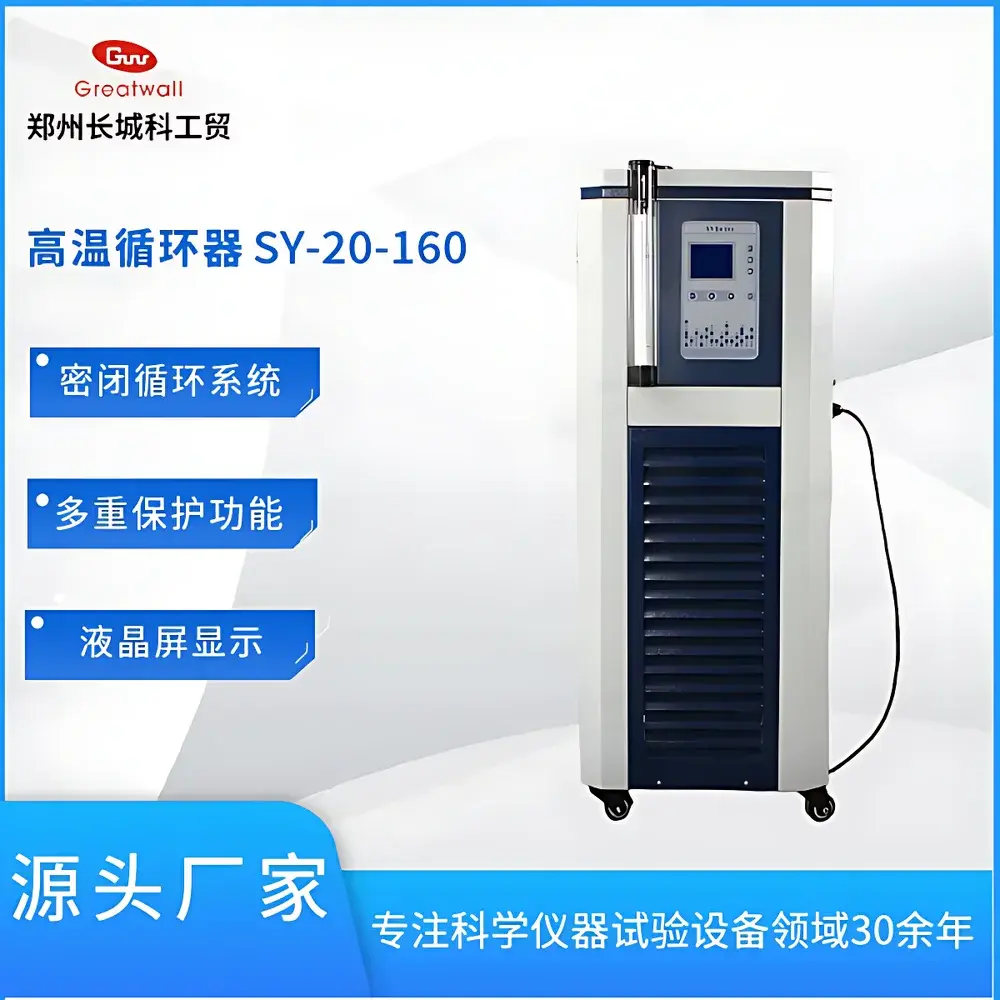
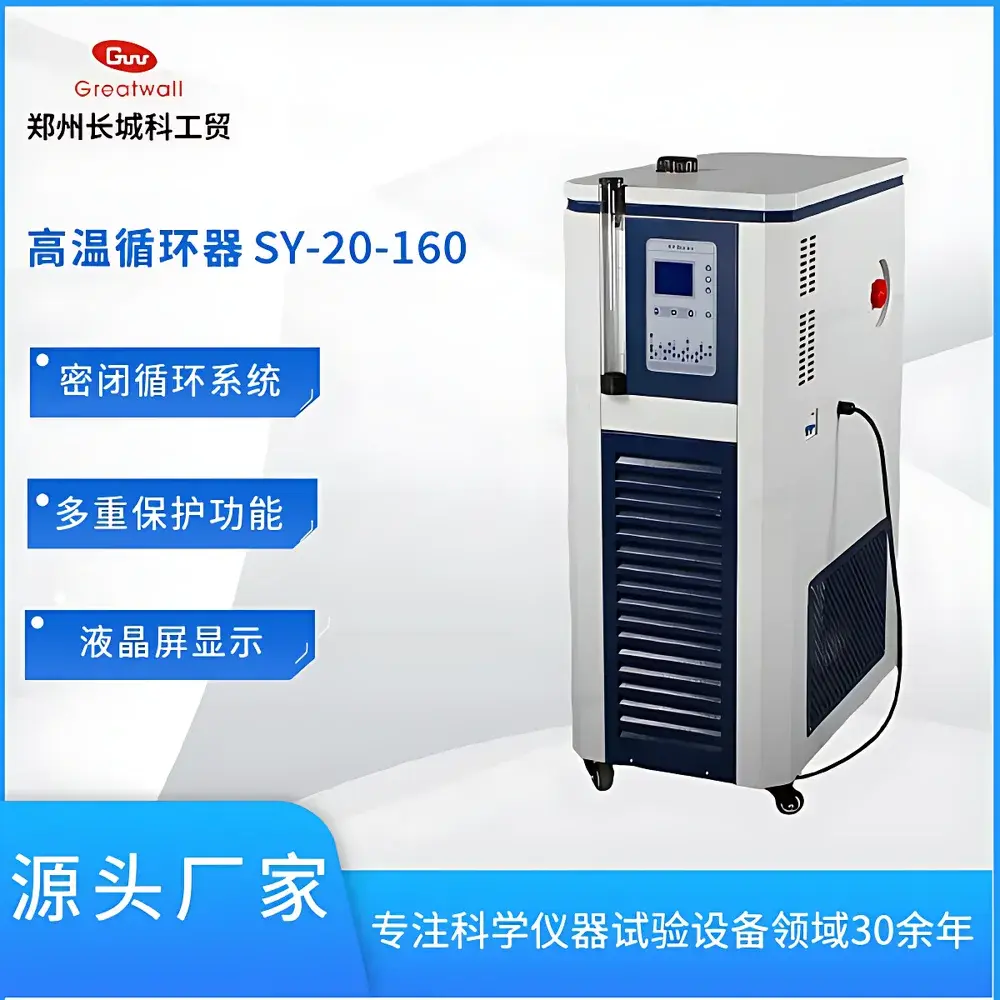
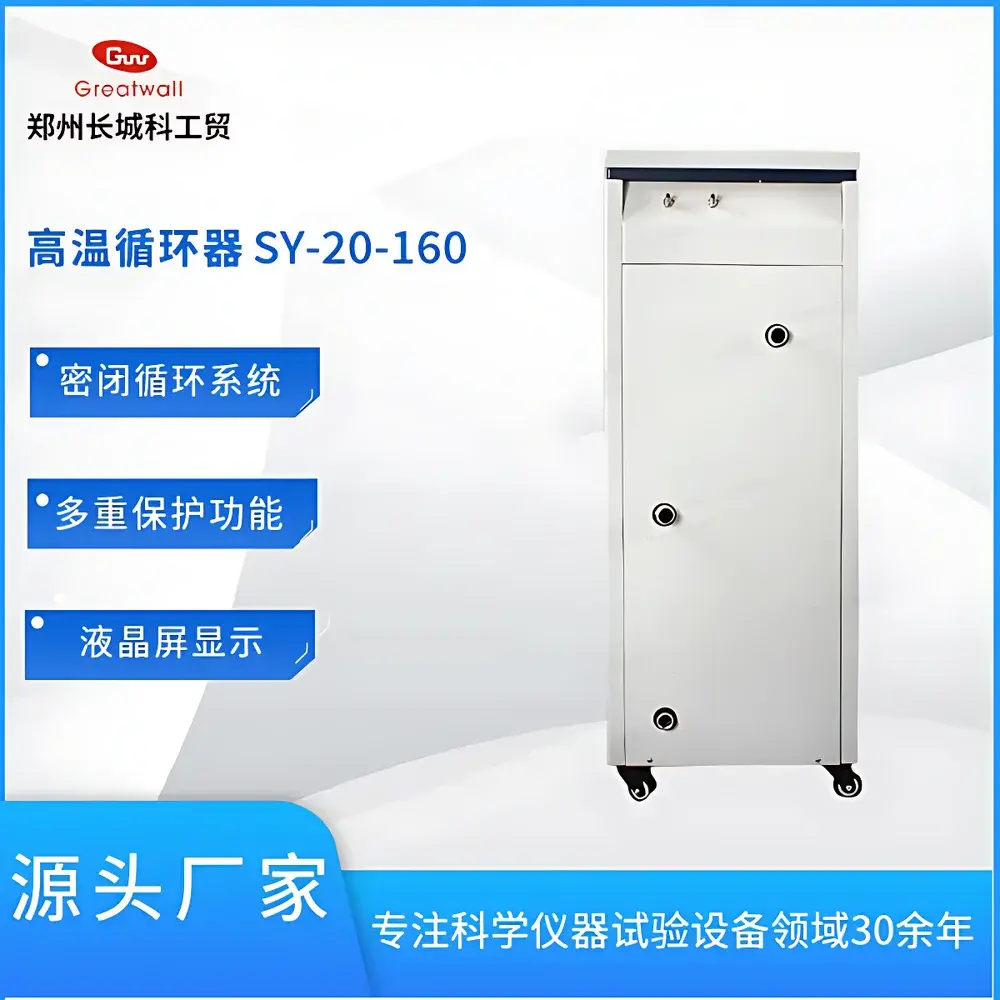
Great Wall SY-20-160 High-Temperature Circulating Bath
| Brand | Great Wall |
|---|---|
| Model | SY-20-160 |
| Temperature Range | +5 °C above ambient to 160 °C |
| Temperature Stability | ±0.5 °C |
| Heating Power | 3 kW |
| Circulation Flow Rate | ≤42 L/min |
| Max. Pressure | 2.8 bar |
| Pump Power | 370 W |
| Heat Transfer Fluid Capacity | 9 L |
| External Cooling Coil | Yes (water-cooled) |
| Protection Functions | Overtemperature, leakage current, thermal overload, overcurrent, phase sequence |
| Power Supply | 220–240 V~, 50 Hz |
| IP Rating | IP20 |
| Pollution Degree | 2 |
| Dimensions (W×D×H) | 430×690×1075 mm |
| Weight | 60 kg |
Overview
The Great Wall SY-20-160 High-Temperature Circulating Bath is an engineered thermal management system designed for precise, stable, and safe external temperature control of laboratory and pilot-scale process equipment. Operating on a closed-loop forced-circulation principle, it delivers heat via thermally stable organic heat transfer fluids—primarily synthetic or mineral-based thermal oils—across a continuous operational range from +5 °C above ambient up to 160 °C. Its architecture integrates dual-mode thermal regulation: resistive heating combined with an integrated water-cooled coil for active heat rejection during low- to mid-range setpoints (e.g., 5–60 °C), ensuring high reproducibility in applications requiring tight thermal tolerance. Unlike open-bath systems, the sealed circulation path minimizes fluid oxidation, volatilization, and moisture absorption—key degradation mechanisms that compromise viscosity, flash point, and long-term thermal stability. This design directly extends service life of heat transfer media and reduces maintenance frequency in regulated environments.
Key Features
- Hermetically sealed circulation loop with stainless steel fluid path components to inhibit oxidation and contamination
- Real-time liquid level monitoring via calibrated sight gauge for operational safety and fluid inventory management
- Multi-layer electrical and thermal protection: independent overtemperature cutoff (hardware-based), earth leakage detection, thermal overload relay, electronic overcurrent limiting, and phase sequence verification for three-phase compatibility
- Integrated cooling coil accepts external chilled water (typically 5–15 °C) to augment thermal regulation below 60 °C, eliminating reliance on auxiliary chillers in many workflows
- High-flow, low-pulsation centrifugal pump (370 W, max. 42 L/min at 2.8 bar) optimized for low-viscosity thermal oils and compatible with standard R2¾ external fittings
- Robust mechanical construction: powder-coated steel chassis, IP20-rated enclosure suitable for controlled indoor laboratory environments (pollution degree 2 per IEC 60664-1)
Sample Compatibility & Compliance
The SY-20-160 is compatible with a broad spectrum of external thermal loads—including jacketed glass reactors (1–50 L), calorimetry cells, material testing chambers (e.g., tensile/creep rigs), and analytical instrument ovens—provided inlet/outlet connections match R2¾ NPT or BSPP standards. It is not intended for direct immersion of samples or volatile solvents. As a Class I electrical appliance per IEC 61010-1, it conforms to essential safety requirements for laboratory equipment, including dielectric strength testing, creepage/clearance distances, and protective earthing continuity. While not certified to UL or CE as a standalone medical device, its design principles align with Good Manufacturing Practice (GMP) infrastructure expectations for temperature-critical unit operations in pharmaceutical development (e.g., API crystallization, polymer curing). Documentation supports traceable calibration of temperature sensors (Pt100 class B) and audit-ready maintenance logs.
Software & Data Management
The SY-20-160 operates via a dedicated digital PID controller with local LED interface; no embedded software or network connectivity is provided. All setpoint adjustments, status monitoring (temperature, pump status, alarm flags), and manual override functions are accessible through front-panel keys and visual indicators. For integration into automated workflows, analog 0–10 V or 4–20 mA output signals (optional upon request) enable connection to SCADA, DCS, or PLC systems for centralized supervision. Data logging requires external acquisition hardware; however, the unit’s stable thermal response (<0.5 °C deviation under steady-state load) ensures high-fidelity correlation between controller readings and validated reference thermometry (e.g., calibrated PRTs per ISO/IEC 17025).
Applications
- Temperature control of jacketed chemical reactors during exothermic/endothermic synthesis (e.g., Grignard reactions, hydrogenations)
- Thermal conditioning of polymer melts in rheological testing (capillary, rotational) per ASTM D3835 and ISO 11443
- Accelerated aging studies of battery electrolytes and encapsulants per IEC 62660-2
- Stabilization of optical benches and interferometric platforms requiring sub-degree thermal drift suppression
- Pre-conditioning of test specimens prior to mechanical testing (ASTM D638, ISO 527) to evaluate temperature-dependent modulus and yield behavior
- Support of dissolution apparatus (USP Apparatus II) heating baths where oil-based thermal transfer exceeds water’s 100 °C limit
FAQ
What heat transfer fluids are recommended for use with the SY-20-160?
Synthetic aromatic or silicone-based thermal oils rated for continuous operation up to 200 °C (e.g., Dowtherm J, Marlotherm SH, or comparable ISO VG 32–68 grades) are preferred. Mineral oils may be used below 120 °C but require more frequent analysis for acid number and viscosity drift.
Is external chiller integration mandatory for operation below 60 °C?
No. The built-in water-cooled coil allows passive or low-flow chilled water (5–15 °C) to maintain stability without secondary refrigeration—ideal for labs lacking dedicated chiller infrastructure.
Can this unit be used with water-glycol mixtures?
Not recommended. Water-based fluids risk vapor lock, corrosion, and freezing below 0 °C; the system is engineered for low-vapor-pressure, non-aqueous heat transfer media only.
How often should the thermal fluid be replaced?
Under typical lab usage (≤8 hrs/day, 160 °C max), annual fluid analysis (FTIR, TAN, viscosity) is advised; replacement interval ranges from 12–24 months depending on thermal stress history and fluid specification.
Does the unit support remote monitoring or Ethernet communication?
No native digital interface is included; optional analog signal outputs (0–10 V / 4–20 mA) can be factory-installed for third-party data acquisition systems.



