
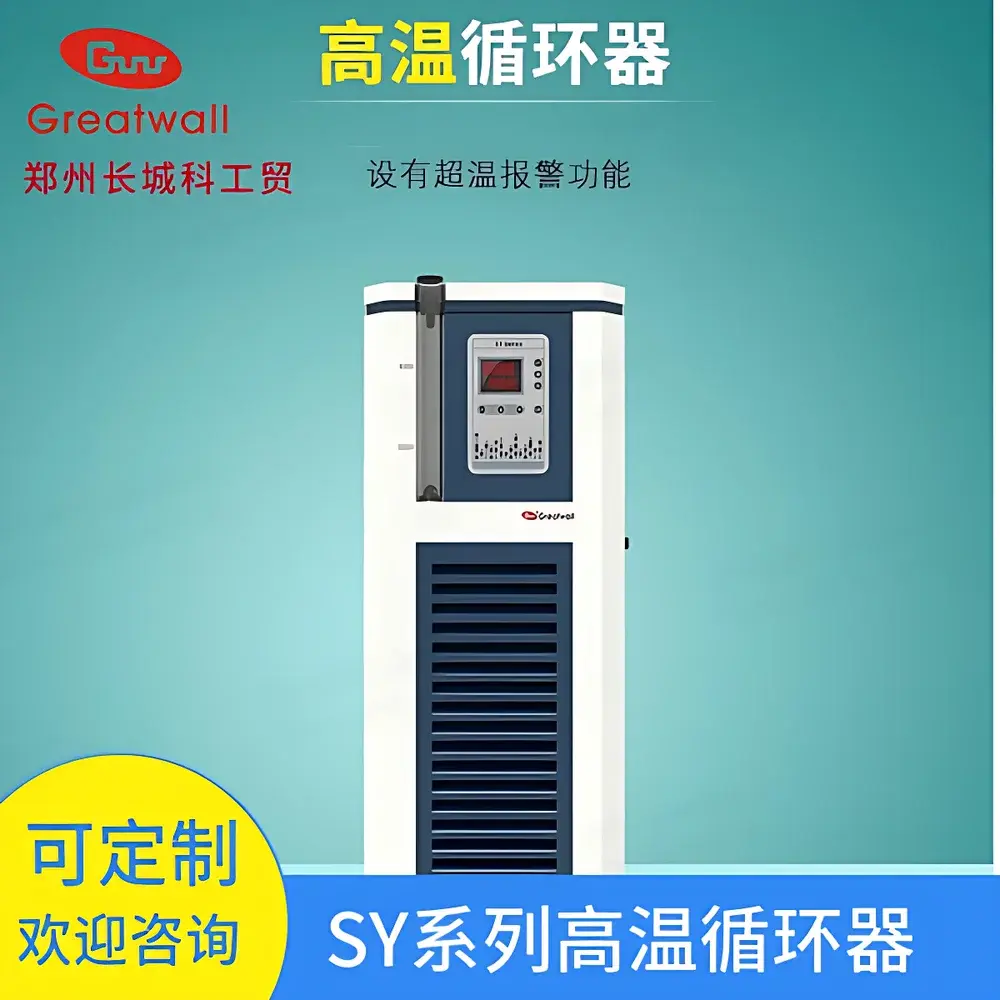
The Great Wall SY-20-250D High-Temperature Circulating Bath
| Brand | The Great Wall |
|---|---|
| Origin | Henan, China |
| Manufacturer Type | Direct Manufacturer |
| Product Category | Domestic |
| Model | SY-20-250D |
| Instrument Type | Constant-Temperature Bath |
| Circulation Mode | Internal & External Loop |
| Temperature Control | Heating-Only |
| Temperature Range | 5–250 °C |
| Temperature Stability | ±0.5 °C |
| Power Supply | 220–240 V~, 50 Hz |
| Maximum Flow Rate | 28 L/min |
| Maximum Pressure | 3.0 bar |
| Circulation Pump Power | 500 W |
| Heating Power | 3 kW |
| Total Power Consumption | 3.5 kW |
| Heat Transfer Fluid Capacity | 9 L |
| External Cooling Interface | R2¾ |
| IP Rating | IP20 |
| Pollution Degree | 2 |
| Dimensions (W×D×H) | 430 × 690 × 1075 mm |
| Weight | 60 kg |
Overview
The Great Wall SY-20-250D High-Temperature Circulating Bath is a precision-engineered thermal management system designed for stable, controllable heat delivery in demanding laboratory and pilot-scale industrial applications. Operating on the principle of forced convection using a closed-loop circulation of high-temperature-compatible heat transfer fluid—typically synthetic or mineral-based thermal oil—the unit maintains accurate temperature setpoints across its full operational range of 5 °C to 250 °C. Unlike open-bath systems, its hermetically sealed architecture minimizes fluid oxidation, volatilization, and moisture absorption from ambient air, thereby preserving fluid integrity and extending service life between maintenance cycles. The bath integrates an internal cooling coil that accepts external chilled water (e.g., from a facility chiller or tap-water line), enabling active temperature suppression during exothermic processes or when maintaining stability near the lower end of its range (e.g., room temperature +5 °C to 60 °C). Its robust mechanical design, dual-loop circulation capability, and comprehensive safety architecture make it suitable for integration with jacketed reactors, material testing rigs, calorimeters, and other temperature-sensitive instrumentation requiring reliable thermal input.
Key Features
- Hermetically sealed circulation system to prevent thermal fluid degradation and contamination
- Dual-mode circulation: configurable for internal recirculation or external process loop connection via R2¾ threaded ports
- Integrated water-cooled condenser coil for auxiliary temperature regulation without requiring external refrigeration units
- Real-time liquid level monitoring via calibrated sight gauge for safe operation and timely refilling
- Multi-layer electrical and thermal protection: independent overtemperature cutoff, earth-leakage detection, thermal overload relay, overcurrent circuit breaker, and phase-sequence monitoring for three-phase compatibility verification
- High-flow, low-pulsation circulation pump (28 L/min at 3.0 bar) engineered for minimal pressure drop across extended external tubing or reactor jackets
- Stainless steel fluid-contact surfaces and corrosion-resistant housing compliant with ISO 14644-1 Class 8 cleanroom-compatible assembly practices
Sample Compatibility & Compliance
The SY-20-250D is compatible with a wide range of thermally stable heat transfer fluids—including Dowtherm A, Therminol VP-1, and Shell Heat Transfer Oil S2—provided viscosity and flash point specifications fall within manufacturer-recommended limits for continuous operation up to 250 °C. It supports both batch and continuous thermal conditioning of samples housed in externally connected vessels, such as glass or stainless steel reaction kettles, tensile test chambers, and environmental stress screening enclosures. The unit meets IEC 61000-6-3 (EMC emission standards) and IEC 61000-6-2 (immunity requirements), and its electrical safety design conforms to IEC 61010-1:2010 for laboratory equipment. While not certified for hazardous area use (ATEX/IECEx), its IP20 enclosure rating and pollution degree 2 classification align with typical indoor laboratory environments under GLP-compliant infrastructure guidelines.
Software & Data Management
The SY-20-250D operates via a front-panel digital controller with LED display, offering manual setpoint adjustment, real-time temperature readout, and status indicators for all active protection circuits. Though not equipped with built-in Ethernet or USB data logging, its analog 0–10 V or 4–20 mA output interface enables seamless integration into centralized SCADA or DCS platforms for remote monitoring and alarm forwarding. When deployed in regulated environments (e.g., pharmaceutical QC labs), users may implement external validated data acquisition systems to meet FDA 21 CFR Part 11 requirements for electronic records and signatures. Audit trails, user access control, and calibration history documentation are maintained externally per site-specific SOPs aligned with ISO/IEC 17025 and ASTM E2500-13.
Applications
- Temperature control of jacketed chemical reactors and polymerization vessels in R&D and scale-up laboratories
- Thermal preconditioning and aging studies of composites, elastomers, and thermoplastics per ASTM D618 and ISO 291
- Calibration support for high-temperature sensors, thermocouples, and RTDs traceable to NIST standards
- Heat source for distillation columns, extraction systems, and catalytic test benches
- Stabilized thermal environment for rheological measurements requiring elevated sample temperatures
- Support equipment in accelerated stability testing programs compliant with ICH Q1A(R2)
FAQ
Can this unit operate continuously at 250 °C?
Yes, provided the selected heat transfer fluid is rated for continuous service at 250 °C and the system is properly vented and maintained per OEM guidelines.
Is external chilling required to maintain stability below 60 °C?
For optimal stability in the 5–60 °C range, external chilled water must be supplied to the integrated cooling coil; ambient air cooling alone is insufficient.
What is the maximum allowable backpressure on the external outlet port?
The circulation pump is rated for up to 3.0 bar of static pressure; ensure downstream piping and process equipment do not exceed this limit to avoid flow restriction or pump overload.
Does the unit support programmable ramp-and-soak temperature profiles?
No—this model features fixed-setpoint control only; for dynamic thermal profiling, integration with an external PID controller or PLC is required.
How often should the thermal fluid be replaced?
Fluid replacement intervals depend on usage intensity and thermal cycling frequency; annual analysis via FTIR and acid number testing is recommended to determine service life extension.



